πŸ”

AZ-700 β€” questions

Page 5 of 9 Β· 172 total questions.

Topic 3 Β· Question 192

Your company has offices in London, Tokyo, and New York. The company has a web app named App1 that has the Azure Traffic Manager profile shown in the following table. In Asia, you plan to deploy an additional endpoint that will host an updated version of App1. You need to route 10 percent of the traffic from the Tokyo office to the new endpoint during testing. What should you configure in Traffic Manager?

  • Atwo profiles and five endpoints (correct answer)
  • Btwo profiles and four endpoints
  • Cthree profiles and four endpoints
  • Done profile and five endpoints
Reveal answer & explanation
Correct answer: A

The correct answer is A. Option A: two profiles and five endpoints.

Topic 3 Β· Question 195

You have an Azure application gateway configured for a single website that is available at https://www.contoso.com. The application gateway contains one backend pool and one rule. The backend pool contains two backend servers. Each backend server has an additional website that is available on port 8080. You need to ensure that if port 8080 is unavailable on a backend server, all the traffic for https://www.contoso.com is redirected to the other backend server. What should you do?

  • ACreate a health probe (correct answer)
  • BAdd a new rule
  • CChange the port on the listener
  • DAdd a new listener
Reveal answer & explanation
Correct answer: A

The correct answer is A. Option A: Create a health probe.

Topic 3 Β· Question 196

You have an Azure subscription that contains the following resources: β€’ A virtual network named Vnet1 β€’ Two subnets named subnet1 and AzureFirewallSubnet β€’ A public Azure Firewall named FW1 β€’ A route table named RT1 that is associated to Subnet1 β€’ A rule routing of 0.0.0.0/0 to FW1 in RT1 After deploying 10 servers that run Windows Server to Subnet1, you discover that none of the virtual machines were activated. You need to ensure that the virtual machines can be activated. What should you do?

  • AOn FW1, create an outbound service tag rule for AzureCloud.
  • BAdd an internet route to RT1 for the Azure Key Management Service (KMS). (correct answer)
  • COn FW1, configure a DNAT rule for port 1688.
  • DDeploy an Azure Standard Load Balancer that has an outbound NAT rule.
Reveal answer & explanation
Correct answer: B

The correct answer is B. Option B: Add an internet route to RT1 for the Azure Key Management Service (KMS).

Topic 3 Β· Question 197

You have an Azure subscription. You plan to implement Azure Virtual WAN as shown in the following exhibit. What is the minimum number of route tables that you should create?

Exhibit 1 for question 197
  • A1
  • B2 (correct answer)
  • C4
  • D6
Reveal answer & explanation
Correct answer: B

The correct answer is B. Option B: 2.

Topic 3 Β· Question 198

You have an internal Basic Azure Load Balancer named LB1 that has two frontend IP addresses. The backend pool of LB1 contains two Azure virtual machines named VM1 and VM2. You need to configure the rules on LB1 as shown in the following table. What should you do for each rule?

Exhibit 1 for question 198
  • AEnable Floating IP. (correct answer)
  • BDisable Floating IP.
  • CSet Session persistence to Enabled.
  • DSet Session persistence to Disabled.
Reveal answer & explanation
Correct answer: A

The correct answer is A. Option A: Enable Floating IP.

Topic 3 Β· Question 199

Your company has 40 branch offices that are linked by using a Software-Defined Wide Area Network (SD-WAN). The SD-WAN uses BGP. You have an Azure subscription that contains 20 virtual networks configured as a hub and spoke topology. The topology contains a hub virtual network named Vnet1. The virtual networks connect to the SD-WAN by using a network virtual appliance (NVA) in Vnet1. You need to ensure that BGP route advertisements will propagate between the virtual networks and the SD-WAN. The solution must minimize administrative effort. What should you implement?

  • AAn Azure VPN Gateway that has BGP enabled
  • Ba NAT gateway
  • CAzure Traffic Manager
  • DAzure Route Server (correct answer)
Reveal answer & explanation
Correct answer: D

The correct answer is D. Option D: Azure Route Server.

Topic 3 Β· Question 203

You have an Azure subscription that contains the resources shown in the following table. Gateway1 provides access to App1 by using a URL of https://app1.contoso.com. You create a new web app named App2. You need to configure Gateway1 to enable access to App2 by using a URL of https://app2.contoso.com. The solution must minimize administrative effort. What should you configure on Gateway1?

Exhibit 1 for question 203
  • Aa backend pool and a routing rule
  • Ba listener and a routing rule
  • Ca listener, a backend pool, and a routing rule (correct answer)
  • Da listener and a backend pool
Reveal answer & explanation
Correct answer: C

The correct answer is C. Option C: a listener, a backend pool, and a routing rule.

Topic 3 Β· Question 205

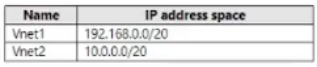
You have two Azure virtual networks in the East US Azure region as shown in the following table. The virtual networks are peered to one another. Each virtual network contains four subnets. You plan to deploy a virtual machine named VM1 that will inspect and route traffic between all the subnets on both the virtual networks. What is the minimum number of IP addresses that you must assign to VM1?

Exhibit 1 for question 205
  • A1 (correct answer)
  • B2
  • C4
  • D8
Reveal answer & explanation
Correct answer: A

The correct answer is A. Option A: 1.

Topic 3 Β· Question 206

You have an Azure subscription that contains the following resources: β€’ A virtual network named Vnet1 β€’ Two subnets named subnet1 and AzureFirewallSubnet β€’ A public Azure Firewall named FW1 β€’ A route table named RT1 that is associated to Subnet1 β€’ A rule routing of 0.0.0.0/0 to FW1 in RT1 After deploying 10 servers that run Windows Server to Subnet1, you discover that none of the virtual machines were activated. You need to ensure that the virtual machines can be activated. What should you do?

  • AOn FW1, configure a DNAT rule for port 1688
  • BDeploy a NAT gateway.
  • CAdd an internet route to RT1 for the Azure Key Management Service (KMS). (correct answer)
  • DTo Subnet1, associate a network security group (NSG) that allows outbound access to port 1688.
Reveal answer & explanation
Correct answer: C

The correct answer is C. Option C: Add an internet route to RT1 for the Azure Key Management Service (KMS).

Topic 3 Β· Question 207

You have an on-premises network. You have an Azure subscription that includes a virtual network named VNet1 and a private Azure Kubernetes Service (AKS) cluster named AKS1. VNet1 is connected to your on-premises environment via an Azure ExpressRoute circuit. AKS1 is connected to VNet1. You need to implement an off-cluster ingress controller for AKS1. The solution must provide connectivity from the on-premises environment to containerized workloads hosted on AKS1. Which Azure service should you use?

  • AAzure Application Gateway (correct answer)
  • BAzure Front Door
  • CAzure Traffic Manager
  • DAzure Load Balancer
Reveal answer & explanation
Correct answer: A

The correct answer is A. Option A: Azure Application Gateway

Explanation

Azure Application Gateway is a layer-7 load balancer with WAF, path-based routing, and SSL termination.

Topic 3 Β· Question 210 Β· Select all that apply

You have an Azure subscription that contains the Azure App Service web apps shown in the following table. You need to deploy Azure Traffic Manager. The solution must meet the following requirements: β€’ Traffic to https://www.fabrikam.com must be directed to App1eu. β€’ If App1eu becomes unresponsive, all the traffic to https://www.fabrikam.com must be directed to App1us. You need to implement Traffic Manager to meet the requirements. Which two resources should you create? Each correct answer presents part of the solution. NOTE: Each correct selection is worth one point.

Exhibit 1 for question 210
  • Aa Traffic Manager profile that uses the priority routing method (correct answer)
  • Ba Traffic Manager profile that uses the geographic routing method
  • Ca CNAME record in a DNS domain named fabrikam.com (correct answer)
  • Da TXT record in a DNS domain named fabricam.com
  • Ea real user measurements key in Traffic Manager
Reveal answer & explanation
Correct answer: A, C

The correct answer is A, C. Option A: a Traffic Manager profile that uses the priority routing method Option C: a CNAME record in a DNS domain named fabrikam.com

Explanation

Azure Traffic Manager is DNS-based global traffic routing across regions for availability and latency.

Topic 3 Β· Question 212

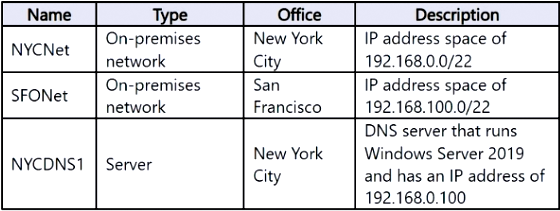
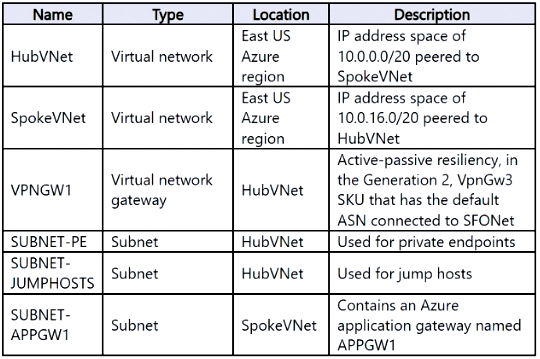
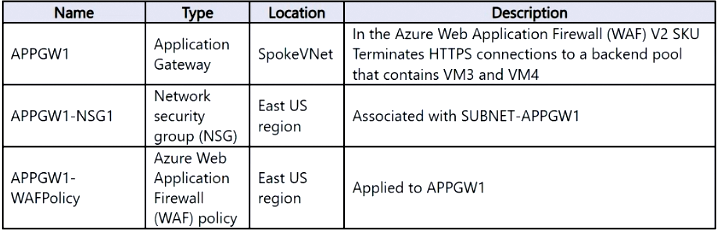
Case Study - This is a case study. Case studies are not timed separately. You can use as much exam time as you would like to complete each case. However, there may be additional case studies and sections on this exam. You must manage your time to ensure that you are able to complete all questions included on this exam in the time provided. To answer the questions included in a case study, you will need to reference information that is provided in the case study. Case studies might contain exhibits and other resources that provide more information about the scenario that is described in the case study. Each question is independent of the other questions in this case study. At the end of this case study, a review screen will appear. This screen allows you to review your answers and to make changes before you move to the next section of the exam. After you begin a new section, you cannot return to this section. To start the case study - To display the first question in this case study, click the Next button. Use the buttons in the left pane to explore the content of the case study before you answer the questions. Clicking these buttons displays information such as business requirements, existing environment, and problem statements. When you are ready to answer a question, click the Question button to return to the question. Overview - Proseware, Inc. is a financial services company that has a main office in New York City and a branch office in San Francisco. Existing Environment. Hybrid Environment Proseware has an on-premises Active Directory Domain Services (AD DS) forest named corp.proseware.com that syncs with a Microsoft Entra tenant named proseware.com. Proseware has an Azure subscription that is linked to proseware.com. Proseware has an internal certification authority (CA). Existing Environment. Network Infrastructure The offices contain the resources shown in the following table. NYCNet connects to Azure by using an ExpressRoute circuit. SFONet connects to Azure by using a Site-to-Site (S2S) VPN. Existing Environment. Azure Resources The Azure subscription contains the virtual networks and subnets shown in the following table. The subscription contains four virtual machines named VM1, VM2, VM3, and VM4. VM1 and VM2 host an app named App1. VM3 and VM4 host a web app named App2 that is accessed by using a FQDN of app2.proseware.com. Users access app2.proseware.com by using HTTP or HTTPS. VM1, VM2, and VM4 are connected to SpokeVNet. The subscription contains Application Gateway resources shown in the following table. The subscription contains an Azure Front Door Standard profile named FD1. FD1 contains a single origin group that targets APPGW1 by using the default endpoint name. HubVNet connects to NYCNet by using an ExpressRoute gateway named ERGW1. Planned Changes and Requirements. Planned Changes Proseware plans to implement the following changes: β€’ Deploy an Azure Private DNS Resolver named PRDNS1 to HubVNet and link PRDNS1 to SpokeVNet. β€’ Create a DNS forwarding ruleset named DNSRS1 and associate DNSRS1 with PRDNS1. β€’ Deploy Azure Virtual Network Manager and implement the following rules: - Allow inbound connections on TCP port 3389 from the on-premises networks to SUBNET-JUMPHOSTS. - Block inbound connections on TCP port 80 from the internet to SpokeVNet. β€’ Ensure that Azure Virtual Network Manager rules take precedence over conflicting NSG rules. β€’ Deploy two network virtual appliances (NVAs) named NVA1 and NVA2 to HubVNet. β€’ Deploy a gateway load balancer named LBGW1 to HubVNet. β€’ Configure LBGW1 to inspect traffic on TCP ports 443, 1433, and 1434 from LBS1 by using NVA1 and NVA2. β€’ Ensure that all the traffic to App2 is processed by using FD1. Planned Changes and Requirements. Connectivity requirements Proseware identifies the following connectivity requirements: β€’ Minimize the complexity of the Azure Virtual Network Manager deployment. β€’ Route traffic between NYCNet and SFONet via the ExpressRoute circuit and the S2S VPN. β€’ Ensure that remote users on Windows 11 devices can connect to HubVNet by using a Point-to-Site (P2S) VPN and their proseware.com credentials. Planned Changes and Requirements. Security requirements Proseware identifies the following security requirements: β€’ Whenever possible, use the internal CA. β€’ Ensure that all connections routed via APPGW1 use end-to-end encryption. β€’ Ensure that user connections to Azure-hosted apps use end-to-end encryption. β€’ Ensure that all inbound internet traffic to app2.proseware.com is routed via FD1. β€’ Prevent devices that connect to NYCNet from accessing Azure services that use private endpoints. β€’ Enable the virtual machines that connect to HubVNet and SpokeVNet to access Azure services that use private endpoints. Planned Changes and Requirements. General requirements Proseware identifies the following general requirements: β€’ Minimize the IP address space required to deploy platform-managed resources to the virtual networks. β€’ From SpokeVNet, resolve name resolution requests for the azure.proseware.com namespace and the corp.proseware.com namespace by using PRDNS1. β€’ Whenever possible, minimize administrative effort. You need to configure FD1 to provide user access to app2.proseware.com. The solution must meet the security requirements and the general requirements. What should you do first?
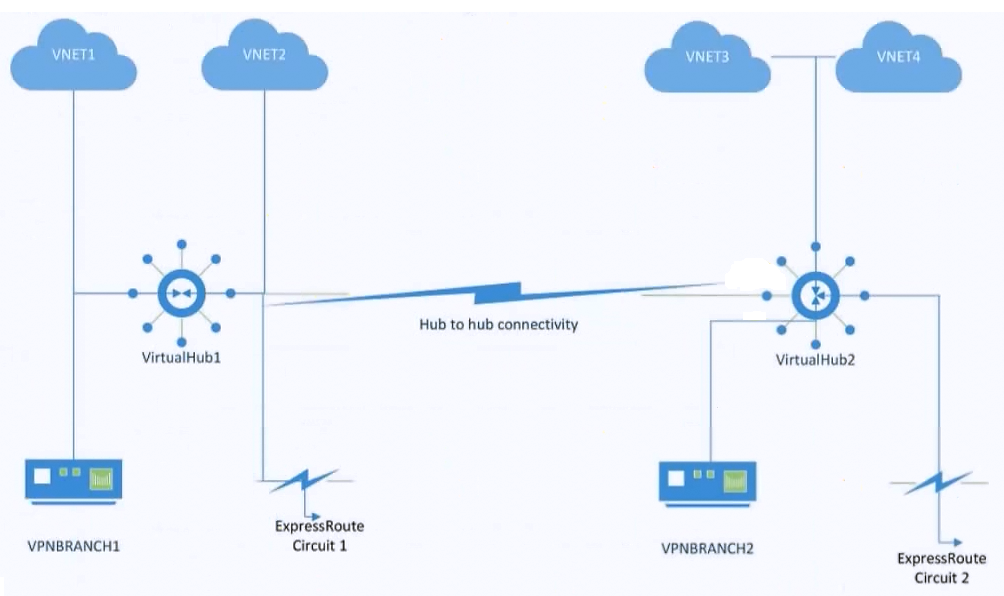

Exhibit 1 for question 212Exhibit 2 for question 212Exhibit 3 for question 212
  • ARequest a certificate from a trusted root CA.
  • BAdd a security policy to FD1.
  • CAdd a custom domain to FD1. (correct answer)
  • DExport the TLS certificate and the private key from App2.
Reveal answer & explanation
Correct answer: C

The correct answer is C. Option C: Add a custom domain to FD1.

Topic 3 Β· Question 213

You have an Azure subscription that contains a virtual network named VNet1. VNet1 contains a subnet named Subnet1. You deploy an instance of Azure Application Gateway v2 named AppGw1 to Subnet1. You create a network security group (NSG) named NSG1 and link NSG1 to Subnet1. You need to ensure that AppGw1 will only load balance traffic that originates from VNet1. The solution must minimize the impact on the functionality of AppGw1. What should you add to NSG1?

  • Aan outbound rule that has a priority of 4096 and blocks all internet traffic
  • Ban inbound rule that has a priority of 4096 and blocks all internet traffic (correct answer)
  • Can inbound rule that has a priority of 100 and blocks all internet traffic
  • Dan outbound rule that has a priority 100 and blocks all internet traffic
Reveal answer & explanation
Correct answer: B

The correct answer is B. Option B: an inbound rule that has a priority of 4096 and blocks all internet traffic.

Topic 3 Β· Question 214

You plan to implement an Azure virtual network that will contain 10 virtual subnets. The subnets will use IPv6 addresses. Each subnet will host up to 200 load-balanced virtual machines. You need to recommend a load balancing solution for the virtual network. The solution must meet the following requirements: β€’ The virtual machines and the load balancer must be accessible only from the virtual network. β€’ Costs must be minimized. What should you include in the recommendation?

  • ABasic Azure Load Balancer
  • BAzure Application Gateway v1
  • CAzure Standard Load Balancer (correct answer)
  • DAzure Application Gateway v2
Reveal answer & explanation
Correct answer: C

The correct answer is C. Option C: Azure Standard Load Balancer

Explanation

Azure Load Balancer distributes layer-4 traffic across healthy backends in a region for availability.

Topic 3 Β· Question 223

You have an Azure Front Door instance named FD that contains an origin group named OG1. You need to configure a health probe for OG1. The solution must minimize the amount of traffic generated by the health probe. Which HTTP method should you use?

  • ACONNECT
  • BHEAD (correct answer)
  • CTRACE
  • DGET
Reveal answer & explanation
Correct answer: B

The correct answer is B. Option B: HEAD.

Topic 3 Β· Question 224

You have an Azure subscription that contains the resources shown in the following table. You need to configure FW1 to filter traffic that originates from VNet1 and targets the FQDN of SQLDB1. Which type of rule should you use?

Exhibit 1 for question 224
  • ADNAT
  • Bnetwork
  • Capplication (correct answer)
  • Dinfrastructure
Reveal answer & explanation
Correct answer: C

The correct answer is C. Option C: application.

Topic 3 Β· Question 226

You have an Azure subscription that contains the resources shown in the following table. You need to configure a solution to meet the following requirements: β€’ App1 must be assigned a private endpoint. β€’ Access to App1 from the internet must be routed via FD1. What should you configure on FD1?

Exhibit 1 for question 226
  • Aa security policy that redirects traffic
  • Ba rule that has the route configuration override action
  • Can origin that enables the Azure Private Link service (correct answer)
  • Da route that redirects traffic
Reveal answer & explanation
Correct answer: C

The correct answer is C. Option C: an origin that enables the Azure Private Link service

Explanation

Azure Private Link exposes services privately inside the VNet without public internet exposure.

Topic 3 Β· Question 229

You have two Azure virtual networks named VNet1 and VNet2 that are peered with each other. VNet1 hosts 10 virtual machines that contain web servers. VNet2 hosts five virtual machines that contain database servers. You need to configure a security solution that meets the following requirements: β€’ Ensures that the database servers can accept connections only from the web servers β€’ Ensures that the web servers can initiate connections only to the database servers β€’ Ensures that all network security groups (NSGs) are associated only with subnets β€’ Use application security groups to implement the solution What is the minimum number of application security groups required?

  • A1
  • B2 (correct answer)
  • C4
  • D8
Reveal answer & explanation
Correct answer: B

The correct answer is B. Option B: 2.

Topic 3 Β· Question 232

You have an Azure subscription. You plan to deploy an app named App1 that will be accessed by using Azure Application Gateway. You need to deploy the application gateway for App1. What should you create first?

  • Aa user-assigned managed identity
  • Ba subnet (correct answer)
  • Can X.509 certificate
  • Dan Azure Web Application Firewall (WAF) policy
Reveal answer & explanation
Correct answer: B

The correct answer is B. Option B: a subnet.

Topic 3 Β· Question 233

You have an Azure subscription that contains a distributed web app named App1. App1 is hosted across multiple Azure regions. You need to recommend a solution for routing user requests to App. The solution must meet the following requirements: β€’ Support the routing of a user request to a resource based on the URL of the request. β€’ Support query string replacement. β€’ Minimize network latency. What should you include in the recommendation?

  • AAzure Load Balancer
  • BAzure Traffic Manager
  • CAzure Content Delivery Network (CDN)
  • DAzure Front Door (correct answer)
Reveal answer & explanation
Correct answer: D

The correct answer is D. Option D: Azure Front Door

Explanation

Azure Front Door provides global HTTP load balancing, caching, and WAF at the edge for low latency and failover.

Showing questions 81–100 of 172 Β· Page 5 of 9