πŸ”

PMLE β€” questions

Page 13 of 17 Β· 339 total questions.

Topic 1 Β· Question 241

You have created a Vertex AI pipeline that automates custom model training. You want to add a pipeline component that enables your team to most easily collaborate when running different executions and comparing metrics both visually and programmatically. What should you do?

  • AAdd a component to the Vertex AI pipeline that logs metrics to a BigQuery table. Query the table to compare different executions of the pipeline. Connect BigQuery to Looker Studio to visualize metrics.
  • BAdd a component to the Vertex AI pipeline that logs metrics to a BigQuery table. Load the table into a pandas DataFrame to compare different executions of the pipeline. Use Matplotlib to visualize metrics.
  • CAdd a component to the Vertex AI pipeline that logs metrics to Vertex ML Metadata. Use Vertex AI Experiments to compare different executions of the pipeline. Use Vertex AI TensorBoard to visualize metrics. (correct answer)
  • DAdd a component to the Vertex AI pipeline that logs metrics to Vertex ML Metadata. Load the Vertex ML Metadata into a pandas DataFrame to compare different executions of the pipeline. Use Matplotlib to visualize metrics.
Reveal answer & explanation
Correct answer: C

The correct answer is C. Option C: Add a component to the Vertex AI pipeline that logs metrics to Vertex ML Metadata. Use Vertex AI Experiments to compare different executions of the pipeline. Use Vertex AI TensorBoard to visualize metrics.

Explanation

Vertex AI is the unified managed platform to build, train, tune, deploy, and operate ML models.
Topic 1 Β· Question 242

Your team is training a large number of ML models that use different algorithms, parameters, and datasets. Some models are trained in Vertex AI Pipelines, and some are trained on Vertex AI Workbench notebook instances. Your team wants to compare the performance of the models across both services. You want to minimize the effort required to store the parameters and metrics. What should you do?

  • AImplement an additional step for all the models running in pipelines and notebooks to export parameters and metrics to BigQuery.
  • BCreate a Vertex AI experiment. Submit all the pipelines as experiment runs. For models trained on notebooks log parameters and metrics by using the Vertex AI SDK. (correct answer)
  • CImplement all models in Vertex AI Pipelines Create a Vertex AI experiment, and associate all pipeline runs with that experiment.
  • DStore all model parameters and metrics as model metadata by using the Vertex AI Metadata API.
Reveal answer & explanation
Correct answer: B

The correct answer is B. Option B: Create a Vertex AI experiment. Submit all the pipelines as experiment runs. For models trained on notebooks log parameters and metrics by using the Vertex AI SDK.

Explanation

Vertex AI is the unified managed platform to build, train, tune, deploy, and operate ML models.

Topic 1 Β· Question 243

You work on a team that builds state-of-the-art deep learning models by using the TensorFlow framework. Your team runs multiple ML experiments each week, which makes it difficult to track the experiment runs. You want a simple approach to effectively track, visualize, and debug ML experiment runs on Google Cloud while minimizing any overhead code. How should you proceed?

  • ASet up Vertex AI Experiments to track metrics and parameters. Configure Vertex AI TensorBoard for visualization. (correct answer)
  • BSet up a Cloud Function to write and save metrics files to a Cloud Storage bucket. Configure a Google Cloud VM to host TensorBoard locally for visualization.
  • CSet up a Vertex AI Workbench notebook instance. Use the instance to save metrics data in a Cloud Storage bucket and to host TensorBoard locally for visualization.
  • DSet up a Cloud Function to write and save metrics files to a BigQuery table. Configure a Google Cloud VM to host TensorBoard locally for visualization.
Reveal answer & explanation
Correct answer: A

The correct answer is A. Option A: Set up Vertex AI Experiments to track metrics and parameters. Configure Vertex AI TensorBoard for visualization.

Explanation

Vertex AI is the unified managed platform to build, train, tune, deploy, and operate ML models.

Topic 1 Β· Question 244

Your work for a textile manufacturing company. Your company has hundreds of machines, and each machine has many sensors. Your team used the sensory data to build hundreds of ML models that detect machine anomalies. Models are retrained daily, and you need to deploy these models in a cost-effective way. The models must operate 24/7 without downtime and make sub millisecond predictions. What should you do?

  • ADeploy a Dataflow batch pipeline and a Vertex AI Prediction endpoint.
  • BDeploy a Dataflow batch pipeline with the Runlnference API, and use model refresh.
  • CDeploy a Dataflow streaming pipeline and a Vertex AI Prediction endpoint with autoscaling.
  • DDeploy a Dataflow streaming pipeline with the Runlnference API, and use automatic model refresh. (correct answer)
Reveal answer & explanation
Correct answer: D

The correct answer is D. Option D: Deploy a Dataflow streaming pipeline with the Runlnference API, and use automatic model refresh.

Explanation

Dataflow runs serverless Apache Beam pipelines for stream and batch data processing with autoscaling. This option delivers the requirement at the lowest cost.

Topic 1 Β· Question 245

You are developing an ML model that predicts the cost of used automobiles based on data such as location, condition, model type, color, and engine/battery efficiency. The data is updated every night. Car dealerships will use the model to determine appropriate car prices. You created a Vertex AI pipeline that reads the data splits the data into training/evaluation/test sets performs feature engineering trains the model by using the training dataset and validates the model by using the evaluation dataset. You need to configure a retraining workflow that minimizes cost. What should you do?

  • ACompare the training and evaluation losses of the current run. If the losses are similar, deploy the model to a Vertex AI endpoint. Configure a cron job to redeploy the pipeline every night.
  • BCompare the training and evaluation losses of the current run. If the losses are similar, deploy the model to a Vertex AI endpoint with training/serving skew threshold model monitoring. When the model monitoring threshold is triggered redeploy the pipeline.
  • CCompare the results to the evaluation results from a previous run. If the performance improved deploy the model to a Vertex AI endpoint. Configure a cron job to redeploy the pipeline every night.
  • DCompare the results to the evaluation results from a previous run. If the performance improved deploy the model to a Vertex AI endpoint with training/serving skew threshold model monitoring. When the model monitoring threshold is triggered redeploy the pipeline. (correct answer)
Reveal answer & explanation
Correct answer: D

The correct answer is D. Option D: Compare the results to the evaluation results from a previous run. If the performance improved deploy the model to a Vertex AI endpoint with training/serving skew threshold model monitoring. When the model monitoring...

Explanation

Vertex AI is the unified managed platform to build, train, tune, deploy, and operate ML models.

Topic 1 Β· Question 246

You recently used BigQuery ML to train an AutoML regression model. You shared results with your team and received positive feedback. You need to deploy your model for online prediction as quickly as possible. What should you do?

  • ARetrain the model by using BigQuery ML, and specify Vertex AI as the model registry. Deploy the model from Vertex AI Model Registry to a Vertex AI endpoint,
  • BRetrain the model by using Vertex Al Deploy the model from Vertex AI Model. Registry to a Vertex AI endpoint.
  • CAlter the model by using BigQuery ML, and specify Vertex AI as the model registry. Deploy the model from Vertex AI Model Registry to a Vertex AI endpoint. (correct answer)
  • DExport the model from BigQuery ML to Cloud Storage. Import the model into Vertex AI Model Registry. Deploy the model to a Vertex AI endpoint.
Reveal answer & explanation
Correct answer: C

The correct answer is C. Option C: Alter the model by using BigQuery ML, and specify Vertex AI as the model registry. Deploy the model from Vertex AI Model Registry to a Vertex AI endpoint.

Explanation

BigQuery is a serverless, petabyte-scale data warehouse for fast SQL analytics with no infrastructure to manage. Vertex AI is the unified managed platform to build, train, tune, deploy, and operate ML models.

Topic 1 Β· Question 247

You built a deep learning-based image classification model by using on-premises data. You want to use Vertex AI to deploy the model to production. Due to security concerns, you cannot move your data to the cloud. You are aware that the input data distribution might change over time. You need to detect model performance changes in production. What should you do?

  • AUse Vertex Explainable AI for model explainability. Configure feature-based explanations.
  • BUse Vertex Explainable AI for model explainability. Configure example-based explanations.
  • CCreate a Vertex AI Model Monitoring job. Enable training-serving skew detection for your model.
  • DCreate a Vertex AI Model Monitoring job. Enable feature attribution skew and drift detection for your model. (correct answer)
Reveal answer & explanation
Correct answer: D

The correct answer is D. Option D: Create a Vertex AI Model Monitoring job. Enable feature attribution skew and drift detection for your model.

Explanation

Vertex AI is the unified managed platform to build, train, tune, deploy, and operate ML models.

Topic 1 Β· Question 248

You trained a model packaged it with a custom Docker container for serving, and deployed it to Vertex AI Model Registry. When you submit a batch prediction job, it fails with this error: "Error model server never became ready. Please validate that your model file or container configuration are valid. " There are no additional errors in the logs. What should you do?

  • AAdd a logging configuration to your application to emit logs to Cloud Logging
  • BChange the HTTP port in your model’s configuration to the default value of 8080
  • CChange the healthRoute value in your model’s configuration to /healthcheck
  • DPull the Docker image locally, and use the docker run command to launch it locally. Use the docker logs command to explore the error logs (correct answer)
Reveal answer & explanation
Correct answer: D

The correct answer is D. Option D: Pull the Docker image locally, and use the docker run command to launch it locally. Use the docker logs command to explore the error logs.

Topic 1 Β· Question 249

You are developing an ML model to identify your company’s products in images. You have access to over one million images in a Cloud Storage bucket. You plan to experiment with different TensorFlow models by using Vertex AI Training. You need to read images at scale during training while minimizing data I/O bottlenecks. What should you do?

  • ALoad the images directly into the Vertex AI compute nodes by using Cloud Storage FUSE. Read the images by using the tf.data.Dataset.from_tensor_slices function
  • BCreate a Vertex AI managed dataset from your image data. Access the AIP_TRAINING_DATA_URI environment variable to read the images by using the tf.data.Dataset.list_files function.
  • CConvert the images to TFRecords and store them in a Cloud Storage bucket. Read the TFRecords by using the tf.data.TFRecordDataset function. (correct answer)
  • DStore the URLs of the images in a CSV file. Read the file by using the tf.data.experimental.CsvDataset function.
Reveal answer & explanation
Correct answer: C

The correct answer is C. Option C: Convert the images to TFRecords and store them in a Cloud Storage bucket. Read the TFRecords by using the tf.data.TFRecordDataset function.

Explanation

Cloud Storage provides durable, scalable object storage that is fully managed.

Topic 1 Β· Question 250

You work at an ecommerce startup. You need to create a customer churn prediction model. Your company’s recent sales records are stored in a BigQuery table. You want to understand how your initial model is making predictions. You also want to iterate on the model as quickly as possible while minimizing cost. How should you build your first model?

  • AExport the data to a Cloud Storage bucket. Load the data into a pandas DataFrame on Vertex AI Workbench and train a logistic regression model with scikit-learn.
  • BCreate a tf.data.Dataset by using the TensorFlow BigQueryClient. Implement a deep neural network in TensorFlow.
  • CPrepare the data in BigQuery and associate the data with a Vertex AI dataset. Create an AutoMLTabularTrainingJob to tram a classification model. (correct answer)
  • DExport the data to a Cloud Storage bucket. Create a tf.data.Dataset to read the data from Cloud Storage. Implement a deep neural network in TensorFlow.
Reveal answer & explanation
Correct answer: C

The correct answer is C. Option C: Prepare the data in BigQuery and associate the data with a Vertex AI dataset. Create an AutoMLTabularTrainingJob to tram a classification model.

Explanation

BigQuery is a serverless, petabyte-scale data warehouse for fast SQL analytics with no infrastructure to manage. Vertex AI is the unified managed platform to build, train, tune, deploy, and operate ML models. AutoML trains high-quality custom models from your data with minimal ML expertise.

Topic 1 Β· Question 251

You are developing a training pipeline for a new XGBoost classification model based on tabular data. The data is stored in a BigQuery table. You need to complete the following steps: 1. Randomly split the data into training and evaluation datasets in a 65/35 ratio 2. Conduct feature engineering 3. Obtain metrics for the evaluation dataset 4. Compare models trained in different pipeline executions How should you execute these steps?

  • A1. Using Vertex AI Pipelines, add a component to divide the data into training and evaluation sets, and add another component for feature engineering.2. Enable autologging of metrics in the training component.3. Compare pipeline runs in Vertex AI Experiments. (correct answer)
  • B1. Using Vertex AI Pipelines, add a component to divide the data into training and evaluation sets, and add another component for feature engineering.2. Enable autologging of metrics in the training component.3. Compare models using the artifacts’ lineage in Vertex ML Metadata.
  • C1. In BigQuery ML, use the CREATE MODEL statement with BOOSTED_TREE_CLASSIFIER as the model type and use BigQuery to handle the data splits.2. Use a SQL view to apply feature engineering and train the model using the data in that view.3. Compare the evaluation metrics of the models by using a SQL query with the ML.TRAINING_INFO statement.
  • D1. In BigQuery ML, use the CREATE MODEL statement with BOOSTED_TREE_CLASSIFIER as the model type and use BigQuery to handle the data splits.2. Use ML TRANSFORM to specify the feature engineering transformations and tram the model using the data in the table.3. Compare the evaluation metrics of the models by using a SQL query with the ML.TRAINING_INFO statement.
Reveal answer & explanation
Correct answer: A

The correct answer is A. Option A: 1. Using Vertex AI Pipelines, add a component to divide the data into training and evaluation sets, and add another component for feature engineering.2. Enable autologging of metrics in the training component.3. Compa...

Explanation

Vertex AI is the unified managed platform to build, train, tune, deploy, and operate ML models.

Topic 1 Β· Question 252

You work for a company that sells corporate electronic products to thousands of businesses worldwide. Your company stores historical customer data in BigQuery. You need to build a model that predicts customer lifetime value over the next three years. You want to use the simplest approach to build the model and you want to have access to visualization tools. What should you do?

  • ACreate a Vertex AI Workbench notebook to perform exploratory data analysis. Use IPython magics to create a new BigQuery table with input features. Use the BigQuery console to run the CREATE MODEL statement. Validate the results by using the ML.EVALUATE and ML.PREDICT statements.
  • BRun the CREATE MODEL statement from the BigQuery console to create an AutoML model. Validate the results by using the ML.EVALUATE and ML.PREDICT statements.
  • CCreate a Vertex AI Workbench notebook to perform exploratory data analysis and create input features. Save the features as a CSV file in Cloud Storage. Import the CSV file as a new BigQuery table. Use the BigQuery console to run the CREATE MODEL statement. Validate the results by using the ML.EVALUATE and ML.PREDICT statements.
  • DCreate a Vertex AI Workbench notebook to perform exploratory data analysis. Use IPython magics to create a new BigQuery table with input features, create the model, and validate the results by using the CREATE MODEL, ML.EVALUATE, and ML.PREDICT statements. (correct answer)
Reveal answer & explanation
Correct answer: D

The correct answer is D. Option D: Create a Vertex AI Workbench notebook to perform exploratory data analysis. Use IPython magics to create a new BigQuery table with input features, create the model, and validate the results by using the CREATE MODEL,...

Explanation

BigQuery is a serverless, petabyte-scale data warehouse for fast SQL analytics with no infrastructure to manage. Vertex AI is the unified managed platform to build, train, tune, deploy, and operate ML models.

Topic 1 Β· Question 253

You work for a delivery company. You need to design a system that stores and manages features such as parcels delivered and truck locations over time. The system must retrieve the features with low latency and feed those features into a model for online prediction. The data science team will retrieve historical data at a specific point in time for model training. You want to store the features with minimal effort. What should you do?

  • AStore features in Bigtable as key/value data.
  • BStore features in Vertex AI Feature Store. (correct answer)
  • CStore features as a Vertex AI dataset, and use those features to train the models hosted in Vertex AI endpoints.
  • DStore features in BigQuery timestamp partitioned tables, and use the BigQuery Storage Read API to serve the features.
Reveal answer & explanation
Correct answer: B

The correct answer is B. Option B: Store features in Vertex AI Feature Store.

Explanation

Vertex AI is the unified managed platform to build, train, tune, deploy, and operate ML models.

Topic 1 Β· Question 254

You are working on a prototype of a text classification model in a managed Vertex AI Workbench notebook. You want to quickly experiment with tokenizing text by using a Natural Language Toolkit (NLTK) library. How should you add the library to your Jupyter kernel?

  • AInstall the NLTK library from a terminal by using the pip install nltk command.
  • BWrite a custom Dataflow job that uses NLTK to tokenize your text and saves the output to Cloud Storage.
  • CCreate a new Vertex AI Workbench notebook with a custom image that includes the NLTK library.
  • DInstall the NLTK library from a Jupyter cell by using the !pip install nltk --user command. (correct answer)
Reveal answer & explanation
Correct answer: D

The correct answer is D. Option D: Install the NLTK library from a Jupyter cell by using the !pip install nltk --user command.

Topic 1 Β· Question 255

You have recently used TensorFlow to train a classification model on tabular data. You have created a Dataflow pipeline that can transform several terabytes of data into training or prediction datasets consisting of TFRecords. You now need to productionize the model, and you want the predictions to be automatically uploaded to a BigQuery table on a weekly schedule. What should you do?

  • AImport the model into Vertex AI and deploy it to a Vertex AI endpoint. On Vertex AI Pipelines, create a pipeline that uses the DataflowPythonJobOp and the ModelBacthPredictOp components.
  • BImport the model into Vertex AI and deploy it to a Vertex AI endpoint. Create a Dataflow pipeline that reuses the data processing logic sends requests to the endpoint, and then uploads predictions to a BigQuery table.
  • CImport the model into Vertex AI. On Vertex AI Pipelines, create a pipeline that uses theDataflowPvthonJobOp and the ModelBatchPredictOp components. (correct answer)
  • DImport the model into BigQuery. Implement the data processing logic in a SQL query. On Vertex AI Pipelines create a pipeline that uses the BigquervQueryJobOp and the BigqueryPredictModelJobOp components.
Reveal answer & explanation
Correct answer: C

The correct answer is C. Option C: Import the model into Vertex AI. On Vertex AI Pipelines, create a pipeline that uses theDataflowPvthonJobOp and the ModelBatchPredictOp components.

Explanation

Google Cloud Batch schedules and runs batch jobs at scale without managing infrastructure. Dataflow runs serverless Apache Beam pipelines for stream and batch data processing with autoscaling. Vertex AI is the unified managed platform to build, train, tune, deploy, and operate ML models.

Topic 1 Β· Question 256

You work for an online grocery store. You recently developed a custom ML model that recommends a recipe when a user arrives at the website. You chose the machine type on the Vertex AI endpoint to optimize costs by using the queries per second (QPS) that the model can serve, and you deployed it on a single machine with 8 vCPUs and no accelerators. A holiday season is approaching and you anticipate four times more traffic during this time than the typical daily traffic. You need to ensure that the model can scale efficiently to the increased demand. What should you do?

  • A1. Maintain the same machine type on the endpoint.2. Set up a monitoring job and an alert for CPU usage.3. If you receive an alert, add a compute node to the endpoint.
  • B1. Change the machine type on the endpoint to have 32 vCPUs.2. Set up a monitoring job and an alert for CPU usage.3. If you receive an alert, scale the vCPUs further as needed.
  • C1. Maintain the same machine type on the endpoint Configure the endpoint to enable autoscaling based on vCPU usage.2. Set up a monitoring job and an alert for CPU usage.3. If you receive an alert, investigate the cause. (correct answer)
  • D1. Change the machine type on the endpoint to have a GPU. Configure the endpoint to enable autoscaling based on the GPU usage.2. Set up a monitoring job and an alert for GPU usage.3. If you receive an alert, investigate the cause.
Reveal answer & explanation
Correct answer: C

The correct answer is C. Option C: 1. Maintain the same machine type on the endpoint Configure the endpoint to enable autoscaling based on vCPU usage.2. Set up a monitoring job and an alert for CPU usage.3. If you receive an alert, investigate the cause.

Topic 1 Β· Question 257

You recently trained an XGBoost model on tabular data. You plan to expose the model for internal use as an HTTP microservice. After deployment, you expect a small number of incoming requests. You want to productionize the model with the least amount of effort and latency. What should you do?

  • ADeploy the model to BigQuery ML by using CREATE MODEL with the BOOSTED_TREE_REGRESSOR statement, and invoke the BigQuery API from the microservice.
  • BBuild a Flask-based app. Package the app in a custom container on Vertex AI, and deploy it to Vertex AI Endpoints.
  • CBuild a Flask-based app. Package the app in a Docker image, and deploy it to Google Kubernetes Engine in Autopilot mode.
  • DUse a prebuilt XGBoost Vertex container to create a model, and deploy it to Vertex AI Endpoints. (correct answer)
Reveal answer & explanation
Correct answer: D

The correct answer is D. Option D: Use a prebuilt XGBoost Vertex container to create a model, and deploy it to Vertex AI Endpoints.

Explanation

Vertex AI is the unified managed platform to build, train, tune, deploy, and operate ML models.

Topic 1 Β· Question 258

You work for an international manufacturing organization that ships scientific products all over the world. Instruction manuals for these products need to be translated to 15 different languages. Your organization’s leadership team wants to start using machine learning to reduce the cost of manual human translations and increase translation speed. You need to implement a scalable solution that maximizes accuracy and minimizes operational overhead. You also want to include a process to evaluate and fix incorrect translations. What should you do?

  • ACreate a workflow using Cloud Function triggers. Configure a Cloud Function that is triggered when documents are uploaded to an input Cloud Storage bucket. Configure another Cloud Function that translates the documents using the Cloud Translation API, and saves the translations to an output Cloud Storage bucket. Use human reviewers to evaluate the incorrect translations.
  • BCreate a Vertex AI pipeline that processes the documents launches, an AutoML Translation training job, evaluates the translations and deploys the model to a Vertex AI endpoint with autoscaling and model monitoring. When there is a predetermined skew between training and live data, re-trigger the pipeline with the latest data.
  • CUse AutoML Translation to train a model. Configure a Translation Hub project, and use the trained model to translate the documents. Use human reviewers to evaluate the incorrect translations. (correct answer)
  • DUse Vertex AI custom training jobs to fine-tune a state-of-the-art open source pretrained model with your data. Deploy the model to a Vertex AI endpoint with autoscaling and model monitoring. When there is a predetermined skew between the training and live data, configure a trigger to run another training job with the latest data.
Reveal answer & explanation
Correct answer: C

The correct answer is C. Option C: Use AutoML Translation to train a model. Configure a Translation Hub project, and use the trained model to translate the documents. Use human reviewers to evaluate the incorrect translations.

Explanation

AutoML trains high-quality custom models from your data with minimal ML expertise. Translation API provides neural machine translation between languages.

Topic 1 Β· Question 259

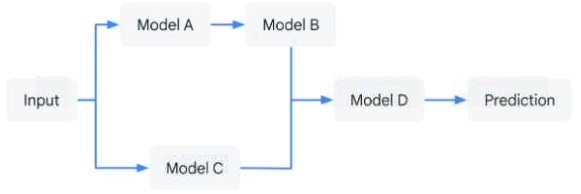
You have developed an application that uses a chain of multiple scikit-learn models to predict the optimal price for your company’s products. The workflow logic is shown in the diagram. Members of your team use the individual models in other solution workflows. You want to deploy this workflow while ensuring version control for each individual model and the overall workflow. Your application needs to be able to scale down to zero. You want to minimize the compute resource utilization and the manual effort required to manage this solution. What should you do?

Exhibit 1 for question 259
  • AExpose each individual model as an endpoint in Vertex AI Endpoints. Create a custom container endpoint to orchestrate the workflow.
  • BCreate a custom container endpoint for the workflow that loads each model’s individual files Track the versions of each individual model in BigQuery.
  • CExpose each individual model as an endpoint in Vertex AI Endpoints. Use Cloud Run to orchestrate the workflow. (correct answer)
  • DLoad each model’s individual files into Cloud Run. Use Cloud Run to orchestrate the workflow. Track the versions of each individual model in BigQuery.
Reveal answer & explanation
Correct answer: C

The correct answer is C. Option C: Expose each individual model as an endpoint in Vertex AI Endpoints. Use Cloud Run to orchestrate the workflow.

Explanation

Cloud Run runs stateless containers serverlessly and scales to zero, minimizing operational overhead. Vertex AI is the unified managed platform to build, train, tune, deploy, and operate ML models.

Topic 1 Β· Question 260

You are developing a model to predict whether a failure will occur in a critical machine part. You have a dataset consisting of a multivariate time series and labels indicating whether the machine part failed. You recently started experimenting with a few different preprocessing and modeling approaches in a Vertex AI Workbench notebook. You want to log data and track artifacts from each run. How should you set up your experiments?

  • A1. Use the Vertex AI SDK to create an experiment and set up Vertex ML Metadata.2. Use the log_time_series_metrics function to track the preprocessed data, and use the log_merrics function to log loss values.
  • B1. Use the Vertex AI SDK to create an experiment and set up Vertex ML Metadata.2. Use the log_time_series_metrics function to track the preprocessed data, and use the log_metrics function to log loss values. (correct answer)
  • C1. Create a Vertex AI TensorBoard instance and use the Vertex AI SDK to create an experiment and associate the TensorBoard instance.2. Use the assign_input_artifact method to track the preprocessed data and use the log_time_series_metrics function to log loss values.
  • D1. Create a Vertex AI TensorBoard instance, and use the Vertex AI SDK to create an experiment and associate the TensorBoard instance.2. Use the log_time_series_metrics function to track the preprocessed data, and use the log_metrics function to log loss values.
Reveal answer & explanation
Correct answer: B

The correct answer is B. Option B: 1. Use the Vertex AI SDK to create an experiment and set up Vertex ML Metadata.2. Use the log_time_series_metrics function to track the preprocessed data, and use the log_metrics function to log loss values.

Explanation

Vertex AI is the unified managed platform to build, train, tune, deploy, and operate ML models.

Showing questions 241–260 of 339 Β· Page 13 of 17