πŸ”

PCNE β€” questions

Page 8 of 13 Β· 255 total questions.

Topic 1 Β· Question 142

You have configured a service on Google Cloud that connects to an on-premises service via a Dedicated Interconnect. Users are reporting recent connectivity issues. You need to determine whether the traffic is being dropped because of firewall rules or a routing decision. What should you do?

  • AUse the Network Intelligence Center Connectivity Tests to test the connectivity between the VPC and the on-premises network. (correct answer)
  • BUse Network Intelligence Center Network Topology to check the traffic flow, and replay the traffic from the time period when the connectivity issue occurred.
  • CConfigure VPC Flow Logs. Review the logs by filtering on the source and destination.
  • DConfigure a Compute Engine instance on the same VPC as the service running on Google Cloud to run a traceroute targeted at the on-premises service.
Reveal answer & explanation
Correct answer: A

The correct answer is A. Option A: Use the Network Intelligence Center Connectivity Tests to test the connectivity between the VPC and the on-premises network.

Explanation

A VPC provides a global, software-defined private network for your Google Cloud resources.

Topic 1 Β· Question 143

You are configuring a new HTTP application that will be exposed externally behind both IPv4 and IPv6 virtual IP addresses, using ports 80, 8080, and 443. You will have backends in two regions: us-west1 and us-east1. You want to serve the content with the lowest-possible latency while ensuring high availability and autoscaling, and create native content-based rules using the HTTP hostname and request path. The IP addresses of the clients that connect to the load balancer need to be visible to the backends. Which configuration should you use?

  • AUse Network Load Balancing
  • BUse TCP Proxy Load Balancing with PROXY protocol enabled
  • CUse External HTTP(S) Load Balancing with URL Maps and custom headers
  • DUse External HTTP(S) Load Balancing with URL Maps and an X-Forwarded-For header (correct answer)
Reveal answer & explanation
Correct answer: D

The correct answer is D. Option D: Use External HTTP(S) Load Balancing with URL Maps and an X-Forwarded-For header

Explanation

The external HTTP(S) Load Balancer distributes global web traffic with a single anycast IP. A load balancer distributes traffic across healthy backends in multiple zones for availability and scale.

Topic 1 Β· Question 144

You are reviewing and tuning Secure Web Proxy at your organization, Mount Kirk Games. Users have reported that they are unable to reach the documents they need on the Terram Earth website (https://www.terramearth.com/docs/*). The Secure Web Proxy rules configuration is as follows: You need to enable access to these documents. What should you do?

Exhibit 1 for question 144
  • ADelete the updates-limiter rule.
  • BModify the updates-1 rule to perform the TLS inspection. (correct answer)
  • CReview Cloud Logging for errors with Cloud NAT. If there are no errors, assign the VM a public IP address.
  • DModify the priority of the updates-limiter rule to 1000.
Reveal answer & explanation
Correct answer: B

The correct answer is B. Option B: Modify the updates-1 rule to perform the TLS inspection.

Topic 1 Β· Question 145

You are responsible for designing a new connectivity solution for your organization's enterprise network to access and use Google Workspace. You have an existing Shared VPC with Compute Engine instances in us-west1. Currently, you access Google Workspace via your service provider's internet access. You want to set up a direct connection between your network and Google. What should you do?

  • AOrder a Dedicated Interconnect connection in the same metropolitan area. Create a VLAN attachment, a Cloud Router in us-west1, and a Border Gateway Protocol (BGP) session between your Cloud Router and your router.
  • BOrder a Direct Peering connection in the same metropolitan area. Configure a Border Gateway Protocol (BGP) session between Google and your router. (correct answer)
  • CConfigure HA VPN in us-west1. Configure a Border Gateway Protocol (BGP) session between your Cloud Router and your on-premises data center.
  • DOrder a Carrier Peering connection in the same metropolitan area. Configure a Border Gateway Protocol (BGP) session between Google and your router.
Reveal answer & explanation
Correct answer: B

The correct answer is B. Option B: Order a Direct Peering connection in the same metropolitan area. Configure a Border Gateway Protocol (BGP) session between Google and your router.

Topic 1 Β· Question 146

You suspect that one of the virtual machines (VMs) in your default Virtual Private Cloud (VPC) is under a denial-of-service attack. You need to analyze the incoming traffic for the VM to understand where the traffic is coming from. What should you do?

  • AEnable Data Access audit logs of the VPC. Analyze the logs and get the source IP addresses from the subnetworks.get field.
  • BEnable VPC Flow Logs for the subnet. Analyze the logs and get the source IP addresses from the connection field. (correct answer)
  • CEnable VPC Flow Logs for the VPAnalyze the logs and get the source IP addresses from the src_location field.
  • DEnable Data Access audit logs of the subnet. Analyze the logs and get the source IP addresses from the networks.get field.
Reveal answer & explanation
Correct answer: B

The correct answer is B. Option B: Enable VPC Flow Logs for the subnet. Analyze the logs and get the source IP addresses from the connection field.

Explanation

A VPC provides a global, software-defined private network for your Google Cloud resources.
Topic 1 Β· Question 147

You are responsible for configuring firewall policies for your company in Google Cloud. Your security team has a strict set of requirements that must be met to configure firewall rules. β€’ Always allow Secure Shell (SSH) from your corporate IP address. β€’ Restrict SSH access from all other IP addresses. There are multiple projects and VPCs in your Google Cloud organization. You need to ensure that other VPC firewall rules cannot bypass the security team’s requirements. What should you do?

  • A1. Configure a hierarchical firewall policy to the organization node to allow TCP port 22 for your corporate IP address with priority 0.2. Configure a hierarchical firewall policy to the organization node to deny TCP port 22 for all IP addresses with priority 1. (correct answer)
  • B1. Configure a VPC firewall rule to allow TCP port 22 for your corporate IP address with priority 0.2. Configure a VPC firewall rule to deny TCP port 22 for all IP addresses with priority 1.
  • C1. Configure a VPC firewall rule to allow TCP port 22 for your corporate IP address with priority 1.2. Configure a VPC firewall rule to deny TCP port 22 for all IP addresses with priority 0.
  • D1. Configure a hierarchical firewall policy to the organization node to allow TCP port 22 for your corporate IP address with priority 12. Configure a hierarchical firewall policy to the organization node to deny TCP port 22 for all IP addresses with priority 0.
Reveal answer & explanation
Correct answer: A

The correct answer is A. Option A: 1. Configure a hierarchical firewall policy to the organization node to allow TCP port 22 for your corporate IP address with priority 0.2. Configure a hierarchical firewall policy to the organization node to deny TCP...

Topic 1 Β· Question 148

You are designing a new application that has backends internally exposed on port 800. The application will be exposed externally using both IPv4 and IPv6 via TCP on port 700. You want to ensure high availability for this application. What should you do?

  • ACreate a network load balancer that used backend services containing one instance group with two instances.
  • BCreate a network load balancer that uses a target pool backend with two instances.
  • CCreate a TCP proxy that uses a zonal network endpoint group containing one instance.
  • DCreate a TCP proxy that uses backend services containing an instance group with two instances. (correct answer)
Reveal answer & explanation
Correct answer: D

The correct answer is D. Option D: Create a TCP proxy that uses backend services containing an instance group with two instances.

Topic 1 Β· Question 149

You have several microservices running in a private subnet in an existing Virtual Private Cloud (VPC). You need to create additional serverless services that use Cloud Run and Cloud Functions to access the microservices. The network traffic volume between your serverless services and private microservices is low. However, each serverless service must be able to communicate with any of your microservices. You want to implement a solution that minimizes cost. What should you do?

  • ADeploy your serverless services to the serverless VPC. Peer the serverless service VPC to the existing VPC. Configure firewall rules to allow traffic between the serverless services and your existing microservices.
  • BCreate a serverless VPC access connector for each serverless service. Configure the connectors to allow traffic between the serverless services and your existing microservices.
  • CDeploy your serverless services to the existing VPConfigure firewall rules to allow traffic between the serverless services and your existing microservices.
  • DCreate a serverless VPC access connector. Configure the serverless service to use the connector for communication to the microservices. (correct answer)
Reveal answer & explanation
Correct answer: D

The correct answer is D. Option D: Create a serverless VPC access connector. Configure the serverless service to use the connector for communication to the microservices.

Explanation

A VPC provides a global, software-defined private network for your Google Cloud resources.
Topic 1 Β· Question 150 Β· Select all that apply

You have provisioned a Dedicated Interconnect connection of 20 Gbps with a VLAN attachment of 10 Gbps. You recently noticed a steady increase in ingress traffic on the Interconnect connection from the on-premises data center. You need to ensure that your end users can achieve the full 20 Gbps throughput as quickly as possible. Which two methods can you use to accomplish this? (Choose two.)

  • AConfigure an additional VLAN attachment of 10 Gbps in another region. Configure the on-premises router to advertise routes with the same multi-exit discriminator (MED).
  • BConfigure an additional VLAN attachment of 10 Gbps in the same region. Configure the on-premises router to advertise routes with the same multi-exit discriminator (MED). (correct answer)
  • CFrom the Google Cloud Console, modify the bandwidth of the VLAN attachment to 20 Gbps. (correct answer)
  • DFrom the Google Cloud Console, request a new Dedicated Interconnect connection of 20 Gbps, and configure a VLAN attachment of 10 Gbps.
  • EConfigure Link Aggregation Control Protocol (LACP) on the on-premises router to use the 20-Gbps Dedicated Interconnect connection.
Reveal answer & explanation
Correct answer: B, C

The correct answer is B, C. Option B: Configure an additional VLAN attachment of 10 Gbps in the same region. Configure the on-premises router to advertise routes with the same multi-exit discriminator (MED). Option C: From the Google Cloud Console, modify the bandwidth of the VLAN attachment to 20 Gbps.

Topic 1 Β· Question 151

Your company has a Virtual Private Cloud (VPC) with two Dedicated Interconnect connections in two different regions: us-west1 and us-east1. Each Dedicated Interconnect connection is attached to a Cloud Router in its respective region by a VLAN attachment. You need to configure a high availability failover path. By default, all ingress traffic from the on-premises environment should flow to the VPC using the us-west1 connection. If us-west1 is unavailable, you want traffic to be rerouted to us-east1. How should you configure the multi-exit discriminator (MED) values to enable this failover path?

  • AUse regional routing. Set the us-east1 Cloud Router to a base priority of 100, and set the us-west1 Cloud Router to a base priority of 1
  • BUse global routing. Set the us-east1 Cloud Router to a base priority of 100, and set the us-west1 Cloud Router to a base priority of 1
  • CUse regional routing. Set the us-east1 Cloud Router to a base priority of 1000, and set the us-west1 Cloud Router to a base priority of 1
  • DUse global routing. Set the us-east1 Cloud Router to a base priority of 1000, and set the us-west1 Cloud Router to a base priority of 1 (correct answer)
Reveal answer & explanation
Correct answer: D

The correct answer is D. Option D: Use global routing. Set the us-east1 Cloud Router to a base priority of 1000, and set the us-west1 Cloud Router to a base priority of 1.

Topic 1 Β· Question 152

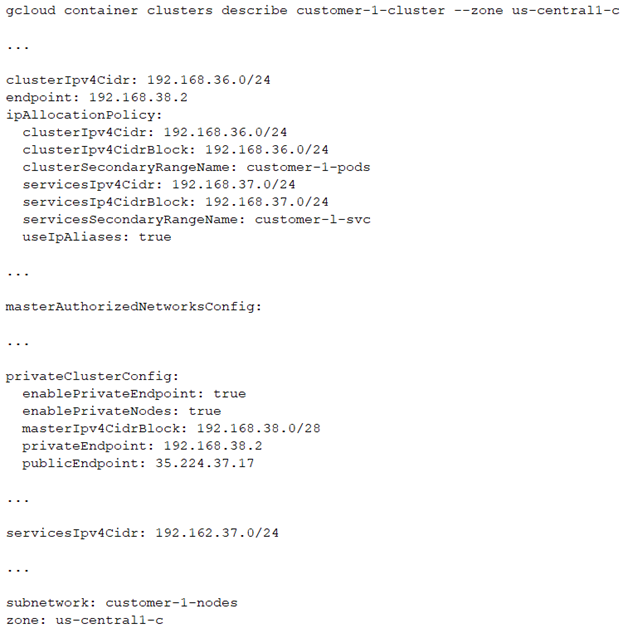
You have the following private Google Kubernetes Engine (GKE) cluster deployment: You have a virtual machine (VM) deployed in the same VPC in the subnetwork kubernetes-management with internal IP address 192.168.40 2/24 and no external IP address assigned. You need to communicate with the cluster master using kubectl. What should you do?

Exhibit 1 for question 152
  • AAdd the network 192.168.40.0/24 to the masterAuthorizedNetworksConfig. Configure kubectl to communicate with the endpoint 192.168.38.2. (correct answer)
  • BAdd the network 192.168.38.0/28 to the masterAuthorizedNetworksConfig. Configure kubectl to communicate with the endpoint 192.168.38.2
  • CAdd the network 192.168.36.0/24 to the masterAuthorizedNetworksConfig. Configure kubectl to communicate with the endpoint 192.168.38.2
  • DAdd an external IP address to the VM, and add this IP address in the masterAuthorizedNetworksConfig. Configure kubectl to communicate with the endpoint 35.224.37.17.
Reveal answer & explanation
Correct answer: A

The correct answer is A. Option A: Add the network 192.168.40.0/24 to the masterAuthorizedNetworksConfig. Configure kubectl to communicate with the endpoint 192.168.38.2.

Topic 1 Β· Question 153

Your company's logo is published as an image file across multiple websites that are hosted by your company. You have implemented Cloud CDN; however, you want to improve the performance of the cache hit ratio associated with this image file. What should you do?

  • AConfigure custom cache keys for the backend service that holds the image file, and clear the Host and Protocol checkboxes. (correct answer)
  • BConfigure the default time to live (TTL) as 0 for the image file.
  • CConfigure versioned URLs for each domain to serve users the image file before the cache entry expires.
  • DConfigure Cloud Storage as a custom origin backend to host the image file, and select multi-region as the location type.
Reveal answer & explanation
Correct answer: A

The correct answer is A. Option A: Configure custom cache keys for the backend service that holds the image file, and clear the Host and Protocol checkboxes.

Topic 1 Β· Question 154

Your company recently migrated to Google Cloud in a single region. You configured separate Virtual Private Cloud (VPC) networks for two departments: Department A and Department B. Department A has requested access to resources that are part of Department B's VPC. You need to configure the traffic from private IP addresses to flow between the VPCs using multi-NIC virtual machines (VMs) to meet security requirements. Your configuration also must: β€’ Support both TCP and UDP protocols β€’ Provide fully automated failover β€’ Include health-checks β€’ Require minimal manual intervention in the client VMs Which approach should you take?

  • ACreate the VMs in the same zone, and configure static routes with IP addresses as next hops.
  • BCreate the VMs in different zones, and configure static routes with instance names as next hops.
  • CCreate an instance template and a managed instance group. Configure a single internal load balancer, and define a custom static route with the internal TCP/UDP load balancer as the next hop. (correct answer)
  • DCreate an instance template and a managed instance group. Configure two separate internal TCP/UDP load balancers for each protocol (TCP/UDP), and configure the client VMs to use the internal load balancers’ virtual IP addresses.
Reveal answer & explanation
Correct answer: C

The correct answer is C. Option C: Create an instance template and a managed instance group. Configure a single internal load balancer, and define a custom static route with the internal TCP/UDP load balancer as the next hop.

Explanation

A managed instance group provides autoscaling, autohealing, and rolling updates for VMs. A load balancer distributes traffic across healthy backends in multiple zones for availability and scale.

Topic 1 Β· Question 155

You are designing an IP address scheme for new private Google Kubernetes Engine (GKE) clusters. Due to IP address exhaustion of the RFC 1918 address space in your enterprise, you plan to use privately used public IP space for the new clusters. You want to follow Google-recommended practices. What should you do after designing your IP scheme?

  • ACreate the minimum usable RFC 1918 primary and secondary subnet IP ranges for the clusters. Re-use the secondary address range for the pods across multiple private GKE clusters.
  • BCreate the minimum usable RFC 1918 primary and secondary subnet IP ranges for the clusters, Re-use the secondary address range for the services across multiple private GKE clusters.
  • CCreate privately used public IP primary and secondary subnet ranges for the clusters. Create a private GKE cluster with the following options selected: --enable-ip-alias and --enable-private-nodes.
  • DCreate privately used public IP primary and secondary subnet ranges for the clusters. Create a private GKE cluster with the following options selected: --disable-default-snat, --enable-ip-alias, and --enable-private-nodes. (correct answer)
Reveal answer & explanation
Correct answer: D

The correct answer is D. Option D: Create privately used public IP primary and secondary subnet ranges for the clusters. Create a private GKE cluster with the following options selected: --disable-default-snat, --enable-ip-alias, and --enable-private-n...

Explanation

Google Kubernetes Engine runs managed Kubernetes for containerized, portable workloads.

Topic 1 Β· Question 156

You want Cloud CDN to serve the https://www.example.com/images/spacetime.png static image file that is hosted in a private Cloud Storage bucket. You are using the USE_ORIGIN_HEADERS cache mode. You receive an HTTP 403 error when opening the file in your browser, and you see that the HTTP response has a Cache-Control: private, max-age=0 header. How should you correct this issue?

  • AEnable negative caching for the backend bucket.
  • BChange the cache mode to Force cache all content.C Configure a Cloud Storage bucket permission that gives allUsers the Storage Legacy Object Reader role. (correct answer)
  • DIncrease the default time-to-live (TTL) for the backend service.
Reveal answer & explanation
Correct answer: B

The correct answer is B. Option B: Change the cache mode to Force cache all content.C Configure a Cloud Storage bucket permission that gives allUsers the Storage Legacy Object Reader role.

Explanation

Cloud Storage provides durable, scalable object storage that is fully managed.

Topic 1 Β· Question 157

You are deploying an application that runs on Compute Engine instances. You need to determine how to expose your application to a new customer. You must ensure that your application meets the following requirements: β€’ Maps multiple existing reserved external IP addresses to the instance β€’ Processes IP Encapsulating Security Payload (ESP) traffic What should you do?

  • AConfigure a target pool, and create protocol forwarding rules for each external IP address.
  • BConfigure a backend service, and create an external network load balancer for each external IP address.
  • CConfigure a target instance, and create a protocol forwarding rule for each external IP address to be mapped to the instance. (correct answer)
  • DConfigure the Compute Engine instances’ network interface external IP address from None to Ephemeral. Add as many external IP addresses as required.
Reveal answer & explanation
Correct answer: C

The correct answer is C. Option C: Configure a target instance, and create a protocol forwarding rule for each external IP address to be mapped to the instance.

Topic 1 Β· Question 158

Your product team has web servers running on both us-east1 and us-west1 regions in the prod-servers project. Your security team plans to install an intrusion detection system (IDS) in their own Google Cloud project to inspect the incoming network traffic. What should you do?

  • ACreate a new project and a VPC for the security team.Peer the new VPC with the web servers’ VPC in the prod-servers project.Create an internal load balancer and the IDS system in both us-east1 and us-west1.Enable Packet Mirroring, and create packet mirroring policies inside the new project. (correct answer)
  • CCreate a host project and a Sharad VPC for the security team.Make prod-servers a service project, and relocate the web servers to shared subnets in both regions.Enable IP forwarding on all the web servers.Create the IDS system in a non-shared subnet of us-east1 or us-west1.Configure the web servers to forward the packets to the IDS system.C. Create a new project and a VPC for the security team.Peer the new VPC with the web servers’ VPC in the prod-servers project.Enable IP forwarding on all the web servers.Install the IDS system in both us-east1 and us-west1.Configure the web servers to forward the packets to the IDS system.
  • DCreate a host project and a Shared VPC for the security team.Make prod-servers a service project, and relocate the web servers to shared subnets in both regions.Create an internal load balancer and the IDS system in a subnet in either us-east1 or us-west1.Enable Packet Mirroring, and create a packet mirroring policy inside the host project.
Reveal answer & explanation
Correct answer: A

The correct answer is A. Option A: Create a new project and a VPC for the security team.Peer the new VPC with the web servers’ VPC in the prod-servers project.Create an internal load balancer and the IDS system in both us-east1 and us-west1.Enable Pack...

Explanation

A load balancer distributes traffic across healthy backends in multiple zones for availability and scale. A VPC provides a global, software-defined private network for your Google Cloud resources.
Topic 1 Β· Question 159 Β· Select all that apply

You are in the process of deploying an internal HTTP(S) load balancer for your web server virtual machine (VM) instances. What two prerequisite tasks must be completed before creating the load balancer? (Choose two.)

  • AChoose a region.
  • BCreate firewall rules for health checks. (correct answer)
  • CReserve a static IP address for the load balancer.
  • DDetermine the subnet mask for a proxy-only subnet. (correct answer)
  • EDetermine the subnet mask for Serverless VPC Access.
Reveal answer & explanation
Correct answer: B, D

The correct answer is B, D. Option B: Create firewall rules for health checks. Option D: Determine the subnet mask for a proxy-only subnet.

Topic 1 Β· Question 160 Β· Select all that apply

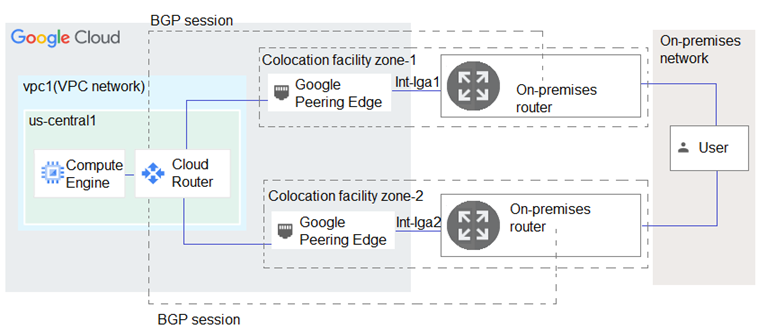
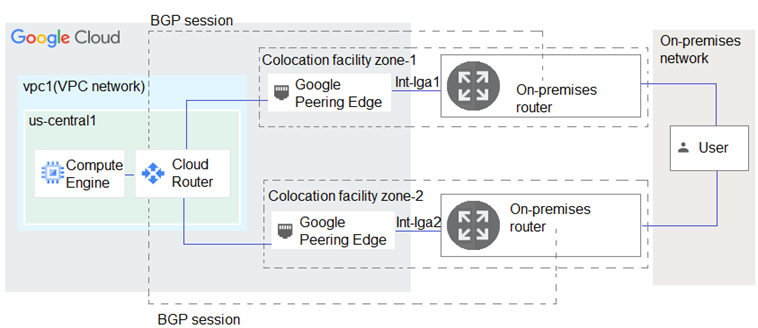
You have the networking configuration shown in the diagram. A pair of redundant Dedicated Interconnect connections (int-Iga1 and int-Iga2) terminate on the same Cloud Router. The Interconnect connections terminate on two separate on-premises routers. You are advertising the same prefixes from the Border Gateway Protocol (BGP) sessions associated with the Dedicated Interconnect connections. You need to configure one connection as Active for both ingress and egress traffic. If the active Interconnect connection falls, you want the passive Interconnect connection to automatically begin routing all traffic. Which two actions should you take to meet this requirement? (Choose two.)

Exhibit 1 for question 160
  • AConfigure the advertised route priority as 200 for the BGP session associated with the active interconnect connection.
  • BConfigure the advertised route priority > 10,200 on the active Interconnect connection.
  • CAdvertise a lower MED on the active Interconnect connection from the on-premises router. (correct answer)
  • DAdvertise a lower MED on the passive Interconnect connection from the on-premises router.
  • EConfigure the advertised route priority as 200 for the BGP session associated with the passive Interconnect connection. (correct answer)
Reveal answer & explanation
Correct answer: C, E

The correct answer is C, E. Option C: Advertise a lower MED on the active Interconnect connection from the on-premises router. Option E: Configure the advertised route priority as 200 for the BGP session associated with the passive Interconnect connection.

Topic 1 Β· Question 161

Your team is developing an application that will be used by consumers all over the world. Currently, the application sits behind a global external application load balancer. You need to protect the application from potential application-level attacks. What should you do?

Exhibit 1 for question 161
  • AEnable Cloud CDN on the backend service.
  • BCreate multiple firewall deny rules to block malicious users, and apply them to the global external application load balancer.
  • CCreate a Google Cloud Armor security policy with web application firewall rules, and apply the security policy to the backend service (correct answer)
  • DCreate a VPC Service Controls perimeter with the global external application load balancer as the protected service, and apply it to the backend service.
Reveal answer & explanation
Correct answer: C

The correct answer is C. Option C: Create a Google Cloud Armor security policy with web application firewall rules, and apply the security policy to the backend service

Explanation

Cloud Armor protects applications from DDoS and common web attacks with WAF rules.

Showing questions 141–160 of 255 Β· Page 8 of 13