🔍

SAP-C02 — questions

Page 3 of 27 · 529 total questions.

Topic 1 · Question 41

A company recently deployed an application on AWS. The application uses Amazon DynamoDB. The company measured the application load and configured the RCUs and WCUs on the DynamoDB table to match the expected peak load. The peak load occurs once a week for a 4-hour period and is double the average load. The application load is close to the average load for the rest of the week. The access pattern includes many more writes to the table than reads of the table. A solutions architect needs to implement a solution to minimize the cost of the table. Which solution will meet these requirements?

  • AUse AWS Application Auto Scaling to increase capacity during the peak period. Purchase reserved RCUs and WCUs to match the average load. (correct answer)
  • BConfigure on-demand capacity mode for the table.
  • CConfigure DynamoDB Accelerator (DAX) in front of the table. Reduce the provisioned read capacity to match the new peak load on the table.
  • DConfigure DynamoDB Accelerator (DAX) in front of the table. Configure on-demand capacity mode for the table.
Reveal answer & explanation
Correct answer: A

The correct answer is A. Option A: Use AWS Application Auto Scaling to increase capacity during the peak period. Purchase reserved RCUs and WCUs to match the average load.

Explanation

Auto Scaling adjusts capacity automatically to match demand, improving availability and cost efficiency.
Topic 1 · Question 42

A solutions architect needs to advise a company on how to migrate its on-premises data processing application to the AWS Cloud. Currently, users upload input files through a web portal. The web server then stores the uploaded files on NAS and messages the processing server over a message queue. Each media file can take up to 1 hour to process. The company has determined that the number of media files awaiting processing is significantly higher during business hours, with the number of files rapidly declining after business hours. What is the MOST cost-effective migration recommendation?

  • ACreate a queue using Amazon SQS. Configure the existing web server to publish to the new queue. When there are messages in the queue, invoke an AWS Lambda function to pull requests from the queue and process the files. Store the processed files in an Amazon S3 bucket.
  • BCreate a queue using Amazon MQ. Configure the existing web server to publish to the new queue. When there are messages in the queue, create a new Amazon EC2 instance to pull requests from the queue and process the files. Store the processed files in Amazon EFS. Shut down the EC2 instance after the task is complete.
  • CCreate a queue using Amazon MQ. Configure the existing web server to publish to the new queue. When there are messages in the queue, invoke an AWS Lambda function to pull requests from the queue and process the files. Store the processed files in Amazon EFS.
  • DCreate a queue using Amazon SQS. Configure the existing web server to publish to the new queue. Use Amazon EC2 instances in an EC2 Auto Scaling group to pull requests from the queue and process the files. Scale the EC2 instances based on the SQS queue length. Store the processed files in an Amazon S3 bucket. (correct answer)
Reveal answer & explanation
Correct answer: D

The correct answer is D. Option D: Create a queue using Amazon SQS. Configure the existing web server to publish to the new queue. Use Amazon EC2 instances in an EC2 Auto Scaling group to pull requests from the queue and process the files. Scale the EC...

Explanation

Auto Scaling adjusts capacity automatically to match demand, improving availability and cost efficiency. Amazon EC2 provides resizable virtual servers when you need full control of the operating system. Amazon S3 provides durable, scalable object storage that is fully managed. This option delivers the requirement at the lowest cost.

Topic 1 · Question 43

A company is using Amazon OpenSearch Service to analyze data. The company loads data into an OpenSearch Service cluster with 10 data nodes from an Amazon S3 bucket that uses S3 Standard storage. The data resides in the cluster for 1 month for read-only analysis. After 1 month, the company deletes the index that contains the data from the cluster. For compliance purposes, the company must retain a copy of all input data. The company is concerned about ongoing costs and asks a solutions architect to recommend a new solution. Which solution will meet these requirements MOST cost-effectively?

  • AReplace all the data nodes with UltraWarm nodes to handle the expected capacity. Transition the input data from S3 Standard to S3 Glacier Deep Archive when the company loads the data into the cluster.
  • BReduce the number of data nodes in the cluster to 2 Add UltraWarm nodes to handle the expected capacity. Configure the indexes to transition to UltraWarm when OpenSearch Service ingests the data. Transition the input data to S3 Glacier Deep Archive after 1 month by using an S3 Lifecycle policy. (correct answer)
  • CReduce the number of data nodes in the cluster to 2. Add UltraWarm nodes to handle the expected capacity. Configure the indexes to transition to UltraWarm when OpenSearch Service ingests the data. Add cold storage nodes to the cluster Transition the indexes from UltraWarm to cold storage. Delete the input data from the S3 bucket after 1 month by using an S3 Lifecycle policy.
  • DReduce the number of data nodes in the cluster to 2. Add instance-backed data nodes to handle the expected capacity. Transition the input data from S3 Standard to S3 Glacier Deep Archive when the company loads the data into the cluster.
Reveal answer & explanation
Correct answer: B

The correct answer is B. Option B: Reduce the number of data nodes in the cluster to 2 Add UltraWarm nodes to handle the expected capacity. Configure the indexes to transition to UltraWarm when OpenSearch Service ingests the data. Transition the input...

Explanation

S3 Glacier Deep Archive is the lowest-cost storage for long-term archival with retrieval in hours. Amazon S3 Glacier offers low-cost archival storage for infrequently accessed data. S3 Lifecycle policies automatically transition or expire objects to control storage cost. This option delivers the requirement at the lowest cost.

Topic 1 · Question 44

A company has 10 accounts that are part of an organization in AWS Organizations. AWS Config is configured in each account. All accounts belong to either the Prod OU or the NonProd OU. The company has set up an Amazon EventBridge rule in each AWS account to notify an Amazon Simple Notification Service (Amazon SNS) topic when an Amazon EC2 security group inbound rule is created with 0.0.0.0/0 as the source. The company’s security team is subscribed to the SNS topic. For all accounts in the NonProd OU, the security team needs to remove the ability to create a security group inbound rule that includes 0.0.0.0/0 as the source. Which solution will meet this requirement with the LEAST operational overhead?

  • AModify the EventBridge rule to invoke an AWS Lambda function to remove the security group inbound rule and to publish to the SNS topic. Deploy the updated rule to the NonProd OU.
  • BAdd the vpc-sg-open-only-to-authorized-ports AWS Config managed rule to the NonProd OU.
  • CConfigure an SCP to allow the ec2:AuthorizeSecurityGroupIngress action when the value of the aws:SourceIp condition key is not 0.0.0.0/0. Apply the SCP to the NonProd OU.
  • DConfigure an SCP to deny the ec2:AuthorizeSecurityGroupIngress action when the value of the aws:SourceIp condition key is 0.0.0.0/0. Apply the SCP to the NonProd OU. (correct answer)
Reveal answer & explanation
Correct answer: D

The correct answer is D. Option D: Configure an SCP to deny the ec2:AuthorizeSecurityGroupIngress action when the value of the aws:SourceIp condition key is 0.0.0.0/0. Apply the SCP to the NonProd OU.

Explanation

Amazon EC2 provides resizable virtual servers when you need full control of the operating system. Service Control Policies set guardrails on what accounts in an organization can do. AWS Config tracks resource configuration changes and evaluates compliance.

Topic 1 · Question 45

A company hosts a Git repository in an on-premises data center. The company uses webhooks to invoke functionality that runs in the AWS Cloud. The company hosts the webhook logic on a set of Amazon EC2 instances in an Auto Scaling group that the company set as a target for an Application Load Balancer (ALB). The Git server calls the ALB for the configured webhooks. The company wants to move the solution to a serverless architecture. Which solution will meet these requirements with the LEAST operational overhead?

  • AFor each webhook, create and configure an AWS Lambda function URL. Update the Git servers to call the individual Lambda function URLs.
  • BCreate an Amazon API Gateway HTTP API. Implement each webhook logic in a separate AWS Lambda function. Update the Git servers to call the API Gateway endpoint. (correct answer)
  • CDeploy the webhook logic to AWS App Runner. Create an ALB, and set App Runner as the target. Update the Git servers to call the ALB endpoint.
  • DContainerize the webhook logic. Create an Amazon Elastic Container Service (Amazon ECS) cluster, and run the webhook logic in AWS Fargate. Create an Amazon API Gateway REST API, and set Fargate as the target. Update the Git servers to call the API Gateway endpoint.
Reveal answer & explanation
Correct answer: B

The correct answer is B. Option B: Create an Amazon API Gateway HTTP API. Implement each webhook logic in a separate AWS Lambda function. Update the Git servers to call the API Gateway endpoint.

Explanation

AWS Lambda runs code without provisioning servers and scales automatically, which minimizes operational overhead. Amazon API Gateway is a fully managed front door for creating and securing APIs at scale.

Topic 1 · Question 46

A company is planning to migrate 1,000 on-premises servers to AWS. The servers run on several VMware clusters in the company’s data center. As part of the migration plan, the company wants to gather server metrics such as CPU details, RAM usage, operating system information, and running processes. The company then wants to query and analyze the data. Which solution will meet these requirements?

  • ADeploy and configure the AWS Agentless Discovery Connector virtual appliance on the on-premises hosts. Configure Data Exploration in AWS Migration Hub. Use AWS Glue to perform an ETL job against the data. Query the data by using Amazon S3 Select.
  • BExport only the VM performance information from the on-premises hosts. Directly import the required data into AWS Migration Hub. Update any missing information in Migration Hub. Query the data by using Amazon QuickSight.
  • CCreate a script to automatically gather the server information from the on-premises hosts. Use the AWS CLI to run the put-resource-attributes command to store the detailed server data in AWS Migration Hub. Query the data directly in the Migration Hub console.
  • DDeploy the AWS Application Discovery Agent to each on-premises server. Configure Data Exploration in AWS Migration Hub. Use Amazon Athena to run predefined queries against the data in Amazon S3. (correct answer)
Reveal answer & explanation
Correct answer: D

The correct answer is D. Option D: Deploy the AWS Application Discovery Agent to each on-premises server. Configure Data Exploration in AWS Migration Hub. Use Amazon Athena to run predefined queries against the data in Amazon S3.

Explanation

Amazon S3 provides durable, scalable object storage that is fully managed. Amazon Athena runs serverless SQL queries directly on data in Amazon S3 with no infrastructure to manage. AWS Config tracks resource configuration changes and evaluates compliance.

Topic 1 · Question 47

A company is building a serverless application that runs on an AWS Lambda function that is attached to a VPC. The company needs to integrate the application with a new service from an external provider. The external provider supports only requests that come from public IPv4 addresses that are in an allow list. The company must provide a single public IP address to the external provider before the application can start using the new service. Which solution will give the application the ability to access the new service?

  • ADeploy a NAT gateway. Associate an Elastic IP address with the NAT gateway. Configure the VPC to use the NAT gateway. (correct answer)
  • BDeploy an egress-only internet gateway. Associate an Elastic IP address with the egress-only internet gateway. Configure the elastic network interface on the Lambda function to use the egress-only internet gateway.
  • CDeploy an internet gateway. Associate an Elastic IP address with the internet gateway. Configure the Lambda function to use the internet gateway.
  • DDeploy an internet gateway. Associate an Elastic IP address with the internet gateway. Configure the default route in the public VPC route table to use the internet gateway.
Reveal answer & explanation
Correct answer: A

The correct answer is A. Option A: Deploy a NAT gateway. Associate an Elastic IP address with the NAT gateway. Configure the VPC to use the NAT gateway.

Explanation

A NAT gateway lets private subnet resources reach the internet for outbound traffic only. AWS Config tracks resource configuration changes and evaluates compliance.

Topic 1 · Question 48 · Select all that apply

A solutions architect has developed a web application that uses an Amazon API Gateway Regional endpoint and an AWS Lambda function. The consumers of the web application are all close to the AWS Region where the application will be deployed. The Lambda function only queries an Amazon Aurora MySQL database. The solutions architect has configured the database to have three read replicas. During testing, the application does not meet performance requirements. Under high load, the application opens a large number of database connections. The solutions architect must improve the application’s performance. Which actions should the solutions architect take to meet these requirements? (Choose two.)

  • AUse the cluster endpoint of the Aurora database.
  • BUse RDS Proxy to set up a connection pool to the reader endpoint of the Aurora database. (correct answer)
  • CUse the Lambda Provisioned Concurrency feature.
  • DMove the code for opening the database connection in the Lambda function outside of the event handler. (correct answer)
  • EChange the API Gateway endpoint to an edge-optimized endpoint.
Reveal answer & explanation
Correct answer: B, D

The correct answer is B, D. Option B: Use RDS Proxy to set up a connection pool to the reader endpoint of the Aurora database. Option D: Move the code for opening the database connection in the Lambda function outside of the event handler.

Explanation

AWS Lambda runs code without provisioning servers and scales automatically, which minimizes operational overhead. Amazon Aurora is a high-performance managed relational database with built-in replication and failover. Amazon RDS Proxy pools and shares database connections to improve scalability and resilience.

Topic 1 · Question 49

A company is planning to host a web application on AWS and wants to load balance the traffic across a group of Amazon EC2 instances. One of the security requirements is to enable end-to-end encryption in transit between the client and the web server. Which solution will meet this requirement?

  • APlace the EC2 instances behind an Application Load Balancer (ALB). Provision an SSL certificate using AWS Certificate Manager (ACM), and associate the SSL certificate with the ALB. Export the SSL certificate and install it on each EC2 instance. Configure the ALB to listen on port 443 and to forward traffic to port 443 on the instances.
  • BAssociate the EC2 instances with a target group. Provision an SSL certificate using AWS Certificate Manager (ACM). Create an Amazon CloudFront distribution and configure it to use the SSL certificate. Set CloudFront to use the target group as the origin server.
  • CPlace the EC2 instances behind an Application Load Balancer (ALB) Provision an SSL certificate using AWS Certificate Manager (ACM), and associate the SSL certificate with the ALB. Provision a third-party SSL certificate and install it on each EC2 instance. Configure the ALB to listen on port 443 and to forward traffic to port 443 on the instances. (correct answer)
  • DPlace the EC2 instances behind a Network Load Balancer (NLB). Provision a third-party SSL certificate and install it on the NLB and on each EC2 instance. Configure the NLB to listen on port 443 and to forward traffic to port 443 on the instances.
Reveal answer & explanation
Correct answer: C

The correct answer is C. Option C: Place the EC2 instances behind an Application Load Balancer (ALB) Provision an SSL certificate using AWS Certificate Manager (ACM), and associate the SSL certificate with the ALB. Provision a third-party SSL certifica...

Explanation

Amazon EC2 provides resizable virtual servers when you need full control of the operating system. An Application Load Balancer distributes HTTP/HTTPS traffic and supports path/host routing. A load balancer distributes traffic across targets in multiple AZs for availability and scale.

Topic 1 · Question 50

A company wants to migrate its data analytics environment from on premises to AWS. The environment consists of two simple Node.js applications. One of the applications collects sensor data and loads it into a MySQL database. The other application aggregates the data into reports. When the aggregation jobs run, some of the load jobs fail to run correctly. The company must resolve the data loading issue. The company also needs the migration to occur without interruptions or changes for the company’s customers. What should a solutions architect do to meet these requirements?

  • ASet up an Amazon Aurora MySQL database as a replication target for the on-premises database. Create an Aurora Replica for the Aurora MySQL database, and move the aggregation jobs to run against the Aurora Replica. Set up collection endpoints as AWS Lambda functions behind a Network Load Balancer (NLB), and use Amazon RDS Proxy to write to the Aurora MySQL database. When the databases are synced, disable the replication job and restart the Aurora Replica as the primary instance. Point the collector DNS record to the NLB.
  • BSet up an Amazon Aurora MySQL database. Use AWS Database Migration Service (AWS DMS) to perform continuous data replication from the on-premises database to Aurora. Move the aggregation jobs to run against the Aurora MySQL database. Set up collection endpoints behind an Application Load Balancer (ALB) as Amazon EC2 instances in an Auto Scaling group. When the databases are synced, point the collector DNS record to the ALDisable the AWS DMS sync task after the cutover from on premises to AWS.
  • CSet up an Amazon Aurora MySQL database. Use AWS Database Migration Service (AWS DMS) to perform continuous data replication from the on-premises database to Aurora. Create an Aurora Replica for the Aurora MySQL database, and move the aggregation jobs to run against the Aurora Replica. Set up collection endpoints as AWS Lambda functions behind an Application Load Balancer (ALB), and use Amazon RDS Proxy to write to the Aurora MySQL database. When the databases are synced, point the collector DNS record to the ALB. Disable the AWS DMS sync task after the cutover from on premises to AWS. (correct answer)
  • DSet up an Amazon Aurora MySQL database. Create an Aurora Replica for the Aurora MySQL database, and move the aggregation jobs to run against the Aurora Replica. Set up collection endpoints as an Amazon Kinesis data stream. Use Amazon Kinesis Data Firehose to replicate the data to the Aurora MySQL database. When the databases are synced, disable the replication job and restart the Aurora Replica as the primary instance. Point the collector DNS record to the Kinesis data stream.
Reveal answer & explanation
Correct answer: C

The correct answer is C. Option C: Set up an Amazon Aurora MySQL database. Use AWS Database Migration Service (AWS DMS) to perform continuous data replication from the on-premises database to Aurora. Create an Aurora Replica for the Aurora MySQL databa...

Explanation

AWS Lambda runs code without provisioning servers and scales automatically, which minimizes operational overhead. Amazon Aurora is a high-performance managed relational database with built-in replication and failover. Amazon RDS Proxy pools and shares database connections to improve scalability and resilience.

Topic 1 · Question 51

A health insurance company stores personally identifiable information (PII) in an Amazon S3 bucket. The company uses server-side encryption with S3 managed encryption keys (SSE-S3) to encrypt the objects. According to a new requirement, all current and future objects in the S3 bucket must be encrypted by keys that the company’s security team manages. The S3 bucket does not have versioning enabled. Which solution will meet these requirements?

  • AIn the S3 bucket properties, change the default encryption to SSE-S3 with a customer managed key. Use the AWS CLI to re-upload all objects in the S3 bucket. Set an S3 bucket policy to deny unencrypted PutObject requests.
  • BIn the S3 bucket properties, change the default encryption to server-side encryption with AWS KMS managed encryption keys (SSE-KMS). Set an S3 bucket policy to deny unencrypted PutObject requests. Use the AWS CLI to re-upload all objects in the S3 bucket. (correct answer)
  • CIn the S3 bucket properties, change the default encryption to server-side encryption with AWS KMS managed encryption keys (SSE-KMS). Set an S3 bucket policy to automatically encrypt objects on GetObject and PutObject requests.
  • DIn the S3 bucket properties, change the default encryption to AES-256 with a customer managed key. Attach a policy to deny unencrypted PutObject requests to any entities that access the S3 bucket. Use the AWS CLI to re-upload all objects in the S3 bucket.
Reveal answer & explanation
Correct answer: B

The correct answer is B. Option B: In the S3 bucket properties, change the default encryption to server-side encryption with AWS KMS managed encryption keys (SSE-KMS). Set an S3 bucket policy to deny unencrypted PutObject requests. Use the AWS CLI to r...

Explanation

Amazon S3 provides durable, scalable object storage that is fully managed. AWS KMS manages encryption keys and integrates with most AWS services for encryption at rest.

Topic 1 · Question 52

A company is running a web application in the AWS Cloud. The application consists of dynamic content that is created on a set of Amazon EC2 instances. The EC2 instances run in an Auto Scaling group that is configured as a target group for an Application Load Balancer (ALB). The company is using an Amazon CloudFront distribution to distribute the application globally. The CloudFront distribution uses the ALB as an origin. The company uses Amazon Route 53 for DNS and has created an A record of www.example.com for the CloudFront distribution. A solutions architect must configure the application so that itis highly available and fault tolerant. Which solution meets these requirements?

  • AProvision a full, secondary application deployment in a different AWS Region. Update the Route 53 A record to be a failover record. Add both of the CloudFront distributions as values. Create Route 53 health checks.
  • BProvision an ALB, an Auto Scaling group, and EC2 instances in a different AWS Region. Update the CloudFront distribution, and create a second origin for the new ALCreate an origin group for the two origins. Configure one origin as primary and one origin as secondary. (correct answer)
  • CProvision an Auto Scaling group and EC2 instances in a different AWS Region. Create a second target for the new Auto Scaling group in the ALB. Set up the failover routing algorithm on the ALB.
  • DProvision a full, secondary application deployment in a different AWS Region. Create a second CloudFront distribution, and add the new application setup as an origin. Create an AWS Global Accelerator accelerator. Add both of the CloudFront distributions as endpoints.
Reveal answer & explanation
Correct answer: B

The correct answer is B. Option B: Provision an ALB, an Auto Scaling group, and EC2 instances in a different AWS Region. Update the CloudFront distribution, and create a second origin for the new ALCreate an origin group for the two origins. Configure...

Explanation

Auto Scaling adjusts capacity automatically to match demand, improving availability and cost efficiency. Amazon EC2 provides resizable virtual servers when you need full control of the operating system. Amazon CloudFront caches content at edge locations to reduce latency and offload origins. By spanning multiple Availability Zones / adding redundancy, this option provides the high availability and resilience required.

Topic 1 · Question 53

A company has an organization in AWS Organizations that has a large number of AWS accounts. One of the AWS accounts is designated as a transit account and has a transit gateway that is shared with all of the other AWS accounts. AWS Site-to-Site VPN connections are configured between all of the company’s global offices and the transit account. The company has AWS Config enabled on all of its accounts. The company’s networking team needs to centrally manage a list of internal IP address ranges that belong to the global offices. Developers will reference this list to gain access to their applications securely. Which solution meets these requirements with the LEAST amount of operational overhead?

  • ACreate a JSON file that is hosted in Amazon S3 and that lists all of the internal IP address ranges. Configure an Amazon Simple Notification Service (Amazon SNS) topic in each of the accounts that can be invoked when the JSON file is updated. Subscribe an AWS Lambda function to the SNS topic to update all relevant security group rules with the updated IP address ranges.
  • BCreate a new AWS Config managed rule that contains all of the internal IP address ranges. Use the rule to check the security groups in each of the accounts to ensure compliance with the list of IP address ranges. Configure the rule to automatically remediate any noncompliant security group that is detected.
  • CIn the transit account, create a VPC prefix list with all of the internal IP address ranges. Use AWS Resource Access Manager to share the prefix list with all of the other accounts. Use the shared prefix list to configure security group rules in the other accounts. (correct answer)
  • DIn the transit account, create a security group with all of the internal IP address ranges. Configure the security groups in the other accounts to reference the transit account’s security group by using a nested security group reference of “/sg-1a2b3c4d”.
Reveal answer & explanation
Correct answer: C

The correct answer is C. Option C: In the transit account, create a VPC prefix list with all of the internal IP address ranges. Use AWS Resource Access Manager to share the prefix list with all of the other accounts. Use the shared prefix list to confi...

Explanation

AWS Config tracks resource configuration changes and evaluates compliance.

Topic 1 · Question 54

A company runs a new application as a static website in Amazon S3. The company has deployed the application to a production AWS account and uses Amazon CloudFront to deliver the website. The website calls an Amazon API Gateway REST API. An AWS Lambda function backs each API method. The company wants to create a CSV report every 2 weeks to show each API Lambda function’s recommended configured memory, recommended cost, and the price difference between current configurations and the recommendations. The company will store the reports in an S3 bucket. Which solution will meet these requirements with the LEAST development time?

  • ACreate a Lambda function that extracts metrics data for each API Lambda function from Amazon CloudWatch Logs for the 2-week period. Collate the data into tabular format. Store the data as a .csv file in an S3 bucket. Create an Amazon EventBridge rule to schedule the Lambda function to run every 2 weeks.
  • BOpt in to AWS Compute Optimizer. Create a Lambda function that calls the ExportLambdaFunctionRecommendations operation. Export the .csv file to an S3 bucket. Create an Amazon EventBridge rule to schedule the Lambda function to run every 2 weeks. (correct answer)
  • COpt in to AWS Compute Optimizer. Set up enhanced infrastructure metrics. Within the Compute Optimizer console, schedule a job to export the Lambda recommendations to a .csv file. Store the file in an S3 bucket every 2 weeks.
  • DPurchase the AWS Business Support plan for the production account. Opt in to AWS Compute Optimizer for AWS Trusted Advisor checks. In the Trusted Advisor console, schedule a job to export the cost optimization checks to a .csv file. Store the file in an S3 bucket every 2 weeks.
Reveal answer & explanation
Correct answer: B

The correct answer is B. Option B: Opt in to AWS Compute Optimizer. Create a Lambda function that calls the ExportLambdaFunctionRecommendations operation. Export the.csv file to an S3 bucket. Create an Amazon EventBridge rule to schedule the Lambda fu...

Explanation

AWS Lambda runs code without provisioning servers and scales automatically, which minimizes operational overhead. Amazon EKS runs managed Kubernetes when you need the Kubernetes ecosystem. Amazon S3 provides durable, scalable object storage that is fully managed.

Topic 1 · Question 55 · Select all that apply

A company’s factory and automation applications are running in a single VPC. More than 20 applications run on a combination of Amazon EC2, Amazon Elastic Container Service (Amazon ECS), and Amazon RDS. The company has software engineers spread across three teams. One of the three teams owns each application, and each time is responsible for the cost and performance of all of its applications. Team resources have tags that represent their application and team. The teams use IAM access for daily activities. The company needs to determine which costs on the monthly AWS bill are attributable to each application or team. The company also must be able to create reports to compare costs from the last 12 months and to help forecast costs for the next 12 months. A solutions architect must recommend an AWS Billing and Cost Management solution that provides these cost reports. Which combination of actions will meet these requirements? (Choose three.)

  • AActivate the user-define cost allocation tags that represent the application and the team. (correct answer)
  • BActivate the AWS generated cost allocation tags that represent the application and the team.
  • CCreate a cost category for each application in Billing and Cost Management. (correct answer)
  • DActivate IAM access to Billing and Cost Management.
  • ECreate a cost budget.
  • FEnable Cost Explorer. (correct answer)
Reveal answer & explanation
Correct answer: A, C, F

The correct answer is A, C, F. Option A: Activate the user-define cost allocation tags that represent the application and the team. Option C: Create a cost category for each application in Billing and Cost Management. Option F: Enable Cost Explorer.

Explanation

AWS Cost Explorer analyzes and visualizes AWS spend.

Topic 1 · Question 56

An AWS customer has a web application that runs on premises. The web application fetches data from a third-party API that is behind a firewall. The third party accepts only one public CIDR block in each client’s allow list. The customer wants to migrate their web application to the AWS Cloud. The application will be hosted on a set of Amazon EC2 instances behind an Application Load Balancer (ALB) in a VPC. The ALB is located in public subnets. The EC2 instances are located in private subnets. NAT gateways provide internet access to the private subnets. How should a solutions architect ensure that the web application can continue to call the third-party API after the migration?

  • AAssociate a block of customer-owned public IP addresses to the VPC. Enable public IP addressing for public subnets in the VPC.
  • BRegister a block of customer-owned public IP addresses in the AWS account. Create Elastic IP addresses from the address block and assign them to the NAT gateways in the VPC. (correct answer)
  • CCreate Elastic IP addresses from the block of customer-owned IP addresses. Assign the static Elastic IP addresses to the ALB.
  • DRegister a block of customer-owned public IP addresses in the AWS account. Set up AWS Global Accelerator to use Elastic IP addresses from the address block. Set the ALB as the accelerator endpoint.
Reveal answer & explanation
Correct answer: B

The correct answer is B. Option B: Register a block of customer-owned public IP addresses in the AWS account. Create Elastic IP addresses from the address block and assign them to the NAT gateways in the VPC.

Explanation

A NAT gateway lets private subnet resources reach the internet for outbound traffic only.

Topic 1 · Question 57

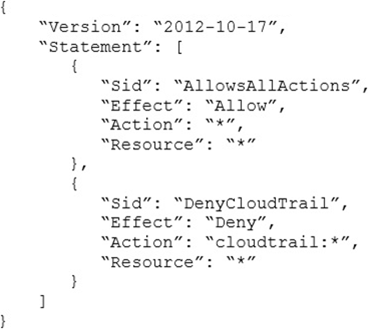
A company with several AWS accounts is using AWS Organizations and service control policies (SCPs). An administrator created the following SCP and has attached it to an organizational unit (OU) that contains AWS account 1111-1111-1111: Developers working in account 1111-1111-1111 complain that they cannot create Amazon S3 buckets. How should the administrator address this problem?

Exhibit 1 for question 57
  • AAdd s3:CreateBucket with “Allow” effect to the SCP.
  • BRemove the account from the OU, and attach the SCP directly to account 1111-1111-1111.
  • CInstruct the developers to add Amazon S3 permissions to their IAM entities. (correct answer)
  • DRemove the SCP from account 1111-1111-1111.
Reveal answer & explanation
Correct answer: C

The correct answer is C. Option C: Instruct the developers to add Amazon S3 permissions to their IAM entities.

Explanation

Amazon S3 provides durable, scalable object storage that is fully managed. AWS IAM controls authenticated and authorized access to AWS resources with fine-grained policies.

Topic 1 · Question 58

A company has a monolithic application that is critical to the company’s business. The company hosts the application on an Amazon EC2 instance that runs Amazon Linux 2. The company’s application team receives a directive from the legal department to back up the data from the instance’s encrypted Amazon Elastic Block Store (Amazon EBS) volume to an Amazon S3 bucket. The application team does not have the administrative SSH key pair for the instance. The application must continue to serve the users. Which solution will meet these requirements?

  • AAttach a role to the instance with permission to write to Amazon S3. Use the AWS Systems Manager Session Manager option to gain access to the instance and run commands to copy data into Amazon S3. (correct answer)
  • BCreate an image of the instance with the reboot option turned on. Launch a new EC2 instance from the image. Attach a role to the new instance with permission to write to Amazon S3. Run a command to copy data into Amazon S3.
  • CTake a snapshot of the EBS volume by using Amazon Data Lifecycle Manager (Amazon DLM). Copy the data to Amazon S3.
  • DCreate an image of the instance. Launch a new EC2 instance from the image. Attach a role to the new instance with permission to write to Amazon S3. Run a command to copy data into Amazon S3.
Reveal answer & explanation
Correct answer: A

The correct answer is A. Option A: Attach a role to the instance with permission to write to Amazon S3. Use the AWS Systems Manager Session Manager option to gain access to the instance and run commands to copy data into Amazon S3.

Explanation

Amazon S3 provides durable, scalable object storage that is fully managed. AWS Systems Manager operates and automates management of fleets of resources.

Topic 1 · Question 59 · Select all that apply

A solutions architect needs to copy data from an Amazon S3 bucket m an AWS account to a new S3 bucket in a new AWS account. The solutions architect must implement a solution that uses the AWS CLI. Which combination of steps will successfully copy the data? (Choose three.)

  • ACreate a bucket policy to allow the source bucket to list its contents and to put objects and set object ACLs in the destination bucket. Attach the bucket policy to the destination bucket.
  • BCreate a bucket policy to allow a user in the destination account to list the source bucket’s contents and read the source bucket’s objects. Attach the bucket policy to the source bucket. (correct answer)
  • CCreate an IAM policy in the source account. Configure the policy to allow a user in the source account to list contents and get objects in the source bucket, and to list contents, put objects, and set object ACLs in the destination bucket. Attach the policy to the user.
  • DCreate an IAM policy in the destination account. Configure the policy to allow a user in the destination account to list contents and get objects in the source bucket, and to list contents, put objects, and set objectACLs in the destination bucket. Attach the policy to the user. (correct answer)
  • ERun the aws s3 sync command as a user in the source account. Specify the source and destination buckets to copy the data.
  • FRun the aws s3 sync command as a user in the destination account. Specify the source and destination buckets to copy the data. (correct answer)
Reveal answer & explanation
Correct answer: B, D, F

The correct answer is B, D, F. Option B: Create a bucket policy to allow a user in the destination account to list the source bucket’s contents and read the source bucket’s objects. Attach the bucket policy to the source bucket. Option D: Create an IAM policy in the destination account. Configure the policy to allow a user in the destination account to list contents and get objects in the source bucket, and to list contents, put objects, and set object... Option F: Run the aws s3 sync command as a user in the destination account. Specify the source and destination buckets to copy the data.

Explanation

Amazon S3 provides durable, scalable object storage that is fully managed. AWS IAM controls authenticated and authorized access to AWS resources with fine-grained policies. AWS Config tracks resource configuration changes and evaluates compliance.

Topic 1 · Question 60

A company built an application based on AWS Lambda deployed in an AWS CloudFormation stack. The last production release of the web application introduced an issue that resulted in an outage lasting several minutes. A solutions architect must adjust the deployment process to support a canary release. Which solution will meet these requirements?

  • ACreate an alias for every new deployed version of the Lambda function. Use the AWS CLI update-alias command with the routing-config parameter to distribute the load. (correct answer)
  • BDeploy the application into a new CloudFormation stack. Use an Amazon Route 53 weighted routing policy to distribute the load.
  • CCreate a version for every new deployed Lambda function. Use the AWS CLI update-function-configuration command with the routing-config parameter to distribute the load.
  • DConfigure AWS CodeDeploy and use CodeDeployDefault.OneAtATime in the Deployment configuration to distribute the load.
Reveal answer & explanation
Correct answer: A

The correct answer is A. Option A: Create an alias for every new deployed version of the Lambda function. Use the AWS CLI update-alias command with the routing-config parameter to distribute the load.

Explanation

AWS Lambda runs code without provisioning servers and scales automatically, which minimizes operational overhead. AWS Config tracks resource configuration changes and evaluates compliance.

Showing questions 4160 of 529 · Page 3 of 27