🔍

SAP-C02 — questions

Page 2 of 27 · 529 total questions.

Topic 1 · Question 21

A company is using an on-premises Active Directory service for user authentication. The company wants to use the same authentication service to sign in to the company’s AWS accounts, which are using AWS Organizations. AWS Site-to-Site VPN connectivity already exists between the on-premises environment and all the company’s AWS accounts. The company’s security policy requires conditional access to the accounts based on user groups and roles. User identities must be managed in a single location. Which solution will meet these requirements?

  • AConfigure AWS IAM Identity Center (AWS Single Sign-On) to connect to Active Directory by using SAML 2.0. Enable automatic provisioning by using the System for Cross-domain Identity Management (SCIM) v2.0 protocol. Grant access to the AWS accounts by using attribute-based access controls (ABACs). (correct answer)
  • BConfigure AWS IAM Identity Center (AWS Single Sign-On) by using IAM Identity Center as an identity source. Enable automatic provisioning by using the System for Cross-domain Identity Management (SCIM) v2.0 protocol. Grant access to the AWS accounts by using IAM Identity Center permission sets.
  • CIn one of the company’s AWS accounts, configure AWS Identity and Access Management (IAM) to use a SAML 2.0 identity provider. Provision IAM users that are mapped to the federated users. Grant access that corresponds to appropriate groups in Active Directory. Grant access to the required AWS accounts by using cross-account IAM users.
  • DIn one of the company’s AWS accounts, configure AWS Identity and Access Management (IAM) to use an OpenID Connect (OIDC) identity provider. Provision IAM roles that grant access to the AWS account for the federated users that correspond to appropriate groups in Active Directory. Grant access to the required AWS accounts by using cross-account IAM roles.
Reveal answer & explanation
Correct answer: A

The correct answer is A. Option A: Configure AWS IAM Identity Center (AWS Single Sign-On) to connect to Active Directory by using SAML 2.0. Enable automatic provisioning by using the System for Cross-domain Identity Management (SCIM) v2.0 protocol. Gra...

Explanation

AWS IAM controls authenticated and authorized access to AWS resources with fine-grained policies. AWS IAM Identity Center (SSO) centrally manages workforce access to multiple accounts and apps. AWS Config tracks resource configuration changes and evaluates compliance.
Topic 1 · Question 22

A software company has deployed an application that consumes a REST API by using Amazon API Gateway, AWS Lambda functions, and an Amazon DynamoDB table. The application is showing an increase in the number of errors during PUT requests. Most of the PUT calls come from a small number of clients that are authenticated with specific API keys. A solutions architect has identified that a large number of the PUT requests originate from one client. The API is noncritical, and clients can tolerate retries of unsuccessful calls. However, the errors are displayed to customers and are causing damage to the API’s reputation. What should the solutions architect recommend to improve the customer experience?

  • AImplement retry logic with exponential backoff and irregular variation in the client application. Ensure that the errors are caught and handled with descriptive error messages.
  • BImplement API throttling through a usage plan at the API Gateway level. Ensure that the client application handles code 429 replies without error. (correct answer)
  • CTurn on API caching to enhance responsiveness for the production stage. Run 10-minute load tests. Verify that the cache capacity is appropriate for the workload.
  • DImplement reserved concurrency at the Lambda function level to provide the resources that are needed during sudden increases in traffic.
Reveal answer & explanation
Correct answer: B

The correct answer is B. Option B: Implement API throttling through a usage plan at the API Gateway level. Ensure that the client application handles code 429 replies without error.

Explanation

Amazon API Gateway is a fully managed front door for creating and securing APIs at scale.

Topic 1 · Question 23

A company is running a data-intensive application on AWS. The application runs on a cluster of hundreds of Amazon EC2 instances. A shared file system also runs on several EC2 instances that store 200 TB of data. The application reads and modifies the data on the shared file system and generates a report. The job runs once monthly, reads a subset of the files from the shared file system, and takes about 72 hours to complete. The compute instances scale in an Auto Scaling group, but the instances that host the shared file system run continuously. The compute and storage instances are all in the same AWS Region. A solutions architect needs to reduce costs by replacing the shared file system instances. The file system must provide high performance access to the needed data for the duration of the 72-hour run. Which solution will provide the LARGEST overall cost reduction while meeting these requirements?

  • AMigrate the data from the existing shared file system to an Amazon S3 bucket that uses the S3 Intelligent-Tiering storage class. Before the job runs each month, use Amazon FSx for Lustre to create a new file system with the data from Amazon S3 by using lazy loading. Use the new file system as the shared storage for the duration of the job. Delete the file system when the job is complete. (correct answer)
  • BMigrate the data from the existing shared file system to a large Amazon Elastic Block Store (Amazon EBS) volume with Multi-Attach enabled. Attach the EBS volume to each of the instances by using a user data script in the Auto Scaling group launch template. Use the EBS volume as the shared storage for the duration of the job. Detach the EBS volume when the job is complete
  • CMigrate the data from the existing shared file system to an Amazon S3 bucket that uses the S3 Standard storage class. Before the job runs each month, use Amazon FSx for Lustre to create a new file system with the data from Amazon S3 by using batch loading. Use the new file system as the shared storage for the duration of the job. Delete the file system when the job is complete.
  • DMigrate the data from the existing shared file system to an Amazon S3 bucket. Before the job runs each month, use AWS Storage Gateway to create a file gateway with the data from Amazon S3. Use the file gateway as the shared storage for the job. Delete the file gateway when the job is complete.
Reveal answer & explanation
Correct answer: A

The correct answer is A. Option A: Migrate the data from the existing shared file system to an Amazon S3 bucket that uses the S3 Intelligent-Tiering storage class. Before the job runs each month, use Amazon FSx for Lustre to create a new file system wi...

Explanation

S3 Intelligent-Tiering automatically moves objects between tiers to optimize cost with no operational effort. Amazon S3 provides durable, scalable object storage that is fully managed. Amazon FSx for Lustre delivers high-performance file storage for compute-intensive workloads. This option delivers the requirement at the lowest cost.

Topic 1 · Question 24

A company is developing a new service that will be accessed using TCP on a static port. A solutions architect must ensure that the service is highly available, has redundancy across Availability Zones, and is accessible using the DNS name my.service.com, which is publicly accessible. The service must use fixed address assignments so other companies can add the addresses to their allow lists. Assuming that resources are deployed in multiple Availability Zones in a single Region, which solution will meet these requirements?

  • ACreate Amazon EC2 instances with an Elastic IP address for each instance. Create a Network Load Balancer (NLB) and expose the static TCP port. Register EC2 instances with the NLB. Create a new name server record set named my.service.com, and assign the Elastic IP addresses of the EC2 instances to the record set. Provide the Elastic IP addresses of the EC2 instances to the other companies to add to their allow lists.
  • BCreate an Amazon ECS cluster and a service definition for the application. Create and assign public IP addresses for the ECS cluster. Create a Network Load Balancer (NLB) and expose the TCP port. Create a target group and assign the ECS cluster name to the NLCreate a new A record set named my.service.com, and assign the public IP addresses of the ECS cluster to the record set. Provide the public IP addresses of the ECS cluster to the other companies to add to their allow lists.
  • CCreate Amazon EC2 instances for the service. Create one Elastic IP address for each Availability Zone. Create a Network Load Balancer (NLB) and expose the assigned TCP port. Assign the Elastic IP addresses to the NLB for each Availability Zone. Create a target group and register the EC2 instances with the NLB. Create a new A (alias) record set named my.service.com, and assign the NLB DNS name to the record set. (correct answer)
  • DCreate an Amazon ECS cluster and a service definition for the application. Create and assign public IP address for each host in the cluster. Create an Application Load Balancer (ALB) and expose the static TCP port. Create a target group and assign the ECS service definition name to the ALB. Create a new CNAME record set and associate the public IP addresses to the record set. Provide the Elastic IP addresses of the Amazon EC2 instances to the other companies to add to their allow lists.
Reveal answer & explanation
Correct answer: C

The correct answer is C. Option C: Create Amazon EC2 instances for the service. Create one Elastic IP address for each Availability Zone. Create a Network Load Balancer (NLB) and expose the assigned TCP port. Assign the Elastic IP addresses to the NLB...

Explanation

Amazon EC2 provides resizable virtual servers when you need full control of the operating system. A Network Load Balancer handles very high throughput TCP/UDP traffic with ultra-low latency and static IPs. A load balancer distributes traffic across targets in multiple AZs for availability and scale. By spanning multiple Availability Zones / adding redundancy, this option provides the high availability and resilience required.

Topic 1 · Question 25

A company uses an on-premises data analytics platform. The system is highly available in a fully redundant configuration across 12 servers in the company’s data center. The system runs scheduled jobs, both hourly and daily, in addition to one-time requests from users. Scheduled jobs can take between 20 minutes and 2 hours to finish running and have tight SLAs. The scheduled jobs account for 65% of the system usage. User jobs typically finish running in less than 5 minutes and have no SLA. The user jobs account for 35% of system usage. During system failures, scheduled jobs must continue to meet SLAs. However, user jobs can be delayed. A solutions architect needs to move the system to Amazon EC2 instances and adopt a consumption-based model to reduce costs with no long-term commitments. The solution must maintain high availability and must not affect the SLAs. Which solution will meet these requirements MOST cost-effectively?

  • ASplit the 12 instances across two Availability Zones in the chosen AWS Region. Run two instances in each Availability Zone as On-Demand Instances with Capacity Reservations. Run four instances in each Availability Zone as Spot Instances.
  • BSplit the 12 instances across three Availability Zones in the chosen AWS Region. In one of the Availability Zones, run all four instances as On-Demand Instances with Capacity Reservations. Run the remaining instances as Spot Instances.
  • CSplit the 12 instances across three Availability Zones in the chosen AWS Region. Run two instances in each Availability Zone as On-Demand Instances with a Savings Plan. Run two instances in each Availability Zone as Spot Instances.
  • DSplit the 12 instances across three Availability Zones in the chosen AWS Region. Run three instances in each Availability Zone as On-Demand Instances with Capacity Reservations. Run one instance in each Availability Zone as a Spot Instance. (correct answer)
Reveal answer & explanation
Correct answer: D

The correct answer is D. Option D: Split the 12 instances across three Availability Zones in the chosen AWS Region. Run three instances in each Availability Zone as On-Demand Instances with Capacity Reservations. Run one instance in each Availability Z... This option delivers the requirement at the lowest cost.

Topic 1 · Question 26

A security engineer determined that an existing application retrieves credentials to an Amazon RDS for MySQL database from an encrypted file in Amazon S3. For the next version of the application, the security engineer wants to implement the following application design changes to improve security: The database must use strong, randomly generated passwords stored in a secure AWS managed service. The application resources must be deployed through AWS CloudFormation. The application must rotate credentials for the database every 90 days. A solutions architect will generate a CloudFormation template to deploy the application. Which resources specified in the CloudFormation template will meet the security engineer’s requirements with the LEAST amount of operational overhead?

  • AGenerate the database password as a secret resource using AWS Secrets Manager. Create an AWS Lambda function resource to rotate the database password. Specify a Secrets Manager RotationSchedule resource to rotate the database password every 90 days. (correct answer)
  • BGenerate the database password as a SecureString parameter type using AWS Systems Manager Parameter Store. Create an AWS Lambda function resource to rotate the database password. Specify a Parameter Store RotationSchedule resource to rotate the database password every 90 days.
  • CGenerate the database password as a secret resource using AWS Secrets Manager. Create an AWS Lambda function resource to rotate the database password. Create an Amazon EventBridge scheduled rule resource to trigger the Lambda function password rotation every 90 days.
  • DGenerate the database password as a SecureString parameter type using AWS Systems Manager Parameter Store. Specify an AWS AppSync DataSource resource to automatically rotate the database password every 90 days.
Reveal answer & explanation
Correct answer: A

The correct answer is A. Option A: Generate the database password as a secret resource using AWS Secrets Manager. Create an AWS Lambda function resource to rotate the database password. Specify a Secrets Manager RotationSchedule resource to rotate the...

Explanation

AWS Lambda runs code without provisioning servers and scales automatically, which minimizes operational overhead. AWS Secrets Manager stores and automatically rotates secrets such as database credentials.

Topic 1 · Question 27 · Select all that apply

A company is storing data in several Amazon DynamoDB tables. A solutions architect must use a serverless architecture to make the data accessible publicly through a simple API over HTTPS. The solution must scale automatically in response to demand. Which solutions meet these requirements? (Choose two.)

  • ACreate an Amazon API Gateway REST API. Configure this API with direct integrations to DynamoDB by using API Gateway’s AWS integration type. (correct answer)
  • BCreate an Amazon API Gateway HTTP API. Configure this API with direct integrations to Dynamo DB by using API Gateway’s AWS integration type.
  • CCreate an Amazon API Gateway HTTP API. Configure this API with integrations to AWS Lambda functions that return data from the DynamoDB tables. (correct answer)
  • DCreate an accelerator in AWS Global Accelerator. Configure this accelerator with AWS Lambda@Edge function integrations that return data from the DynamoDB tables.
  • ECreate a Network Load Balancer. Configure listener rules to forward requests to the appropriate AWS Lambda functions.
Reveal answer & explanation
Correct answer: A, C

The correct answer is A, C. Option A: Create an Amazon API Gateway REST API. Configure this API with direct integrations to DynamoDB by using API Gateway’s AWS integration type. Option C: Create an Amazon API Gateway HTTP API. Configure this API with integrations to AWS Lambda functions that return data from the DynamoDB tables.

Explanation

AWS Lambda runs code without provisioning servers and scales automatically, which minimizes operational overhead. Amazon DynamoDB is a fully managed, serverless NoSQL database with single-digit millisecond latency and automatic scaling. Amazon API Gateway is a fully managed front door for creating and securing APIs at scale.

Topic 1 · Question 28 · Select all that apply

A company has registered 10 new domain names. The company uses the domains for online marketing. The company needs a solution that will redirect online visitors to a specific URL for each domain. All domains and target URLs are defined in a JSON document. All DNS records are managed by Amazon Route 53. A solutions architect must implement a redirect service that accepts HTTP and HTTPS requests. Which combination of steps should the solutions architect take to meet these requirements with the LEAST amount of operational effort? (Choose three.)

  • ACreate a dynamic webpage that runs on an Amazon EC2 instance. Configure the webpage to use the JSON document in combination with the event message to look up and respond with a redirect URL.
  • BCreate an Application Load Balancer that includes HTTP and HTTPS listeners.
  • CCreate an AWS Lambda function that uses the JSON document in combination with the event message to look up and respond with a redirect URL. (correct answer)
  • DUse an Amazon API Gateway API with a custom domain to publish an AWS Lambda function.
  • ECreate an Amazon CloudFront distribution. Deploy a Lambda@Edge function. (correct answer)
  • FCreate an SSL certificate by using AWS Certificate Manager (ACM). Include the domains as Subject Alternative Names. (correct answer)
Reveal answer & explanation
Correct answer: C, E, F

The correct answer is C, E, F. Option C: Create an AWS Lambda function that uses the JSON document in combination with the event message to look up and respond with a redirect URL. Option E: Create an Amazon CloudFront distribution. Deploy a Lambda@Edge function. Option F: Create an SSL certificate by using AWS Certificate Manager (ACM). Include the domains as Subject Alternative Names.

Explanation

AWS Lambda runs code without provisioning servers and scales automatically, which minimizes operational overhead. Amazon CloudFront caches content at edge locations to reduce latency and offload origins. AWS Certificate Manager provisions and renews TLS certificates automatically.

Topic 1 · Question 29

A company that has multiple AWS accounts is using AWS Organizations. The company’s AWS accounts host VPCs, Amazon EC2 instances, and containers. The company’s compliance team has deployed a security tool in each VPC where the company has deployments. The security tools run on EC2 instances and send information to the AWS account that is dedicated for the compliance team. The company has tagged all the compliance-related resources with a key of “costCenter” and a value or “compliance”. The company wants to identify the cost of the security tools that are running on the EC2 instances so that the company can charge the compliance team’s AWS account. The cost calculation must be as accurate as possible. What should a solutions architect do to meet these requirements?

  • AIn the management account of the organization, activate the costCenter user-defined tag. Configure monthly AWS Cost and Usage Reports to save to an Amazon S3 bucket in the management account. Use the tag breakdown in the report to obtain the total cost for the costCenter tagged resources. (correct answer)
  • BIn the member accounts of the organization, activate the costCenter user-defined tag. Configure monthly AWS Cost and Usage Reports to save to an Amazon S3 bucket in the management account. Schedule a monthly AWS Lambda function to retrieve the reports and calculate the total cost for the costCenter tagged resources.
  • CIn the member accounts of the organization activate the costCenter user-defined tag. From the management account, schedule a monthly AWS Cost and Usage Report. Use the tag breakdown in the report to calculate the total cost for the costCenter tagged resources.
  • DCreate a custom report in the organization view in AWS Trusted Advisor. Configure the report to generate a monthly billing summary for the costCenter tagged resources in the compliance team’s AWS account.
Reveal answer & explanation
Correct answer: A

The correct answer is A. Option A: In the management account of the organization, activate the costCenter user-defined tag. Configure monthly AWS Cost and Usage Reports to save to an Amazon S3 bucket in the management account. Use the tag breakdown in...

Explanation

Amazon S3 provides durable, scalable object storage that is fully managed. AWS Config tracks resource configuration changes and evaluates compliance.

Topic 1 · Question 30 · Select all that apply

A company has 50 AWS accounts that are members of an organization in AWS Organizations. Each account contains multiple VPCs. The company wants to use AWS Transit Gateway to establish connectivity between the VPCs in each member account. Each time a new member account is created, the company wants to automate the process of creating a new VPC and a transit gateway attachment. Which combination of steps will meet these requirements? (Choose two.)

  • AFrom the management account, share the transit gateway with member accounts by using AWS Resource Access Manager. (correct answer)
  • BFrom the management account, share the transit gateway with member accounts by using an AWS Organizations SCP.
  • CLaunch an AWS CloudFormation stack set from the management account that automatically creates a new VPC and a VPC transit gateway attachment in a member account. Associate the attachment with the transit gateway in the management account by using the transit gateway ID. (correct answer)
  • DLaunch an AWS CloudFormation stack set from the management account that automatically creates a new VPC and a peering transit gateway attachment in a member account. Share the attachment with the transit gateway in the management account by using a transit gateway service-linked role.
  • EFrom the management account, share the transit gateway with member accounts by using AWS Service Catalog.
Reveal answer & explanation
Correct answer: A, C

The correct answer is A, C. Option A: From the management account, share the transit gateway with member accounts by using AWS Resource Access Manager. Option C: Launch an AWS CloudFormation stack set from the management account that automatically creates a new VPC and a VPC transit gateway attachment in a member account. Associate the attachment with the transit gateway in th...

Explanation

AWS Transit Gateway centrally connects many VPCs and on-premises networks at scale. AWS CloudFormation provisions infrastructure as code repeatably.

Topic 1 · Question 31

An enterprise company wants to allow its developers to purchase third-party software through AWS Marketplace. The company uses an AWS Organizations account structure with full features enabled, and has a shared services account in each organizational unit (OU) that will be used by procurement managers. The procurement team’s policy indicates that developers should be able to obtain third-party software from an approved list only and use Private Marketplace in AWS Marketplace to achieve this requirement. The procurement team wants administration of Private Marketplace to be restricted to a role named procurement-manager-role, which could be assumed by procurement managers. Other IAM users, groups, roles, and account administrators in the company should be denied Private Marketplace administrative access. What is the MOST efficient way to design an architecture to meet these requirements?

  • ACreate an IAM role named procurement-manager-role in all AWS accounts in the organization. Add the PowerUserAccess managed policy to the role. Apply an inline policy to all IAM users and roles in every AWS account to deny permissions on the AWSPrivateMarketplaceAdminFullAccess managed policy.
  • BCreate an IAM role named procurement-manager-role in all AWS accounts in the organization. Add the AdministratorAccess managed policy to the role. Define a permissions boundary with the AWSPrivateMarketplaceAdminFullAccess managed policy and attach it to all the developer roles.
  • CCreate an IAM role named procurement-manager-role in all the shared services accounts in the organization. Add the AWSPrivateMarketplaceAdminFullAccess managed policy to the role. Create an organization root-level SCP to deny permissions to administer Private Marketplace to everyone except the role named procurement-manager-role. Create another organization root-level SCP to deny permissions to create an IAM role named procurement-manager-role to everyone in the organization. (correct answer)
  • DCreate an IAM role named procurement-manager-role in all AWS accounts that will be used by developers. Add the AWSPrivateMarketplaceAdminFullAccess managed policy to the role. Create an SCP in Organizations to deny permissions to administer Private Marketplace to everyone except the role named procurement-manager-role. Apply the SCP to all the shared services accounts in the organization.
Reveal answer & explanation
Correct answer: C

The correct answer is C. Option C: Create an IAM role named procurement-manager-role in all the shared services accounts in the organization. Add the AWSPrivateMarketplaceAdminFullAccess managed policy to the role. Create an organization root-level SCP...

Explanation

An IAM role grants temporary, least-privilege permissions to AWS resources without long-term credentials. AWS IAM controls authenticated and authorized access to AWS resources with fine-grained policies. Service Control Policies set guardrails on what accounts in an organization can do.

Topic 1 · Question 32

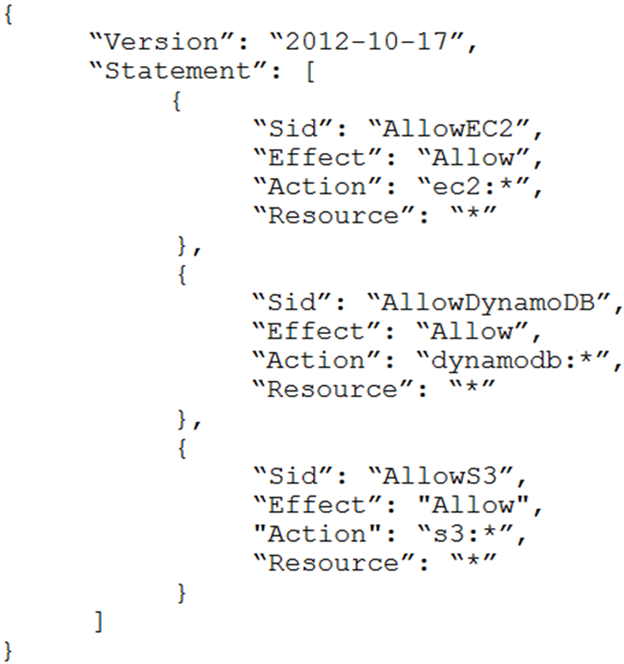
A company is in the process of implementing AWS Organizations to constrain its developers to use only Amazon EC2, Amazon S3, and Amazon DynamoDB. The developers account resides in a dedicated organizational unit (OU). The solutions architect has implemented the following SCP on the developers account: When this policy is deployed, IAM users in the developers account are still able to use AWS services that are not listed in the policy. What should the solutions architect do to eliminate the developers’ ability to use services outside the scope of this policy?

Exhibit 1 for question 32
  • ACreate an explicit deny statement for each AWS service that should be constrained.
  • BRemove the FullAWSAccess SCP from the developers account’s OU. (correct answer)
  • CModify the FullAWSAccess SCP to explicitly deny all services.
  • DAdd an explicit deny statement using a wildcard to the end of the SCP.
Reveal answer & explanation
Correct answer: B

The correct answer is B. Option B: Remove the FullAWSAccess SCP from the developers account’s OU.

Explanation

Service Control Policies set guardrails on what accounts in an organization can do.

Topic 1 · Question 33

A company is hosting a monolithic REST-based API for a mobile app on five Amazon EC2 instances in public subnets of a VPC. Mobile clients connect to the API by using a domain name that is hosted on Amazon Route 53. The company has created a Route 53 multivalue answer routing policy with the IP addresses of all the EC2 instances. Recently, the app has been overwhelmed by large and sudden increases to traffic. The app has not been able to keep up with the traffic. A solutions architect needs to implement a solution so that the app can handle the new and varying load. Which solution will meet these requirements with the LEAST operational overhead?

  • ASeparate the API into individual AWS Lambda functions. Configure an Amazon API Gateway REST API with Lambda integration for the backend. Update the Route 53 record to point to the API Gateway API.
  • BContainerize the API logic. Create an Amazon Elastic Kubernetes Service (Amazon EKS) cluster. Run the containers in the cluster by using Amazon EC2. Create a Kubernetes ingress. Update the Route 53 record to point to the Kubernetes ingress.
  • CCreate an Auto Scaling group. Place all the EC2 instances in the Auto Scaling group. Configure the Auto Scaling group to perform scaling actions that are based on CPU utilization. Create an AWS Lambda function that reacts to Auto Scaling group changes and updates the Route 53 record.
  • DCreate an Application Load Balancer (ALB) in front of the API. Move the EC2 instances to private subnets in the VPC. Add the EC2 instances as targets for the ALB. Update the Route 53 record to point to the ALB. (correct answer)
Reveal answer & explanation
Correct answer: D

The correct answer is D. Option D: Create an Application Load Balancer (ALB) in front of the API. Move the EC2 instances to private subnets in the VPC. Add the EC2 instances as targets for the ALB. Update the Route 53 record to point to the ALB.

Explanation

Amazon EC2 provides resizable virtual servers when you need full control of the operating system. Amazon Route 53 provides DNS with health checks and routing policies for availability and latency. An Application Load Balancer distributes HTTP/HTTPS traffic and supports path/host routing.

Topic 1 · Question 34

A company has created an OU in AWS Organizations for each of its engineering teams. Each OU owns multiple AWS accounts. The organization has hundreds of AWS accounts. A solutions architect must design a solution so that each OU can view a breakdown of usage costs across its AWS accounts. Which solution meets these requirements?

  • ACreate an AWS Cost and Usage Report (CUR) for each OU by using AWS Resource Access Manager. Allow each team to visualize the CUR through an Amazon QuickSight dashboard.
  • BCreate an AWS Cost and Usage Report (CUR) from the AWS Organizations management account. Allow each team to visualize the CUR through an Amazon QuickSight dashboard. (correct answer)
  • CCreate an AWS Cost and Usage Report (CUR) in each AWS Organizations member account. Allow each team to visualize the CUR through an Amazon QuickSight dashboard.
  • DCreate an AWS Cost and Usage Report (CUR) by using AWS Systems Manager. Allow each team to visualize the CUR through Systems Manager OpsCenter dashboards.
Reveal answer & explanation
Correct answer: B

The correct answer is B. Option B: Create an AWS Cost and Usage Report (CUR) from the AWS Organizations management account. Allow each team to visualize the CUR through an Amazon QuickSight dashboard.

Explanation

Amazon QuickSight is a serverless business-intelligence and dashboard service. AWS Organizations centrally governs and secures multiple AWS accounts.

Topic 1 · Question 35

A company is storing data on premises on a Windows file server. The company produces 5 GB of new data daily. The company migrated part of its Windows-based workload to AWS and needs the data to be available on a file system in the cloud. The company already has established an AWS Direct Connect connection between the on-premises network and AWS. Which data migration strategy should the company use?

  • AUse the file gateway option in AWS Storage Gateway to replace the existing Windows file server, and point the existing file share to the new file gateway.
  • BUse AWS DataSync to schedule a daily task to replicate data between the on-premises Windows file server and Amazon FSx. (correct answer)
  • CUse AWS Data Pipeline to schedule a daily task to replicate data between the on-premises Windows file server and Amazon Elastic File System (Amazon EFS).
  • DUse AWS DataSync to schedule a daily task to replicate data between the on-premises Windows file server and Amazon Elastic File System (Amazon EFS).
Reveal answer & explanation
Correct answer: B

The correct answer is B. Option B: Use AWS DataSync to schedule a daily task to replicate data between the on-premises Windows file server and Amazon FSx.

Explanation

Amazon FSx provides fully managed third-party file systems. AWS DataSync automates and accelerates online data transfer to AWS with minimal effort.

Topic 1 · Question 36

A company’s solutions architect is reviewing a web application that runs on AWS. The application references static assets in an Amazon S3 bucket in the us-east-1 Region. The company needs resiliency across multiple AWS Regions. The company already has created an S3 bucket in a second Region. Which solution will meet these requirements with the LEAST operational overhead?

  • AConfigure the application to write each object to both S3 buckets. Set up an Amazon Route 53 public hosted zone with a record set by using a weighted routing policy for each S3 bucket. Configure the application to reference the objects by using the Route 53 DNS name.
  • BCreate an AWS Lambda function to copy objects from the S3 bucket in us-east-1 to the S3 bucket in the second Region. Invoke the Lambda function each time an object is written to the S3 bucket in us-east-1. Set up an Amazon CloudFront distribution with an origin group that contains the two S3 buckets as origins.
  • CConfigure replication on the S3 bucket in us-east-1 to replicate objects to the S3 bucket in the second Region. Set up an Amazon CloudFront distribution with an origin group that contains the two S3 buckets as origins. (correct answer)
  • DConfigure replication on the S3 bucket in us-east-1 to replicate objects to the S3 bucket in the second Region. If failover is required, update the application code to load S3 objects from the S3 bucket in the second Region.
Reveal answer & explanation
Correct answer: C

The correct answer is C. Option C: Configure replication on the S3 bucket in us-east-1 to replicate objects to the S3 bucket in the second Region. Set up an Amazon CloudFront distribution with an origin group that contains the two S3 buckets as origins.

Explanation

Amazon S3 provides durable, scalable object storage that is fully managed. Amazon CloudFront caches content at edge locations to reduce latency and offload origins. AWS Config tracks resource configuration changes and evaluates compliance.

Topic 1 · Question 37

A company is hosting a three-tier web application in an on-premises environment. Due to a recent surge in traffic that resulted in downtime and a significant financial impact, company management has ordered that the application be moved to AWS. The application is written in .NET and has a dependency on a MySQL database. A solutions architect must design a scalable and highly available solution to meet the demand of 200,000 daily users. Which steps should the solutions architect take to design an appropriate solution?

  • AUse AWS Elastic Beanstalk to create a new application with a web server environment and an Amazon RDS MySQL Multi-AZ DB instance. The environment should launch a Network Load Balancer (NLB) in front of an Amazon EC2 Auto Scaling group in multiple Availability Zones. Use an Amazon Route 53 alias record to route traffic from the company’s domain to the NLB.
  • BUse AWS CloudFormation to launch a stack containing an Application Load Balancer (ALB) in front of an Amazon EC2 Auto Scaling group spanning three Availability Zones. The stack should launch a Multi-AZ deployment of an Amazon Aurora MySQL DB cluster with a Retain deletion policy. Use an Amazon Route 53 alias record to route traffic from the company’s domain to the ALB. (correct answer)
  • CUse AWS Elastic Beanstalk to create an automatically scaling web server environment that spans two separate Regions with an Application Load Balancer (ALB) in each Region. Create a Multi-AZ deployment of an Amazon Aurora MySQL DB cluster with a cross-Region read replica. Use Amazon Route 53 with a geoproximity routing policy to route traffic between the two Regions.
  • DUse AWS CloudFormation to launch a stack containing an Application Load Balancer (ALB) in front of an Amazon ECS cluster of Spot instances spanning three Availability Zones. The stack should launch an Amazon RDS MySQL DB instance with a Snapshot deletion policy. Use an Amazon Route 53 alias record to route traffic from the company’s domain to the ALB.
Reveal answer & explanation
Correct answer: B

The correct answer is B. Option B: Use AWS CloudFormation to launch a stack containing an Application Load Balancer (ALB) in front of an Amazon EC2 Auto Scaling group spanning three Availability Zones. The stack should launch a Multi-AZ deployment of a...

Explanation

Auto Scaling adjusts capacity automatically to match demand, improving availability and cost efficiency. Amazon EC2 provides resizable virtual servers when you need full control of the operating system. Amazon Aurora is a high-performance managed relational database with built-in replication and failover. By spanning multiple Availability Zones / adding redundancy, this option provides the high availability and resilience required.

Topic 1 · Question 38

A company is using AWS Organizations to manage multiple AWS accounts. For security purposes, the company requires the creation of an Amazon Simple Notification Service (Amazon SNS) topic that enables integration with a third-party alerting system in all the Organizations member accounts. A solutions architect used an AWS CloudFormation template to create the SNS topic and stack sets to automate the deployment of CloudFormation stacks. Trusted access has been enabled in Organizations. What should the solutions architect do to deploy the CloudFormation StackSets in all AWS accounts?

  • ACreate a stack set in the Organizations member accounts. Use service-managed permissions. Set deployment options to deploy to an organization. Use CloudFormation StackSets drift detection.
  • BCreate stacks in the Organizations member accounts. Use self-service permissions. Set deployment options to deploy to an organization. Enable the CloudFormation StackSets automatic deployment.
  • CCreate a stack set in the Organizations management account. Use service-managed permissions. Set deployment options to deploy to the organization. Enable CloudFormation StackSets automatic deployment. (correct answer)
  • DCreate stacks in the Organizations management account. Use service-managed permissions. Set deployment options to deploy to the organization. Enable CloudFormation StackSets drift detection.
Reveal answer & explanation
Correct answer: C

The correct answer is C. Option C: Create a stack set in the Organizations management account. Use service-managed permissions. Set deployment options to deploy to the organization. Enable CloudFormation StackSets automatic deployment.

Explanation

AWS Organizations centrally governs and secures multiple AWS accounts. AWS CloudFormation provisions infrastructure as code repeatably.

Topic 1 · Question 39 · Select all that apply

A company wants to migrate its workloads from on premises to AWS. The workloads run on Linux and Windows. The company has a large on-premises infrastructure that consists of physical machines and VMs that host numerous applications. The company must capture details about the system configuration, system performance, running processes, and network connections of its on-premises workloads. The company also must divide the on-premises applications into groups for AWS migrations. The company needs recommendations for Amazon EC2 instance types so that the company can run its workloads on AWS in the most cost-effective manner. Which combination of steps should a solutions architect take to meet these requirements? (Choose three.)

  • AAssess the existing applications by installing AWS Application Discovery Agent on the physical machines and VMs. (correct answer)
  • BAssess the existing applications by installing AWS Systems Manager Agent on the physical machines and VMs.
  • CGroup servers into applications for migration by using AWS Systems Manager Application Manager.
  • DGroup servers into applications for migration by using AWS Migration Hub. (correct answer)
  • EGenerate recommended instance types and associated costs by using AWS Migration Hub. (correct answer)
  • FImport data about server sizes into AWS Trusted Advisor. Follow the recommendations for cost optimization.
Reveal answer & explanation
Correct answer: A, D, E

The correct answer is A, D, E. Option A: Assess the existing applications by installing AWS Application Discovery Agent on the physical machines and VMs. Option D: Group servers into applications for migration by using AWS Migration Hub. Option E: Generate recommended instance types and associated costs by using AWS Migration Hub.

Explanation

AWS Migration Hub tracks application migrations across services. This option delivers the requirement at the lowest cost.

Topic 1 · Question 40

A company is hosting an image-processing service on AWS in a VPC. The VPC extends across two Availability Zones. Each Availability Zone contains one public subnet and one private subnet. The service runs on Amazon EC2 instances in the private subnets. An Application Load Balancer in the public subnets is in front of the service. The service needs to communicate with the internet and does so through two NAT gateways. The service uses Amazon S3 for image storage. The EC2 instances retrieve approximately 1 ТВ of data from an S3 bucket each day. The company has promoted the service as highly secure. A solutions architect must reduce cloud expenditures as much as possible without compromising the service’s security posture or increasing the time spent on ongoing operations. Which solution will meet these requirements?

  • AReplace the NAT gateways with NAT instances. In the VPC route table, create a route from the private subnets to the NAT instances.
  • BMove the EC2 instances to the public subnets. Remove the NAT gateways.
  • CSet up an S3 gateway VPC endpoint in the VPAttach an endpoint policy to the endpoint to allow the required actions on the S3 bucket. (correct answer)
  • DAttach an Amazon Elastic File System (Amazon EFS) volume to the EC2 instances. Host the images on the EFS volume.
Reveal answer & explanation
Correct answer: C

The correct answer is C. Option C: Set up an S3 gateway VPC endpoint in the VPAttach an endpoint policy to the endpoint to allow the required actions on the S3 bucket.

Explanation

Amazon S3 provides durable, scalable object storage that is fully managed. A gateway VPC endpoint gives private, no-cost access to Amazon S3 and DynamoDB from within the VPC. A VPC endpoint provides private connectivity to AWS services without traversing the public internet.

Showing questions 2140 of 529 · Page 2 of 27