πŸ”

MLS-C01 β€” questions

Page 8 of 19 Β· 369 total questions.

Topic 1 Β· Question 141

A retail company wants to combine its customer orders with the product description data from its product catalog. The structure and format of the records in each dataset is different. A data analyst tried to use a spreadsheet to combine the datasets, but the effort resulted in duplicate records and records that were not properly combined. The company needs a solution that it can use to combine similar records from the two datasets and remove any duplicates. Which solution will meet these requirements?

  • AUse an AWS Lambda function to process the data. Use two arrays to compare equal strings in the fields from the two datasets and remove any duplicates.
  • BCreate AWS Glue crawlers for reading and populating the AWS Glue Data Catalog. Call the AWS Glue SearchTables API operation to perform a fuzzy- matching search on the two datasets, and cleanse the data accordingly.
  • CCreate AWS Glue crawlers for reading and populating the AWS Glue Data Catalog. Use the FindMatches transform to cleanse the data. (correct answer)
  • DCreate an AWS Lake Formation custom transform. Run a transformation for matching products from the Lake Formation console to cleanse the data automatically.
Reveal answer & explanation
Correct answer: C

The correct answer is C. Option C: Create AWS Glue crawlers for reading and populating the AWS Glue Data Catalog. Use the FindMatches transform to cleanse the data.

Explanation

AWS Glue is a serverless ETL and data-catalog service that prepares and integrates data.
Topic 1 Β· Question 142

A company provisions Amazon SageMaker notebook instances for its data science team and creates Amazon VPC interface endpoints to ensure communication between the VPC and the notebook instances. All connections to the Amazon SageMaker API are contained entirely and securely using the AWS network. However, the data science team realizes that individuals outside the VPC can still connect to the notebook instances across the internet. Which set of actions should the data science team take to fix the issue?

  • AModify the notebook instances' security group to allow traffic only from the CIDR ranges of the VPC. Apply this security group to all of the notebook instances' VPC interfaces.
  • BCreate an IAM policy that allows the sagemaker:CreatePresignedNotebooklnstanceUrl and sagemaker:DescribeNotebooklnstance actions from only the VPC endpoints. Apply this policy to all IAM users, groups, and roles used to access the notebook instances. (correct answer)
  • CAdd a NAT gateway to the VPC. Convert all of the subnets where the Amazon SageMaker notebook instances are hosted to private subnets. Stop and start all of the notebook instances to reassign only private IP addresses.
  • DChange the network ACL of the subnet the notebook is hosted in to restrict access to anyone outside the VPC.
Reveal answer & explanation
Correct answer: B

The correct answer is B. Option B: Create an IAM policy that allows the sagemaker:CreatePresignedNotebooklnstanceUrl and sagemaker:DescribeNotebooklnstance actions from only the VPC endpoints. Apply this policy to all IAM users, groups, and roles used...

Explanation

A VPC endpoint provides private connectivity to AWS services without traversing the public internet. Amazon SageMaker builds, trains and deploys machine learning models in a fully managed service. AWS IAM controls authenticated and authorized access to AWS resources with fine-grained policies.

Topic 1 Β· Question 143

A company will use Amazon SageMaker to train and host a machine learning (ML) model for a marketing campaign. The majority of data is sensitive customer data. The data must be encrypted at rest. The company wants AWS to maintain the root of trust for the master keys and wants encryption key usage to be logged. Which implementation will meet these requirements?

  • AUse encryption keys that are stored in AWS Cloud HSM to encrypt the ML data volumes, and to encrypt the model artifacts and data in Amazon S3.
  • BUse SageMaker built-in transient keys to encrypt the ML data volumes. Enable default encryption for new Amazon Elastic Block Store (Amazon EBS) volumes.
  • CUse customer managed keys in AWS Key Management Service (AWS KMS) to encrypt the ML data volumes, and to encrypt the model artifacts and data in Amazon S3. (correct answer)
  • DUse AWS Security Token Service (AWS STS) to create temporary tokens to encrypt the ML storage volumes, and to encrypt the model artifacts and data in Amazon S3.
Reveal answer & explanation
Correct answer: C

The correct answer is C. Option C: Use customer managed keys in AWS Key Management Service (AWS KMS) to encrypt the ML data volumes, and to encrypt the model artifacts and data in Amazon S3.

Explanation

Amazon S3 provides durable, scalable object storage that is fully managed. AWS KMS manages encryption keys and integrates with most AWS services for encryption at rest.

Topic 1 Β· Question 144

A machine learning specialist stores IoT soil sensor data in Amazon DynamoDB table and stores weather event data as JSON files in Amazon S3. The dataset in DynamoDB is 10 GB in size and the dataset in Amazon S3 is 5 GB in size. The specialist wants to train a model on this data to help predict soil moisture levels as a function of weather events using Amazon SageMaker. Which solution will accomplish the necessary transformation to train the Amazon SageMaker model with the LEAST amount of administrative overhead?

  • ALaunch an Amazon EMR cluster. Create an Apache Hive external table for the DynamoDB table and S3 data. Join the Hive tables and write the results out to Amazon S3.
  • BCrawl the data using AWS Glue crawlers. Write an AWS Glue ETL job that merges the two tables and writes the output to an Amazon Redshift cluster.
  • CEnable Amazon DynamoDB Streams on the sensor table. Write an AWS Lambda function that consumes the stream and appends the results to the existing weather files in Amazon S3.
  • DCrawl the data using AWS Glue crawlers. Write an AWS Glue ETL job that merges the two tables and writes the output in CSV format to Amazon S3. (correct answer)
Reveal answer & explanation
Correct answer: D

The correct answer is D. Option D: Crawl the data using AWS Glue crawlers. Write an AWS Glue ETL job that merges the two tables and writes the output in CSV format to Amazon S3.

Explanation

Amazon S3 provides durable, scalable object storage that is fully managed. AWS Glue is a serverless ETL and data-catalog service that prepares and integrates data.
Topic 1 Β· Question 145

A company sells thousands of products on a public website and wants to automatically identify products with potential durability problems. The company has 1.000 reviews with date, star rating, review text, review summary, and customer email fields, but many reviews are incomplete and have empty fields. Each review has already been labeled with the correct durability result. A machine learning specialist must train a model to identify reviews expressing concerns over product durability. The first model needs to be trained and ready to review in 2 days. What is the MOST direct approach to solve this problem within 2 days?

  • ATrain a custom classifier by using Amazon Comprehend. (correct answer)
  • BBuild a recurrent neural network (RNN) in Amazon SageMaker by using Gluon and Apache MXNet.
  • CTrain a built-in BlazingText model using Word2Vec mode in Amazon SageMaker.
  • DUse a built-in seq2seq model in Amazon SageMaker.
Reveal answer & explanation
Correct answer: A

The correct answer is A. Option A: Train a custom classifier by using Amazon Comprehend.

Explanation

Amazon Comprehend extracts insights and entities from text using NLP.

Topic 1 Β· Question 146

A company that runs an online library is implementing a chatbot using Amazon Lex to provide book recommendations based on category. This intent is fulfilled by an AWS Lambda function that queries an Amazon DynamoDB table for a list of book titles, given a particular category. For testing, there are only three categories implemented as the custom slot types: "comedy," "adventure,` and "documentary.` A machine learning (ML) specialist notices that sometimes the request cannot be fulfilled because Amazon Lex cannot understand the category spoken by users with utterances such as "funny," "fun," and "humor." The ML specialist needs to fix the problem without changing the Lambda code or data in DynamoDB. How should the ML specialist fix the problem?

  • AAdd the unrecognized words in the enumeration values list as new values in the slot type.
  • BCreate a new custom slot type, add the unrecognized words to this slot type as enumeration values, and use this slot type for the slot.
  • CUse the AMAZON.SearchQuery built-in slot types for custom searches in the database.
  • DAdd the unrecognized words as synonyms in the custom slot type. (correct answer)
Reveal answer & explanation
Correct answer: D

The correct answer is D. Option D: Add the unrecognized words as synonyms in the custom slot type.

Explanation

Amazon RDS is a managed relational database that handles patching, backups and failover. This option needs the least custom development effort.

Topic 1 Β· Question 147

A manufacturing company uses machine learning (ML) models to detect quality issues. The models use images that are taken of the company's product at the end of each production step. The company has thousands of machines at the production site that generate one image per second on average. The company ran a successful pilot with a single manufacturing machine. For the pilot, ML specialists used an industrial PC that ran AWS IoT Greengrass with a long-running AWS Lambda function that uploaded the images to Amazon S3. The uploaded images invoked a Lambda function that was written in Python to perform inference by using an Amazon SageMaker endpoint that ran a custom model. The inference results were forwarded back to a web service that was hosted at the production site to prevent faulty products from being shipped. The company scaled the solution out to all manufacturing machines by installing similarly configured industrial PCs on each production machine. However, latency for predictions increased beyond acceptable limits. Analysis shows that the internet connection is at its capacity limit. How can the company resolve this issue MOST cost-effectively?

  • ASet up a 10 Gbps AWS Direct Connect connection between the production site and the nearest AWS Region. Use the Direct Connect connection to upload the images. Increase the size of the instances and the number of instances that are used by the SageMaker endpoint.
  • BExtend the long-running Lambda function that runs on AWS IoT Greengrass to compress the images and upload the compressed files to Amazon S3. Decompress the files by using a separate Lambda function that invokes the existing Lambda function to run the inference pipeline.
  • CUse auto scaling for SageMaker. Set up an AWS Direct Connect connection between the production site and the nearest AWS Region. Use the Direct Connect connection to upload the images.
  • DDeploy the Lambda function and the ML models onto the AWS IoT Greengrass core that is running on the industrial PCs that are installed on each machine. Extend the long-running Lambda function that runs on AWS IoT Greengrass to invoke the Lambda function with the captured images and run the inference on the edge component that forwards the results directly to the web service. (correct answer)
Reveal answer & explanation
Correct answer: D

The correct answer is D. Option D: Deploy the Lambda function and the ML models onto the AWS IoT Greengrass core that is running on the industrial PCs that are installed on each machine. Extend the long-running Lambda function that runs on AWS IoT Gree...

Explanation

AWS Lambda runs code without provisioning servers and scales automatically, which minimizes operational overhead. Amazon RDS is a managed relational database that handles patching, backups and failover. This option delivers the requirement at the lowest cost.

Topic 1 Β· Question 148

A data scientist is using an Amazon SageMaker notebook instance and needs to securely access data stored in a specific Amazon S3 bucket. How should the data scientist accomplish this?

  • AAdd an S3 bucket policy allowing GetObject, PutObject, and ListBucket permissions to the Amazon SageMaker notebook ARN as principal.
  • BEncrypt the objects in the S3 bucket with a custom AWS Key Management Service (AWS KMS) key that only the notebook owner has access to.
  • CAttach the policy to the IAM role associated with the notebook that allows GetObject, PutObject, and ListBucket operations to the specific S3 bucket. (correct answer)
  • DUse a script in a lifecycle configuration to configure the AWS CLI on the instance with an access key ID and secret.
Reveal answer & explanation
Correct answer: C

The correct answer is C. Option C: Attach the policy to the IAM role associated with the notebook that allows GetObject, PutObject, and ListBucket operations to the specific S3 bucket.

Explanation

Amazon S3 provides durable, scalable object storage that is fully managed. An IAM role grants temporary, least-privilege permissions to AWS resources without long-term credentials. AWS IAM controls authenticated and authorized access to AWS resources with fine-grained policies.

Topic 1 Β· Question 149

A company is launching a new product and needs to build a mechanism to monitor comments about the company and its new product on social media. The company needs to be able to evaluate the sentiment expressed in social media posts, and visualize trends and configure alarms based on various thresholds. The company needs to implement this solution quickly, and wants to minimize the infrastructure and data science resources needed to evaluate the messages. The company already has a solution in place to collect posts and store them within an Amazon S3 bucket. What services should the data science team use to deliver this solution?

  • ATrain a model in Amazon SageMaker by using the BlazingText algorithm to detect sentiment in the corpus of social media posts. Expose an endpoint that can be called by AWS Lambda. Trigger a Lambda function when posts are added to the S3 bucket to invoke the endpoint and record the sentiment in an Amazon DynamoDB table and in a custom Amazon CloudWatch metric. Use CloudWatch alarms to notify analysts of trends.
  • BTrain a model in Amazon SageMaker by using the semantic segmentation algorithm to model the semantic content in the corpus of social media posts. Expose an endpoint that can be called by AWS Lambda. Trigger a Lambda function when objects are added to the S3 bucket to invoke the endpoint and record the sentiment in an Amazon DynamoDB table. Schedule a second Lambda function to query recently added records and send an Amazon Simple Notification Service (Amazon SNS) notification to notify analysts of trends.
  • CTrigger an AWS Lambda function when social media posts are added to the S3 bucket. Call Amazon Comprehend for each post to capture the sentiment in the message and record the sentiment in an Amazon DynamoDB table. Schedule a second Lambda function to query recently added records and send an Amazon Simple Notification Service (Amazon SNS) notification to notify analysts of trends.
  • DTrigger an AWS Lambda function when social media posts are added to the S3 bucket. Call Amazon Comprehend for each post to capture the sentiment in the message and record the sentiment in a custom Amazon CloudWatch metric and in S3. Use CloudWatch alarms to notify analysts of trends. (correct answer)
Reveal answer & explanation
Correct answer: D

The correct answer is D. Option D: Trigger an AWS Lambda function when social media posts are added to the S3 bucket. Call Amazon Comprehend for each post to capture the sentiment in the message and record the sentiment in a custom Amazon CloudWatch me...

Explanation

AWS Lambda runs code without provisioning servers and scales automatically, which minimizes operational overhead. Amazon S3 provides durable, scalable object storage that is fully managed. Amazon Comprehend extracts insights and entities from text using NLP.

Topic 1 Β· Question 150

A bank wants to launch a low-rate credit promotion. The bank is located in a town that recently experienced economic hardship. Only some of the bank's customers were affected by the crisis, so the bank's credit team must identify which customers to target with the promotion. However, the credit team wants to make sure that loyal customers' full credit history is considered when the decision is made. The bank's data science team developed a model that classifies account transactions and understands credit eligibility. The data science team used the XGBoost algorithm to train the model. The team used 7 years of bank transaction historical data for training and hyperparameter tuning over the course of several days. The accuracy of the model is sufficient, but the credit team is struggling to explain accurately why the model denies credit to some customers. The credit team has almost no skill in data science. What should the data science team do to address this issue in the MOST operationally efficient manner?

  • AUse Amazon SageMaker Studio to rebuild the model. Create a notebook that uses the XGBoost training container to perform model training. Deploy the model at an endpoint. Enable Amazon SageMaker Model Monitor to store inferences. Use the inferences to create Shapley values that help explain model behavior. Create a chart that shows features and SHapley Additive exPlanations (SHAP) values to explain to the credit team how the features affect the model outcomes.
  • BUse Amazon SageMaker Studio to rebuild the model. Create a notebook that uses the XGBoost training container to perform model training. Activate Amazon SageMaker Debugger, and configure it to calculate and collect Shapley values. Create a chart that shows features and SHapley Additive exPlanations (SHAP) values to explain to the credit team how the features affect the model outcomes. (correct answer)
  • CCreate an Amazon SageMaker notebook instance. Use the notebook instance and the XGBoost library to locally retrain the model. Use the plot_importance() method in the Python XGBoost interface to create a feature importance chart. Use that chart to explain to the credit team how the features affect the model outcomes.
  • DUse Amazon SageMaker Studio to rebuild the model. Create a notebook that uses the XGBoost training container to perform model training. Deploy the model at an endpoint. Use Amazon SageMaker Processing to post-analyze the model and create a feature importance explainability chart automatically for the credit team.
Reveal answer & explanation
Correct answer: B

The correct answer is B. Option B: Use Amazon SageMaker Studio to rebuild the model. Create a notebook that uses the XGBoost training container to perform model training. Activate Amazon SageMaker Debugger, and configure it to calculate and collect Sha...

Explanation

Amazon SageMaker builds, trains and deploys machine learning models in a fully managed service. AWS Config tracks resource configuration changes and evaluates compliance.

Topic 1 Β· Question 151

A data science team is planning to build a natural language processing (NLP) application. The application's text preprocessing stage will include part-of-speech tagging and key phase extraction. The preprocessed text will be input to a custom classification algorithm that the data science team has already written and trained using Apache MXNet. Which solution can the team build MOST quickly to meet these requirements?

  • AUse Amazon Comprehend for the part-of-speech tagging, key phase extraction, and classification tasks.
  • BUse an NLP library in Amazon SageMaker for the part-of-speech tagging. Use Amazon Comprehend for the key phase extraction. Use AWS Deep Learning Containers with Amazon SageMaker to build the custom classifier.
  • CUse Amazon Comprehend for the part-of-speech tagging and key phase extraction tasks. Use Amazon SageMaker built-in Latent Dirichlet Allocation (LDA) algorithm to build the custom classifier.
  • DUse Amazon Comprehend for the part-of-speech tagging and key phase extraction tasks. Use AWS Deep Learning Containers with Amazon SageMaker to build the custom classifier. (correct answer)
Reveal answer & explanation
Correct answer: D

The correct answer is D. Option D: Use Amazon Comprehend for the part-of-speech tagging and key phase extraction tasks. Use AWS Deep Learning Containers with Amazon SageMaker to build the custom classifier.

Explanation

Amazon SageMaker builds, trains and deploys machine learning models in a fully managed service. Amazon Comprehend extracts insights and entities from text using NLP.

Topic 1 Β· Question 152

A machine learning (ML) specialist must develop a classification model for a financial services company. A domain expert provides the dataset, which is tabular with 10,000 rows and 1,020 features. During exploratory data analysis, the specialist finds no missing values and a small percentage of duplicate rows. There are correlation scores of > 0.9 for 200 feature pairs. The mean value of each feature is similar to its 50th percentile. Which feature engineering strategy should the ML specialist use with Amazon SageMaker?

  • AApply dimensionality reduction by using the principal component analysis (PCA) algorithm. (correct answer)
  • BDrop the features with low correlation scores by using a Jupyter notebook.
  • CApply anomaly detection by using the Random Cut Forest (RCF) algorithm.
  • DConcatenate the features with high correlation scores by using a Jupyter notebook.
Reveal answer & explanation
Correct answer: A

The correct answer is A. Option A: Apply dimensionality reduction by using the principal component analysis (PCA) algorithm.

Topic 1 Β· Question 153

A manufacturing company asks its machine learning specialist to develop a model that classifies defective parts into one of eight defect types. The company has provided roughly 100,000 images per defect type for training. During the initial training of the image classification model, the specialist notices that the validation accuracy is 80%, while the training accuracy is 90%. It is known that human-level performance for this type of image classification is around 90%. What should the specialist consider to fix this issue?

  • AA longer training time
  • BMaking the network larger
  • CUsing a different optimizer
  • DUsing some form of regularization (correct answer)
Reveal answer & explanation
Correct answer: D

The correct answer is D. Option D: Using some form of regularization.

Topic 1 Β· Question 154

A machine learning specialist needs to analyze comments on a news website with users across the globe. The specialist must find the most discussed topics in the comments that are in either English or Spanish. What steps could be used to accomplish this task? (Choose two.)

  • AUse an Amazon SageMaker BlazingText algorithm to find the topics independently from language. Proceed with the analysis.
  • BUse an Amazon SageMaker seq2seq algorithm to translate from Spanish to English, if necessary. Use a SageMaker Latent Dirichlet Allocation (LDA) algorithm to find the topics.
  • CUse Amazon Translate to translate from Spanish to English, if necessary. Use Amazon Comprehend topic modeling to find the topics. (correct answer)
  • DUse Amazon Translate to translate from Spanish to English, if necessary. Use Amazon Lex to extract topics form the content.
  • EUse Amazon Translate to translate from Spanish to English, if necessary. Use Amazon SageMaker Neural Topic Model (NTM) to find the topics.
Reveal answer & explanation
Correct answer: C

The correct answer is C. Option C: Use Amazon Translate to translate from Spanish to English, if necessary. Use Amazon Comprehend topic modeling to find the topics.

Explanation

Amazon Comprehend extracts insights and entities from text using NLP. Amazon Translate provides neural machine translation.

Topic 1 Β· Question 155

A machine learning (ML) specialist is administering a production Amazon SageMaker endpoint with model monitoring configured. Amazon SageMaker Model Monitor detects violations on the SageMaker endpoint, so the ML specialist retrains the model with the latest dataset. This dataset is statistically representative of the current production traffic. The ML specialist notices that even after deploying the new SageMaker model and running the first monitoring job, the SageMaker endpoint still has violations. What should the ML specialist do to resolve the violations?

  • AManually trigger the monitoring job to re-evaluate the SageMaker endpoint traffic sample.
  • BRun the Model Monitor baseline job again on the new training set. Configure Model Monitor to use the new baseline. (correct answer)
  • CDelete the endpoint and recreate it with the original configuration.
  • DRetrain the model again by using a combination of the original training set and the new training set.
Reveal answer & explanation
Correct answer: B

The correct answer is B. Option B: Run the Model Monitor baseline job again on the new training set. Configure Model Monitor to use the new baseline.

Explanation

AWS Config tracks resource configuration changes and evaluates compliance.

Topic 1 Β· Question 156 Β· Select all that apply

A company supplies wholesale clothing to thousands of retail stores. A data scientist must create a model that predicts the daily sales volume for each item for each store. The data scientist discovers that more than half of the stores have been in business for less than 6 months. Sales data is highly consistent from week to week. Daily data from the database has been aggregated weekly, and weeks with no sales are omitted from the current dataset. Five years (100 MB) of sales data is available in Amazon S3. Which factors will adversely impact the performance of the forecast model to be developed, and which actions should the data scientist take to mitigate them? (Choose two.)

  • ADetecting seasonality for the majority of stores will be an issue. Request categorical data to relate new stores with similar stores that have more historical data. (correct answer)
  • BThe sales data does not have enough variance. Request external sales data from other industries to improve the model's ability to generalize.
  • CSales data is aggregated by week. Request daily sales data from the source database to enable building a daily model. (correct answer)
  • DThe sales data is missing zero entries for item sales. Request that item sales data from the source database include zero entries to enable building the model.
  • EOnly 100 MB of sales data is available in Amazon S3. Request 10 years of sales data, which would provide 200 MB of training data for the model.
Reveal answer & explanation
Correct answer: A, C

The correct answer is A, C. Option A: Detecting seasonality for the majority of stores will be an issue. Request categorical data to relate new stores with similar stores that have more historical data. Option C: Sales data is aggregated by week. Request daily sales data from the source database to enable building a daily model.

Topic 1 Β· Question 157 Β· Select all that apply

An ecommerce company is automating the categorization of its products based on images. A data scientist has trained a computer vision model using the Amazon SageMaker image classification algorithm. The images for each product are classified according to specific product lines. The accuracy of the model is too low when categorizing new products. All of the product images have the same dimensions and are stored within an Amazon S3 bucket. The company wants to improve the model so it can be used for new products as soon as possible. Which steps would improve the accuracy of the solution? (Choose three.)

  • AUse the SageMaker semantic segmentation algorithm to train a new model to achieve improved accuracy.
  • BUse the Amazon Rekognition DetectLabels API to classify the products in the dataset.
  • CAugment the images in the dataset. Use open source libraries to crop, resize, flip, rotate, and adjust the brightness and contrast of the images. (correct answer)
  • DUse a SageMaker notebook to implement the normalization of pixels and scaling of the images. Store the new dataset in Amazon S3. (correct answer)
  • EUse Amazon Rekognition Custom Labels to train a new model.
  • FCheck whether there are class imbalances in the product categories, and apply oversampling or undersampling as required. Store the new dataset in Amazon S3. (correct answer)
Reveal answer & explanation
Correct answer: C, D, F

The correct answer is C, D, F. Option C: Augment the images in the dataset. Use open source libraries to crop, resize, flip, rotate, and adjust the brightness and contrast of the images. Option D: Use a SageMaker notebook to implement the normalization of pixels and scaling of the images. Store the new dataset in Amazon S3. Option F: Check whether there are class imbalances in the product categories, and apply oversampling or undersampling as required. Store the new dataset in Amazon S3.

Explanation

Amazon S3 provides durable, scalable object storage that is fully managed. Amazon SageMaker builds, trains and deploys machine learning models in a fully managed service.

Topic 1 Β· Question 158

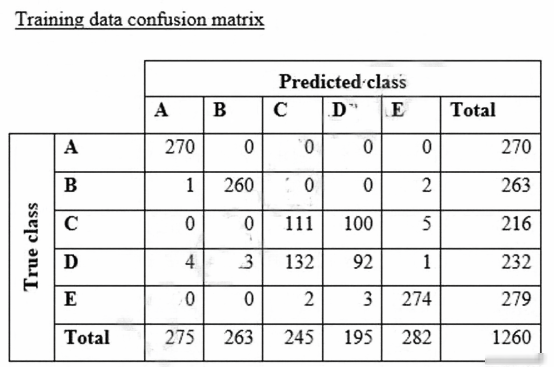
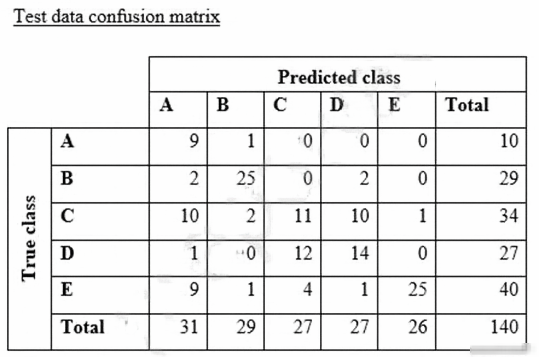
A data scientist is training a text classification model by using the Amazon SageMaker built-in BlazingText algorithm. There are 5 classes in the dataset, with 300 samples for category A, 292 samples for category B, 240 samples for category C, 258 samples for category D, and 310 samples for category E. The data scientist shuffles the data and splits off 10% for testing. After training the model, the data scientist generates confusion matrices for the training and test sets. What could the data scientist conclude form these results?

Exhibit 1 for question 158Exhibit 2 for question 158
  • AClasses C and D are too similar. (correct answer)
  • BThe dataset is too small for holdout cross-validation.
  • CThe data distribution is skewed.
  • DThe model is overfitting for classes B and E.
Reveal answer & explanation
Correct answer: A

The correct answer is A. Option A: Classes C and D are too similar.

Topic 1 Β· Question 159 Β· Select all that apply

A company that manufactures mobile devices wants to determine and calibrate the appropriate sales price for its devices. The company is collecting the relevant data and is determining data features that it can use to train machine learning (ML) models. There are more than 1,000 features, and the company wants to determine the primary features that contribute to the sales price. Which techniques should the company use for feature selection? (Choose three.)

  • AData scaling with standardization and normalization
  • BCorrelation plot with heat maps (correct answer)
  • CData binning
  • DUnivariate selection (correct answer)
  • EFeature importance with a tree-based classifier (correct answer)
  • FData augmentation
Reveal answer & explanation
Correct answer: B, D, E

The correct answer is B, D, E. Option B: Correlation plot with heat maps Option D: Univariate selection Option E: Feature importance with a tree-based classifier.

Topic 1 Β· Question 160

A power company wants to forecast future energy consumption for its customers in residential properties and commercial business properties. Historical power consumption data for the last 10 years is available. A team of data scientists who performed the initial data analysis and feature selection will include the historical power consumption data and data such as weather, number of individuals on the property, and public holidays. The data scientists are using Amazon Forecast to generate the forecasts. Which algorithm in Forecast should the data scientists use to meet these requirements?

  • AAutoregressive Integrated Moving Average (AIRMA)
  • BExponential Smoothing (ETS)
  • CConvolutional Neural Network - Quantile Regression (CNN-QR) (correct answer)
  • DProphet
Reveal answer & explanation
Correct answer: C

The correct answer is C. Option C: Convolutional Neural Network - Quantile Regression (CNN-QR).

Showing questions 141–160 of 369 Β· Page 8 of 19