πŸ”

SOA-C02 β€” questions

Page 21 of 24 Β· 477 total questions.

Topic 1 Β· Question 401

A company hosts a continuous integration and continuous delivery (CI/CD) environment on AWS. The CI/CD environment includes a Jenkins server that is hosted on an Amazon EC2 instance. A 500 GB General Purpose SSD (gp2) Amazon Elastic Block Store (Amazon EBS) volume is attached to the EC2 instance. Because of disk throughput limitations, the Jenkins server reports performance issues that are resulting in slower builds on the server. The EBS volume needs to sustain 3,000 IOPS while performing nightly build tasks. A SysOps administrator examines the server's history in Amazon CloudWatch. The BurstBalance metric has had a value of 0 during nightly builds. The SysOps administrator needs to improve the performance and meet the sustained throughput requirements. Which solution will meet these requirements MOST cost-effectively?

  • ADouble the gp2 EBS volume size from 500 GB to 1,000 GB.
  • BChange the volume type from gp2 to General Purpose SSD (gp3). (correct answer)
  • CChange the volume type from gp2 to Throughput Optimized HDD (st1).
  • DChange the volume type from gp2 to Provisioned IOPS SSD (io2).
Reveal answer & explanation
Correct answer: B

The correct answer is B. Option B: Change the volume type from gp2 to General Purpose SSD (gp3). This option delivers the requirement at the lowest cost.
Topic 1 Β· Question 402

A company is running an application on a group of Amazon EC2 instances behind an Application Load Balancer. The EC2 instances run across three Availability Zones. The company needs to provide the customers with a maximum of two static IP addresses for their applications. How should a SysOps administrator meet these requirement?

  • AAdd AWS Global Accelerator in front of the Application Load Balancer. (correct answer)
  • BAdd an internal Network Load Balancer behind the Application Load Balancer.
  • CConfigure the Application Load Balancer in only two Availability Zones.
  • DCreate two Elastic IP addresses and assign them to the Application Load Balancer.
Reveal answer & explanation
Correct answer: A

The correct answer is A. Option A: Add AWS Global Accelerator in front of the Application Load Balancer.

Explanation

AWS Global Accelerator routes users over the AWS backbone to the optimal endpoint for lower latency and fast failover. An Application Load Balancer distributes HTTP/HTTPS traffic and supports path/host routing. A load balancer distributes traffic across targets in multiple AZs for availability and scale.

Topic 1 Β· Question 403

A SysOps administrator receives an alert that a production Auto Scaling group has been scaled down to two Amazon EC2 instances. The Auto Scaling group was originally configured with a minimum capacity of three instances. However, the SysOps administrator confirms that the configuration now reflects a minimum capacity of two instances. Which AWS service will help identify who made the change?

  • AAWS Config (correct answer)
  • BAmazon Inspector
  • CAmazon Macie
  • DAmazon Cloud Watch Logs
Reveal answer & explanation
Correct answer: A

The correct answer is A. Option A: AWS Config

Explanation

AWS Config tracks resource configuration changes and evaluates compliance.

Topic 1 Β· Question 404

A company wants to store sensitive financial data within Amazon S3 buckets. The company has a corporate policy that does not allow public read or write access to the buckets. A SysOps administrator must create a solution to automatically remove S3 permissions that allow public read or write access. Which AWS service should the SysOps administrator use to meet these requirements in the MOST operationally efficient manner?

  • AAWS Config (correct answer)
  • BAWS Security Hub
  • CAWS Trusted Advisor
  • DAmazon Inspector
Reveal answer & explanation
Correct answer: A

The correct answer is A. Option A: AWS Config

Explanation

AWS Config tracks resource configuration changes and evaluates compliance.

Topic 1 Β· Question 405

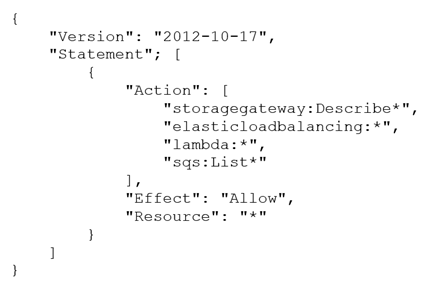
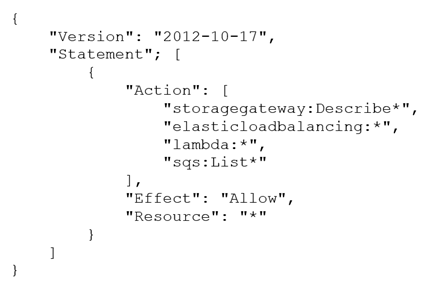
A SysOps administrator must create an IAM policy for a developer who needs access to specific AWS services. Based on the requirements, the SysOps administrator creates the following policy: Which actions does this policy allow? (Choose two.)

Exhibit 1 for question 405
  • ACreate an AWS Storage Gateway.
  • BCreate an IAM role for an AWS Lambda function.
  • CDelete an Amazon Simple Queue Service (Amazon SQS) queue.
  • DDescribe AWS load balancers.
  • EInvoke an AWS Lambda function. (correct answer)
Reveal answer & explanation
Correct answer: E

The correct answer is E. Option E: Invoke an AWS Lambda function.

Explanation

AWS Lambda runs code without provisioning servers and scales automatically, which minimizes operational overhead.

Topic 1 Β· Question 406

A SysOps administrator is re-architecting an application. The SysOps administrator has moved the database from a public subnet, where the database used a public endpoint, into a private subnet to restrict access from the public network. After this change, an AWS Lambda function that requires read access to the database cannot connect to the database. The SysOps administrator must resolve this issue without compromising security. Which solution meets these requirements?

Exhibit 1 for question 406
  • ACreate an AWS PrivateLink interface endpoint for the Lambda function. Connect to the database using its private endpoint. (correct answer)
  • BConnect the Lambda function to the database VPC. Connect to the database using its private endpoint.
  • CAttach an IAM role to the Lambda function with read permissions to the database.
  • DMove the database to a public subnet. Use security groups for secure access.
Reveal answer & explanation
Correct answer: A

The correct answer is A. Option A: Create an AWS PrivateLink interface endpoint for the Lambda function. Connect to the database using its private endpoint.

Explanation

AWS Lambda runs code without provisioning servers and scales automatically, which minimizes operational overhead. AWS PrivateLink exposes services privately inside the VPC without internet exposure.

Topic 1 Β· Question 407 Β· Select all that apply

Users are reporting consistent forced logouts from a stateful web application. The logouts occur before the expiration of a 15-minute application logout timer. The web application is hosted on Amazon EC2 instances that are in an Auto Scaling group. The instances run behind an Application Load Balancer (ALB) that has a single target group. The ALB is configured as the origin in an Amazon CloudFront distribution. Session affinity (sticky sessions) is already enabled on the ALB target group and uses duration-based cookies. The web application generates its own application cookie. Which combination of actions should a SysOps administrator take to resolve the logout problem? (Choose two.)

  • AChange to the least outstanding requests algorithm on the ALB target group.
  • BConfigure cookie forwarding in the CloudFront distribution's cache behavior settings. (correct answer)
  • CConfigure the duration-based cookie to be named AWSALB.
  • DConfigure the ALB to use the expiration cookie header.
  • EChange the ALB to use application-based cookies. (correct answer)
Reveal answer & explanation
Correct answer: B, E

The correct answer is B, E. Option B: Configure cookie forwarding in the CloudFront distribution's cache behavior settings. Option E: Change the ALB to use application-based cookies.

Explanation

Amazon CloudFront caches content at edge locations to reduce latency and offload origins. AWS Config tracks resource configuration changes and evaluates compliance.

Topic 1 Β· Question 408

A company's social media application has strict data residency requirements. The company wants to use Amazon Route 53 to provide the application with DNS services. A SysOps administrator must implement a solution that routes requests to a defined list of AWS Regions. The routing must be based on the user's location. Which solution will meet these requirements?

  • AConfigure a Route 53 latency routing policy.
  • BConfigure a Route 53 multivalue answer routing policy.
  • CConfigure a Route 53 geolocation routing policy. (correct answer)
  • DConfigure a Route 53 IP-based routing policy.
Reveal answer & explanation
Correct answer: C

The correct answer is C. Option C: Configure a Route 53 geolocation routing policy.

Explanation

Amazon Route 53 provides DNS with health checks and routing policies for availability and latency. AWS Config tracks resource configuration changes and evaluates compliance.

Topic 1 Β· Question 409

A company has a cluster of Linux Amazon EC2 Spot Instances that read many files from and write many files to attached Amazon Elastic Block Store (Amazon EBS) volumes. The EC2 instances are frequently started and stopped. As part of the process when an EC2 instance starts, an EBS volume is restored from a snapshot. EBS volumes that are restored from snapshots are experiencing initial performance that is lower than expected. The company's workload needs almost all the provisioned IOPS on the attached EBS volumes. The EC2 instances are unable to support the workload when the performance of the EBS volumes is too low. A SysOps administrator must implement a solution to ensure that the EBS volumes provide the expected performance when they are restored from snapshots. Which solution will meet these requirements?

  • AConfigure fast snapshot restore (FSR) on the snapshots that are used. (correct answer)
  • BRestore each snapshot onto an unencrypted EBS volume. Encrypt the EBS volume when the performance stabilizes.
  • CFormat the EBS volumes as XFS file systems before restoring the snapshots.
  • DIncrease the Linux read-ahead buffer to 1 MiB.
Reveal answer & explanation
Correct answer: A

The correct answer is A. Option A: Configure fast snapshot restore (FSR) on the snapshots that are used.

Explanation

AWS Config tracks resource configuration changes and evaluates compliance.

Topic 1 Β· Question 410

A company recently deployed an application in production. The production environment currently runs on a single Amazon EC2 instance that hosts the application's web application and a MariaDB database. Company policy states that all IT production environments must be highly available. What should a SysOps administrator do to meet this requirement?

  • AMigrate the database from the EC2 instance to an Amazon RDS for MariaDB Multi-AZ DB instance. Run the application on EC2 instances that are in an Auto Scaling group that extends across multiple Availability Zones. Place the EC2 instances behind a load balancer. (correct answer)
  • BMigrate the database from the EC2 instance to an Amazon RDS for MariaDB Multi-AZ DB instance. Use AWS Application Migration Service to convert the application into an AWS Lambda function. Specify the Multi-AZ option for the Lambda function.
  • CCopy the database to a different EC2 instance in a different Availability Zone. Use AWS Backup to create Amazon Machine Images (AMIs) of the application EC2 instance and the database EC2 instance. Create an AWS Lambda function that performs health checks every minute. In case of failure, configure the Lambda function to launch a new EC2 instance from the AMIs that AWS Backup created.
  • DMigrate the database to a different EC2 instance. Place the application EC2 instance in an Auto Scaling group that extends across multiple Availability Zones. Create an Amazon Machine Image (AMI) from the database EC2 instance. Use the AMI to launch a second database EC2 instance in a different Availability Zone. Put the second database EC2 instance in the stopped state. Use the second database EC2 instance as a standby.
Reveal answer & explanation
Correct answer: A

The correct answer is A. Option A: Migrate the database from the EC2 instance to an Amazon RDS for MariaDB Multi-AZ DB instance. Run the application on EC2 instances that are in an Auto Scaling group that extends across multiple Availability Zones. Pla...

Explanation

Auto Scaling adjusts capacity automatically to match demand, improving availability and cost efficiency. Amazon EC2 provides resizable virtual servers when you need full control of the operating system. Amazon RDS is a managed relational database that handles patching, backups and failover. By spanning multiple Availability Zones / adding redundancy, this option provides the high availability and resilience required.

Topic 1 Β· Question 411

A company is running workloads on premises and on AWS. A SysOps administrator needs to automate tasks across all servers on premises by using AWS services. The SysOps administrator must not install long-term credentials on the on-premises servers. What should the SysOps administrator do to meet these requirements?

  • ACreate an IAM role and instance profile that include AWS Systems Manager permissions. Attach the role to the on-premises servers.
  • BCreate a managed-instance activation in AWS Systems Manager. Install the Systems Manager Agent (SSM Agent) on the on-premises servers. Register the servers with the activation code and ID from the instance activation. (correct answer)
  • CCreate an AWS managed IAM policy that includes the appropriate AWS Systems Manager permissions. Download the IAM policy to the on-premises servers.
  • DCreate an IAM user and an access key. Log on to the on-premises servers and install the AWS CLI. Configure the access key in the AWS credentials file after the AWS CLI is successfully installed.
Reveal answer & explanation
Correct answer: B

The correct answer is B. Option B: Create a managed-instance activation in AWS Systems Manager. Install the Systems Manager Agent (SSM Agent) on the on-premises servers. Register the servers with the activation code and ID from the instance activation.

Explanation

AWS Systems Manager operates and automates management of fleets of resources.

Topic 1 Β· Question 412

A company has deployed an application on AWS. The application runs on a fleet of Linux Amazon EC2 instances that are in an Auto Scaling group. The Auto Scaling group is configured to use launch templates. The launch templates launch Amazon Elastic Block Store (Amazon EBS) backed EC2 instances that use General Purpose SSD (gp3) EBS volumes for primary storage. A SysOps administrator needs to implement a solution to ensure that all the EC2 instances can share the same underlying files. The solution also must ensure that the data is consistent. Which solution will meet these requirements?

  • ACreate an Amazon Elastic File System (Amazon EFS) file system. Create a new launch template version that includes user data that mounts the EFS file system. Update the Auto Scaling group to use the new launch template version to cycle in newer EC2 instances and to terminate the older EC2 instances. (correct answer)
  • BEnable Multi-Attach on the EBS volumes. Create a new launch template version that includes user data that mounts the EBS volume. Update the Auto Scaling group to use the new template version to cycle in newer EC2 instances and to terminate the older EC2 instances.
  • CCreate a cron job that synchronizes the data between the EBS volumes for all the EC2 instances in the Auto Scaling group. Create a lifecycle hook during instance launch to configure the cron job on all the EC2 instances. Rotate out the older EC2 instances.
  • DCreate a new launch template version that creates an Amazon Elastic File System (Amazon EFS) file system. Update the Auto Scaling group to use the new template version to cycle in newer EC2 instances and to terminate the older EC2 instances.
Reveal answer & explanation
Correct answer: A

The correct answer is A. Option A: Create an Amazon Elastic File System (Amazon EFS) file system. Create a new launch template version that includes user data that mounts the EFS file system. Update the Auto Scaling group to use the new launch template...

Explanation

Auto Scaling adjusts capacity automatically to match demand, improving availability and cost efficiency. Amazon EC2 provides resizable virtual servers when you need full control of the operating system. Amazon EFS is a shared, elastic NFS file system that multiple instances can mount concurrently across AZs.

Topic 1 Β· Question 413

A company has 50 AWS accounts and wants to create an identical Amazon VPC in each account. Any changes the company makes to the VPCs in the future must be implemented on every VPC. What is the MOST operationally efficient method to deploy and update the VPCs in each account?

  • ACreate an AWS CloudFormation template that defines the VPC. Sign in to the AWS Management Console under each account. Create a stack from the template.
  • BCreate a shell script that configures the VPC using the AWS CLI. Provide a list of accounts to the shell script from a text file. Create the VPC in every account in the list.
  • CCreate an AWS Lambda function that configures the VPStore the account information in Amazon DynamoDB. Grant Lambda access to the DynamoDB table. Create the VPC in every account in the list.
  • DCreate an AWS CloudFormation template that defines the VPC. Create an AWS CloudFormation StackSet based on the template. Deploy the template to all accounts using the stack set. (correct answer)
Reveal answer & explanation
Correct answer: D

The correct answer is D. Option D: Create an AWS CloudFormation template that defines the VPC. Create an AWS CloudFormation StackSet based on the template. Deploy the template to all accounts using the stack set.

Explanation

AWS CloudFormation provisions infrastructure as code repeatably.

Topic 1 Β· Question 414

A company hosts a web application on an Amazon EC2 instance in a production VPC. Client connections to the application are failing. A SysOps administrator inspects the VPC flow logs and finds the following entry: What is a possible cause of these failed connections?

Exhibit 1 for question 414
  • AA security group deny rule is blocking traffic on port 443.
  • BThe EC2 instance is shut down.
  • CThe network ACL is blocking HTTPS traffic. (correct answer)
  • DThe VPC has no internet gateway attached.
Reveal answer & explanation
Correct answer: C

The correct answer is C. Option C: The network ACL is blocking HTTPS traffic.

Topic 1 Β· Question 415

A media company hosts a public news and video portal on AWS. The portal uses an Amazon DynamoDB table with provisioned capacity to maintain an index of video files that are stored in an Amazon S3 bucket. During a recent event, millions of visitors came to the portal for news. This increase in traffic caused read requests to be throttled in the DynamoDB table. Videos could not be displayed in the portal. The company's operations team manually increased the provisioned capacity on a temporary basis to meet the demand. The company wants the operations team to receive an alert before the table is throttled in the future. The company has created an Amazon Simple Notification Service (Amazon SNS) topic and has subscribed the operations team's email address to the SNS topic. What should the company do next to meet these requirements?

Exhibit 1 for question 415
  • ACreate an Amazon CloudWatch alarm that uses the ConsumedReadCapacityUnits metric. Set the alarm threshold to a value that is close to the DynamoDB table's provisioned capacity. Configure the alarm to publish notifications to the SNS topic. (correct answer)
  • BTurn on auto scaling on the DynamoDB table. Configure an Amazon EventBridge rule to publish notifications to the SNS topic during scaling events.
  • CTurn on Amazon CloudWatch Logs for the DynamoDB table. Create an Amazon CloudWatch metric filter to pattern match the THROTTLING_EXCEPTION status code from DynamoDB. Create a CloudWatch alarm for the metric. Select the SNS topic for notifications.
  • DConfigure the application to store logs in Amazon CloudWatch Logs. Create an Amazon CloudWatch metric filter to pattern match the THROTTLING_EXCEPTION status code from DynamoDB. Create a CloudWatch alarm for the metric. Select the SNS topic for notifications.
Reveal answer & explanation
Correct answer: A

The correct answer is A. Option A: Create an Amazon CloudWatch alarm that uses the ConsumedReadCapacityUnits metric. Set the alarm threshold to a value that is close to the DynamoDB table's provisioned capacity. Configure the alarm to publish notificat...

Explanation

Amazon DynamoDB is a fully managed, serverless NoSQL database with single-digit millisecond latency and automatic scaling. Amazon SNS is a managed pub/sub service for fan-out notifications to many subscribers. Amazon CloudWatch collects metrics, logs and alarms to monitor and react to operational health.

Topic 1 Β· Question 416

A company runs its web application on multiple Amazon EC2 instances that are part of an Auto Scaling group. The company wants the Auto Scaling group to scale out as soon as CPU utilization rises above 50% for the instances. How should a SysOps administrator configure the Auto Scaling group to meet these requirements?

  • AConfigure the Auto Scaling group to scale based on events.
  • BConfigure the Auto Scaling group to scale based on a schedule.
  • CConfigure the Auto Scaling group to scale dynamically based on demand. (correct answer)
  • DConfigure the Auto Scaling group to use predictive scaling.
Reveal answer & explanation
Correct answer: C

The correct answer is C. Option C: Configure the Auto Scaling group to scale dynamically based on demand.

Explanation

Auto Scaling adjusts capacity automatically to match demand, improving availability and cost efficiency. AWS Config tracks resource configuration changes and evaluates compliance.

Topic 1 Β· Question 417

A company's VPC has an existing IPv4 configuration. The IPv4 configuration includes public subnets, private subnets, NAT gateways, default route tables, and ACLs. The company associates an IPv6 CIDR block with the VPC. The company adds IPv6 allocations to each existing subnet and adds routes to the route tables. The company updates the ACLs to allow all IPv6 traffic. Public subnets are working as expected, but private subnets are not allowing internet IPv6 connections. What should a SysOps administrator do to allow outbound-only connectivity for the new IPv6 subnets?

  • AConfigure an egress-only internet gateway and associate it with the VPC. Create a default route in the route tables that are associated with the private subnets. Configure the default route to point to the egress-only internet gateway. (correct answer)
  • BTurn on IPv6 NAT on the NAT gateways. Create a default route in the route tables that are associated with the private subnets. Configure the default route to point to the NAT gateways.
  • CConfigure a new IPv6-only NAT gateway. Create a default route in the route tables that are associated with the private subnets. Configure the default route to point to the IPv6-only NAT gateway.
  • DCreate a default route in the route tables that are associated with the private subnets. Configure the default route to point to the existing internet gateway.
Reveal answer & explanation
Correct answer: A

The correct answer is A. Option A: Configure an egress-only internet gateway and associate it with the VPC. Create a default route in the route tables that are associated with the private subnets. Configure the default route to point to the egress-only...

Explanation

AWS Config tracks resource configuration changes and evaluates compliance.

Topic 1 Β· Question 418

A company runs a worker process on three Amazon EC2 instances. The instances are in an Auto Scaling group that is configured to use a simple scaling policy. The instances process messages from an Amazon Simple Queue Service (Amazon SQS) queue. Random periods of increased messages are causing a decrease in the performance of the worker process. A SysOps administrator must scale the instances to accommodate the increased number of messages. Which solution will meet these requirements?

  • AUse CloudWatch to create a metric math expression to calculate the approximate age of the oldest message in the SQS queue. Create a target tracking scaling policy for the metric math expression to modify the Auto Scaling group.
  • BUse CloudWatch to create a metric math expression to calculate the approximate number of messages visible in the SQS queue for each instance. Create a target tracking scaling policy for the metric math expression to modify the Auto Scaling group. (correct answer)
  • CCreate an Application Load Balancer (ALB). Attach the ALB to the Auto Scaling group. Create a target tracking scaling policy for the ALBRequestCountPerTarget metric to modify the Auto Scaling group.
  • DCreate an Application Load Balancer (ALB). Attach the ALB to the Auto Scaling group. Create a scheduled scaling policy for the Auto Scaling group.
Reveal answer & explanation
Correct answer: B

The correct answer is B. Option B: Use CloudWatch to create a metric math expression to calculate the approximate number of messages visible in the SQS queue for each instance. Create a target tracking scaling policy for the metric math expression to m...

Explanation

Auto Scaling adjusts capacity automatically to match demand, improving availability and cost efficiency. Amazon SQS is a fully managed message queue that decouples components and absorbs traffic spikes. Amazon CloudWatch collects metrics, logs and alarms to monitor and react to operational health.

Topic 1 Β· Question 419

A company has created a NAT gateway in a public subnet in a VPC. The VPC also contains a private subnet that includes Amazon EC2 instances. The EC2 instances use the NAT gateway to access the internet to download patches and updates. The company has configured a VPC flow log for the elastic network interface of the NAT gateway. The company is publishing the output to Amazon CloudWatch Logs. A SysOps administrator must identify the top five internet destinations that the EC2 instances in the private subnet communicate with for downloads. What should the SysOps administrator do to meet this requirement in the MOST operationally efficient way?

  • AUse AWS CloudTrail Insights events to identify the top five internet destinations.
  • BUse Amazon CloudFront standard logs (access logs) to identify the top five internet destinations.
  • CUse CloudWatch Logs Insights to identify the top five internet destinations. (correct answer)
  • DChange the flow log to publish logs to Amazon S3. Use Amazon Athena to query the log files in Amazon S3.
Reveal answer & explanation
Correct answer: C

The correct answer is C. Option C: Use CloudWatch Logs Insights to identify the top five internet destinations.

Explanation

Amazon CloudWatch collects metrics, logs and alarms to monitor and react to operational health.

Topic 1 Β· Question 420

A company manages its production applications across several AWS accounts. The company hosts the production applications on Amazon EC2 instances that run Amazon Linux 2. The EC2 instances are spread across multiple VPCs. Each VPC uses its own Amazon Route 53 private hosted zone for private DNS. A VPC from Account A needs to resolve private DNS records from a private hosted zone that is associated with a different VPC in Account B. What should a SysOps administrator do to meet these requirements?

  • AIn Account A, create an AWS Systems Manager document that updates the /etc/resolv.conf file across all EC2 instances to point to the AWS provided default DNS resolver for the VPC in Account B.
  • BIn Account A, create an AWS CloudFormation template that associates the private hosted zone from Account B with the private hosted zone in Account A.
  • CIn Account A, use the AWS CLI to create a VPC association authorization. When the association is created, use the AWS CLI in Account B to associate the VPC from Account A with the private hosted zone in Account B.
  • DIn Account B, use the AWS CLI to create a VPC association authorization. When the association is created, use the AWS CLI in Account A to associate the VPC from Account B with the private hosted zone in Account A. (correct answer)
Reveal answer & explanation
Correct answer: D

The correct answer is D. Option D: In Account B, use the AWS CLI to create a VPC association authorization. When the association is created, use the AWS CLI in Account A to associate the VPC from Account B with the private hosted zone in Account A.

Showing questions 401–420 of 477 Β· Page 21 of 24

