🔍

SAP-C02 — questions

Page 19 of 27 · 529 total questions.

Topic 1 · Question 361

A software as a service (SaaS) company uses AWS to host a service that is powered by AWS PrivateLink. The service consists of proprietary software that runs on three Amazon EC2 instances behind a Network Load Balancer (NLB). The instances are in private subnets in multiple Availability Zones in the eu-west-2 Region. All the company's customers are in eu-west-2. However, the company now acquires a new customer in the us-east-1 Region. The company creates a new VPC and new subnets in us-east-1. The company establishes inter-Region VPC peering between the VPCs in the two Regions. The company wants to give the new customer access to the SaaS service, but the company does not want to immediately deploy new EC2 resources in us-east-1. Which solution will meet these requirements?

  • AConfigure a PrivateLink endpoint service in us-east-1 to use the existing NLB that is in eu-west-2. Grant specific AWS accounts access to connect to the SaaS service.
  • BCreate an NLB in us-east-1. Create an IP target group that uses the IP addresses of the company's instances in eu-west-2 that host the SaaS service. Configure a PrivateLink endpoint service that uses the NLB that is in us-east-1. Grant specific AWS accounts access to connect to the SaaS service. (correct answer)
  • CCreate an Application Load Balancer (ALB) in front of the EC2 instances in eu-west-2. Create an NLB in us-east-1. Associate the NLB that is in us-east-1 with an ALB target group that uses the ALB that is in eu-west-2. Configure a PrivateLink endpoint service that uses the NLB that is in us-east-1. Grant specific AWS accounts access to connect to the SaaS service.
  • DUse AWS Resource Access Manager (AWS RAM) to share the EC2 instances that are in eu-west-2. In us-east-1, create an NLB and an instance target group that includes the shared EC2 instances from eu-west-2. Configure a PrivateLink endpoint service that uses the NLB that is in us-east-1. Grant specific AWS accounts access to connect to the SaaS service.
Reveal answer & explanation
Correct answer: B

The correct answer is B. Option B: Create an NLB in us-east-1. Create an IP target group that uses the IP addresses of the company's instances in eu-west-2 that host the SaaS service. Configure a PrivateLink endpoint service that uses the NLB that is i...

Explanation

AWS PrivateLink exposes services privately inside the VPC without internet exposure. AWS Config tracks resource configuration changes and evaluates compliance. By spanning multiple Availability Zones / adding redundancy, this option provides the high availability and resilience required.
Topic 1 · Question 362

A company needs to monitor a growing number of Amazon S3 buckets across two AWS Regions. The company also needs to track the percentage of objects that are encrypted in Amazon S3. The company needs a dashboard to display this information for internal compliance teams. Which solution will meet these requirements with the LEAST operational overhead?

  • ACreate a new 3 Storage Lens dashboard in each Region to track bucket and encryption metrics. Aggregate data from both Region dashboards into a single dashboard in Amazon QuickSight for the compliance teams.
  • BDeploy an AWS Lambda function in each Region to list the number of buckets and the encryption status of objects. Store this data in Amazon S3. Use Amazon Athena queries to display the data on a custom dashboard in Amazon QuickSight for the compliance teams.
  • CUse the S3 Storage Lens default dashboard to track bucket and encryption metrics. Give the compliance teams access to the dashboard directly in the S3 console. (correct answer)
  • DCreate an Amazon EventBridge rule to detect AWS CloudTrail events for S3 object creation. Configure the rule to invoke an AWS Lambda function to record encryption metrics in Amazon DynamoDB. Use Amazon QuickSight to display the metrics in a dashboard for the compliance teams.
Reveal answer & explanation
Correct answer: C

The correct answer is C. Option C: Use the S3 Storage Lens default dashboard to track bucket and encryption metrics. Give the compliance teams access to the dashboard directly in the S3 console.

Explanation

Amazon S3 provides durable, scalable object storage that is fully managed.

Topic 1 · Question 363

A company’s CISO has asked a solutions architect to re-engineer the company's current CI/CD practices to make sure patch deployments to its application can happen as quickly as possible with minimal downtime if vulnerabilities are discovered. The company must also be able to quickly roll back a change in case of errors. The web application is deployed in a fleet of Amazon EC2 instances behind an Application Load Balancer. The company is currently using GitHub to host the application source code, and has configured an AWS CodeBuild project to build the application. The company also intends to use AWS CodePipeline to trigger builds from GitHub commits using the existing CodeBuild project. What CI/CD configuration meets all of the requirements?

  • AConfigure CodePipeline with a deploy stage using AWS CodeDeploy configured for in-place deployment. Monitor the newly deployed code, and, if there are any issues, push another code update
  • BConfigure CodePipeline with a deploy stage using AWS CodeDeploy configured for blue/green deployments. Monitor the newly deployed code, and, if there are any issues, trigger a manual rollback using CodeDeploy. (correct answer)
  • CConfigure CodePipeline with a deploy stage using AWS CloudFormation to create a pipeline for test and production stacks. Monitor the newly deployed code, and, if there are any issues, push another code update.
  • DConfigure the CodePipeline with a deploy stage using AWS OpsWorks and in-place deployments. Monitor the newly deployed code, and, if there are any issues, push another code update.
Reveal answer & explanation
Correct answer: B

The correct answer is B. Option B: Configure CodePipeline with a deploy stage using AWS CodeDeploy configured for blue/green deployments. Monitor the newly deployed code, and, if there are any issues, trigger a manual rollback using CodeDeploy.

Explanation

AWS Config tracks resource configuration changes and evaluates compliance. AWS CodePipeline automates continuous delivery pipelines. AWS CodeDeploy automates application deployments to compute services.

Topic 1 · Question 364

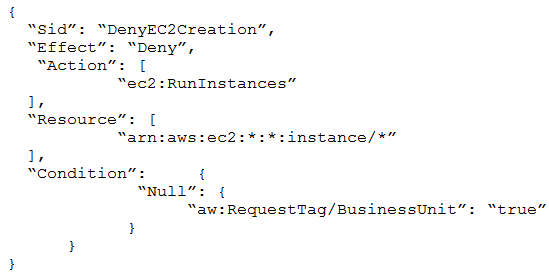
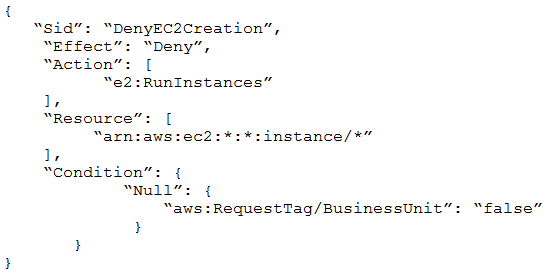
A company is managing many AWS accounts by using an organization in AWS Organizations. Different business units in the company run applications on Amazon EC2 instances. All the EC2 instances must have a BusinessUnit tag so that the company can track the cost for each business unit. A recent audit revealed that some instances were missing this tag. The company manually added the missing tag to the instances. What should a solutions architect do to enforce the tagging requirement in the future?

Exhibit 1 for question 364Exhibit 2 for question 364
  • AEnable tag policies in the organization. Create a tag policy for the BusinessUnit tag. Ensure that compliance with tag key capitalization is turned off. Implement the tag policy for the ec2:instance resource type. Attach the tag policy to the root of the organization.
  • BEnable tag policies in the organization. Create a tag policy for the BusinessUnit tag. Ensure that compliance with tag key capitalization is turned on. Implement the tag policy for the ec2:instance resource type. Attach the tag policy to the organization's management account.
  • CCreate an SCP and attach the SCP to the root of the organization. Include the following statement in the SCP: (correct answer)
  • DCreate an SCP and attach the SCP to the organization’s management account. Include the following statement in the SCP:
Reveal answer & explanation
Correct answer: C

The correct answer is C. Option C: Create an SCP and attach the SCP to the root of the organization. Include the following statement in the SCP:

Explanation

Service Control Policies set guardrails on what accounts in an organization can do.

Topic 1 · Question 365

A company is running a workload that consists of thousands of Amazon EC2 instances. The workload is running in a VPC that contains several public subnets and private subnets. The public subnets have a route for 0.0.0.0/0 to an existing internet gateway. The private subnets have a route for 0.0.0.0/0 to an existing NAT gateway. A solutions architect needs to migrate the entire fleet of EC2 instances to use IPv6. The EC2 instances that are in private subnets must not be accessible from the public internet. What should the solutions architect do to meet these requirements?

  • AUpdate the existing VPC, and associate a custom IPv6 CIDR block with the VPC and all subnets. Update all the VPC route tables, and add a route for ::/0 to the internet gateway.
  • BUpdate the existing VPC, and associate an Amazon-provided IPv6 CIDR block with the VPC and all subnets. Update the VPC route tables for all private subnets, and add a route for ::/0 to the NAT gateway.
  • CUpdate the existing VPC, and associate an Amazon-provided IPv6 CIDR block with the VPC and all subnets. Create an egress-only internet gateway. Update the VPC route tables for all private subnets, and add a route for ::/0 to the egress-only internet gateway. (correct answer)
  • DUpdate the existing VPC, and associate a custom IPV6 CIDR block with the VPC and all subnets. Create a new NAT gateway, and enable IPV6 support. Update the VPC route tables for all private subnets, and add a route for ::/0 to the IPv6-enabled NAT gateway.
Reveal answer & explanation
Correct answer: C

The correct answer is C. Option C: Update the existing VPC, and associate an Amazon-provided IPv6 CIDR block with the VPC and all subnets. Create an egress-only internet gateway. Update the VPC route tables for all private subnets, and add a route for...

Topic 1 · Question 366

A company is using Amazon API Gateway to deploy a private REST API that will provide access to sensitive data. The API must be accessible only from an application that is deployed in a VPC. The company deploys the API successfully. However, the API is not accessible from an Amazon EC2 instance that is deployed in the VPC. Which solution will provide connectivity between the EC2 instance and the API?

  • ACreate an interface VPC endpoint for API Gateway. Attach an endpoint policy that allows apigateway:* actions. Disable private DNS naming for the VPC endpoint. Configure an API resource policy that allows access from the VPC. Use the VPC endpoint's DNS name to access the API.
  • BCreate an interface VPC endpoint for API Gateway. Attach an endpoint policy that allows the execute-api:Invoke action. Enable private DNS naming for the VPC endpoint. Configure an API resource policy that allows access from the VPC endpoint. Use the API endpoint’s DNS names to access the API. (correct answer)
  • CCreate a Network Load Balancer (NLB) and a VPC link. Configure private integration between API Gateway and the NLB. Use the API endpoint’s DNS names to access the API.
  • DCreate an Application Load Balancer (ALB) and a VPC Link. Configure private integration between API Gateway and the ALB. Use the ALB endpoint’s DNS name to access the API.
Reveal answer & explanation
Correct answer: B

The correct answer is B. Option B: Create an interface VPC endpoint for API Gateway. Attach an endpoint policy that allows the execute-api:Invoke action. Enable private DNS naming for the VPC endpoint. Configure an API resource policy that allows acces...

Explanation

A VPC endpoint provides private connectivity to AWS services without traversing the public internet. Amazon API Gateway is a fully managed front door for creating and securing APIs at scale. AWS Config tracks resource configuration changes and evaluates compliance.

Topic 1 · Question 367

A large payroll company recently merged with a small staffing company. The unified company now has multiple business units, each with its own existing AWS account. A solutions architect must ensure that the company can centrally manage the billing and access policies for all the AWS accounts. The solutions architect configures AWS Organizations by sending an invitation to all member accounts of the company from a centralized management account. What should the solutions architect do next to meet these requirements?

  • ACreate the OrganizationAccountAccess IAM group in each member account. Include the necessary IAM roles for each administrator.
  • BCreate the OrganizationAccountAccessPolicy IAM policy in each member account. Connect the member accounts to the management account by using cross-account access.
  • CCreate the OrganizationAccountAccessRole IAM role in each member account. Grant permission to the management account to assume the IAM role. (correct answer)
  • DCreate the OrganizationAccountAccessRole IAM role in the management account. Attach the AdministratorAccess AWS managed policy to the IAM role. Assign the IAM role to the administrators in each member account.
Reveal answer & explanation
Correct answer: C

The correct answer is C. Option C: Create the OrganizationAccountAccessRole IAM role in each member account. Grant permission to the management account to assume the IAM role.

Explanation

An IAM role grants temporary, least-privilege permissions to AWS resources without long-term credentials. AWS IAM controls authenticated and authorized access to AWS resources with fine-grained policies.

Topic 1 · Question 368

A company has application services that have been containerized and deployed on multiple Amazon EC2 instances with public IPs. An Apache Kafka cluster has been deployed to the EC2 instances. A PostgreSQL database has been migrated to Amazon RDS for PostgreSQL. The company expects a significant increase of orders on its platform when a new version of its flagship product is released. What changes to the current architecture will reduce operational overhead and support the product release?

  • ACreate an EC2 Auto Scaling group behind an Application Load Balancer. Create additional read replicas for the DB instance. Create Amazon Kinesis data streams and configure the application services to use the data streams. Store and serve static content directly from Amazon S3.
  • BCreate an EC2 Auto Scaling group behind an Application Load Balancer. Deploy the DB instance in Multi-AZ mode and enable storage auto scaling. Create Amazon Kinesis data streams and configure the application services to use the data streams. Store and serve static content directly from Amazon S3.
  • CDeploy the application on a Kubernetes cluster created on the EC2 instances behind an Application Load Balancer. Deploy the DB instance in Multi-AZ mode and enable storage auto scaling. Create an Amazon Managed Streaming for Apache Kafka cluster and configure the application services to use the cluster. Store static content in Amazon S3 behind an Amazon CloudFront distribution.
  • DDeploy the application on Amazon Elastic Kubernetes Service (Amazon EKS) with AWS Fargate and enable auto scaling behind an Application Load Balancer. Create additional read replicas for the DB instance. Create an Amazon Managed Streaming for Apache Kafka cluster and configure the application services to use the cluster. Store static content in Amazon S3 behind an Amazon CloudFront distribution. (correct answer)
Reveal answer & explanation
Correct answer: D

The correct answer is D. Option D: Deploy the application on Amazon Elastic Kubernetes Service (Amazon EKS) with AWS Fargate and enable auto scaling behind an Application Load Balancer. Create additional read replicas for the DB instance. Create an Ama...

Explanation

AWS Fargate runs containers serverlessly so there are no EC2 hosts to manage or patch. Auto Scaling adjusts capacity automatically to match demand, improving availability and cost efficiency. Amazon EKS runs managed Kubernetes when you need the Kubernetes ecosystem.

Topic 1 · Question 369 · Select all that apply

A company hosts a VPN in an on-premises data center. Employees currently connect to the VPN to access files in their Windows home directories. Recently, there has been a large growth in the number of employees who work remotely. As a result, bandwidth usage for connections into the data center has begun to reach 100% during business hours. The company must design a solution on AWS that will support the growth of the company's remote workforce, reduce the bandwidth usage for connections into the data center, and reduce operational overhead. Which combination of steps will meet these requirements with the LEAST operational overhead? (Choose two.)

  • ACreate an AWS Storage Gateway Volume Gateway. Mount a volume from the Volume Gateway to the on-premises file server.
  • BMigrate the home directories to Amazon FSx for Windows File Server. (correct answer)
  • CMigrate the home directories to Amazon FSx for Lustre.
  • DMigrate remote users to AWS Client VPN. (correct answer)
  • ECreate an AWS Direct Connect connection from the on-premises data center to AWS.
Reveal answer & explanation
Correct answer: B, D

The correct answer is B, D. Option B: Migrate the home directories to Amazon FSx for Windows File Server. Option D: Migrate remote users to AWS Client VPN.

Explanation

Amazon FSx for Windows File Server provides fully managed SMB/Windows shared file storage. Amazon FSx provides fully managed third-party file systems.

Topic 1 · Question 370 · Select all that apply

A company has multiple AWS accounts. The company recently had a security audit that revealed many unencrypted Amazon Elastic Block Store (Amazon EBS) volumes attached to Amazon EC2 instances. A solutions architect must encrypt the unencrypted volumes and ensure that unencrypted volumes will be detected automatically in the future. Additionally, the company wants a solution that can centrally manage multiple AWS accounts with a focus on compliance and security. Which combination of steps should the solutions architect take to meet these requirements? (Choose two.)

  • ACreate an organization in AWS Organizations. Set up AWS Control Tower, and turn on the strongly recommended controls (guardrails). Join all accounts to the organization. Categorize the AWS accounts into OUs. (correct answer)
  • BUse the AWS CLI to list all the unencrypted volumes in all the AWS accounts. Run a script to encrypt all the unencrypted volumes in place.
  • CCreate a snapshot of each unencrypted volume. Create a new encrypted volume from the unencrypted snapshot. Detach the existing volume, and replace it with the encrypted volume. (correct answer)
  • DCreate an organization in AWS Organizations. Set up AWS Control Tower, and turn on the mandatory controls (guardrails). Join all accounts to the organization. Categorize the AWS accounts into OUs.
  • ETurn on AWS CloudTrail. Configure an Amazon EventBridge rule to detect and automatically encrypt unencrypted volumes.
Reveal answer & explanation
Correct answer: A, C

The correct answer is A, C. Option A: Create an organization in AWS Organizations. Set up AWS Control Tower, and turn on the strongly recommended controls (guardrails). Join all accounts to the organization. Categorize the AWS accounts into OUs. Option C: Create a snapshot of each unencrypted volume. Create a new encrypted volume from the unencrypted snapshot. Detach the existing volume, and replace it with the encrypted volume.

Explanation

AWS Organizations centrally governs and secures multiple AWS accounts. AWS Control Tower sets up and governs a secure multi-account landing zone.

Topic 1 · Question 371

A company hosts an intranet web application on Amazon EC2 instances behind an Application Load Balancer (ALB). Currently, users authenticate to the application against an internal user database. The company needs to authenticate users to the application by using an existing AWS Directory Service for Microsoft Active Directory directory. All users with accounts in the directory must have access to the application. Which solution will meet these requirements?

  • ACreate a new app client in the directory. Create a listener rule for the ALB. Specify the authenticate-oidc action for the listener rule. Configure the listener rule with the appropriate issuer, client ID and secret, and endpoint details for the Active Directory service. Configure the new app client with the callback URL that the ALB provides.
  • BConfigure an Amazon Cognito user pool. Configure the user pool with a federated identity provider (ldP) that has metadata from the directory. Create an app client. Associate the app client with the user pool. Create a listener rule for the ALSpecify the authenticate-cognito action for the listener rule. Configure the listener rule to use the user pool and app client. (correct answer)
  • CAdd the directory as a new IAM identity provider (ldP). Create a new IAM role that has an entity type of SAML 2.0 federation. Configure a role policy that allows access to the ALB. Configure the new role as the default authenticated user role for the ldP. Create a listener rule for the ALB. Specify the authenticate-oidc action for the listener rule.
  • DEnable AWS IAM Identity Center (AWS Single Sign-On). Configure the directory as an external identity provider (ldP) that uses SAML. Use the automatic provisioning method. Create a new IAM role that has an entity type of SAML 2.0 federation. Configure a role policy that allows access to the ALB. Attach the new role to all groups. Create a listener rule for the ALB. Specify the authenticate-cognito action for the listener rule.
Reveal answer & explanation
Correct answer: B

The correct answer is B. Option B: Configure an Amazon Cognito user pool. Configure the user pool with a federated identity provider (ldP) that has metadata from the directory. Create an app client. Associate the app client with the user pool. Create a...

Explanation

Amazon Cognito manages user sign-up, sign-in and federated identity for applications. AWS Config tracks resource configuration changes and evaluates compliance.

Topic 1 · Question 372

A company has a website that serves many visitors. The company deploys a backend service for the website in a primary AWS Region and a disaster recovery (DR) Region. A single Amazon CloudFront distribution is deployed for the website. The company creates an Amazon Route 53 record set with health checks and a failover routing policy for the primary Region’s backend service. The company configures the Route 53 record set as an origin for the CloudFront distribution. The company configures another record set that points to the backend service's endpoint in the DR Region as a secondary failover record type. The TTL for both record sets is 60 seconds. Currently, failover takes more than 1 minute. A solutions architect must design a solution that will provide the fastest failover time. Which solution will achieve this goal?

  • ADeploy an additional CloudFront distribution. Create a new Route 53 failover record set with health checks for both CloudFront distributions.
  • BSet the TTL to 4 second for the existing Route 53 record sets that are used for the backend service in each Region.
  • CCreate new record sets for the backend services by using a latency routing policy. Use the record sets as an origin in the CloudFront distribution.
  • DCreate a CloudFront origin group that includes two origins, one for each backend service Region. Configure origin failover as a cache behavior for the CloudFront distribution. (correct answer)
Reveal answer & explanation
Correct answer: D

The correct answer is D. Option D: Create a CloudFront origin group that includes two origins, one for each backend service Region. Configure origin failover as a cache behavior for the CloudFront distribution.

Explanation

Amazon CloudFront caches content at edge locations to reduce latency and offload origins. AWS Config tracks resource configuration changes and evaluates compliance. By spanning multiple Availability Zones / adding redundancy, this option provides the high availability and resilience required.

Topic 1 · Question 373 · Select all that apply

A company is using multiple AWS accounts and has multiple DevOps teams running production and non-production workloads in these accounts. The company would like to centrally-restrict access to some of the AWS services that the DevOps teams do not use. The company decided to use AWS Organizations and successfully invited all AWS accounts into the Organization. They would like to allow access to services that are currently in-use and deny a few specific services. Also they would like to administer multiple accounts together as a single unit. What combination of steps should the solutions architect take to satisfy these requirements? (Choose three.)

  • AUse a Deny list strategy. (correct answer)
  • BReview the Access Advisor in AWS IAM to determine services recently used (correct answer)
  • CReview the AWS Trusted Advisor report to determine services recently used.
  • DRemove the default FullAWSAccess SCP.
  • EDefine organizational units (OUs) and place the member accounts in the OUs. (correct answer)
  • FRemove the default DenyAWSAccess SCP.
Reveal answer & explanation
Correct answer: A, B, E

The correct answer is A, B, E. Option A: Use a Deny list strategy. Option B: Review the Access Advisor in AWS IAM to determine services recently used Option E: Define organizational units (OUs) and place the member accounts in the OUs.

Explanation

AWS IAM controls authenticated and authorized access to AWS resources with fine-grained policies.

Topic 1 · Question 374

A live-events company is designing a scaling solution for its ticket application on AWS. The application has high peaks of utilization during sale events. Each sale event is a one-time event that is scheduled. The application runs on Amazon EC2 instances that are in an Auto Scaling group. The application uses PostgreSQL for the database layer. The company needs a scaling solution to maximize availability during the sale events. Which solution will meet these requirements?

  • AUse a predictive scaling policy for the EC2 instances. Host the database on an Amazon Aurora PostgreSQL Serverless v2 Multi-AZ DB instance with automatically scaling read replicas. Create an AWS Step Functions state machine to run parallel AWS Lambda functions to pre-warm the database before a sale event. Create an Amazon EventBridge rule to invoke the state machine.
  • BUse a scheduled scaling policy for the EC2 instances. Host the database on an Amazon RDS for PostgreSQL Mulli-AZ DB instance with automatically scaling read replicas. Create an Amazon EventBridge rule that invokes an AWS Lambda function to create a larger read replica before a sale event. Fail over to the larger read replica. Create another EventBridge rule that invokes another Lambda function to scale down the read replica after the sale event.
  • CUse a predictive scaling policy for the EC2 instances. Host the database on an Amazon RDS for PostgreSQL MultiAZ DB instance with automatically scaling read replicas. Create an AWS Step Functions state machine to run parallel AWS Lambda functions to pre-warm the database before a sale event. Create an Amazon EventBridge rule to invoke the state machine.
  • DUse a scheduled scaling policy for the EC2 instances. Host the database on an Amazon Aurora PostgreSQL Multi-AZ DB cluster. Create an Amazon EventBridge rule that invokes an AWS Lambda function to create a larger Aurora Replica before a sale event. Fail over to the larger Aurora Replica. Create another EventBridge rule that invokes another Lambda function to scale down the Aurora Replica after the sale event. (correct answer)
Reveal answer & explanation
Correct answer: D

The correct answer is D. Option D: Use a scheduled scaling policy for the EC2 instances. Host the database on an Amazon Aurora PostgreSQL Multi-AZ DB cluster. Create an Amazon EventBridge rule that invokes an AWS Lambda function to create a larger Auro...

Explanation

AWS Lambda runs code without provisioning servers and scales automatically, which minimizes operational overhead. Amazon EC2 provides resizable virtual servers when you need full control of the operating system. Amazon Aurora is a high-performance managed relational database with built-in replication and failover.

Topic 1 · Question 375 · Select all that apply

A company runs an intranet application on premises. The company wants to configure a cloud backup of the application. The company has selected AWS Elastic Disaster Recovery for this solution. The company requires that replication traffic does not travel through the public internet. The application also must not be accessible from the internet. The company does not want this solution to consume all available network bandwidth because other applications require bandwidth. Which combination of steps will meet these requirements? (Choose three.)

  • ACreate a VPC that has at least two private subnets, two NAT gateways, and a virtual private gateway. (correct answer)
  • BCreate a VPC that has at least two public subnets, a virtual private gateway, and an internet gateway.
  • CCreate an AWS Site-to-Site VPN connection between the on-premises network and the target AWS network.
  • DCreate an AWS Direct Connect connection and a Direct Connect gateway between the on-premises network and the target AWS network. (correct answer)
  • EDuring configuration of the replication servers, select the option to use private IP addresses for data replication. (correct answer)
  • FDuring configuration of the launch settings for the target servers, select the option to ensure that the Recovery instance’s private IP address matches the source server's private IP address.
Reveal answer & explanation
Correct answer: A, D, E

The correct answer is A, D, E. Option A: Create a VPC that has at least two private subnets, two NAT gateways, and a virtual private gateway. Option D: Create an AWS Direct Connect connection and a Direct Connect gateway between the on-premises network and the target AWS network. Option E: During configuration of the replication servers, select the option to use private IP addresses for data replication.

Explanation

AWS Direct Connect provides a dedicated, consistent private network link between on premises and AWS. A NAT gateway lets private subnet resources reach the internet for outbound traffic only. AWS Config tracks resource configuration changes and evaluates compliance. By spanning multiple Availability Zones / adding redundancy, this option provides the high availability and resilience required.

Topic 1 · Question 376

A company that provides image storage services wants to deploy a customer-facing solution to AWS. Millions of individual customers will use the solution. The solution will receive batches of large image files, resize the files, and store the files in an Amazon S3 bucket for up to 6 months. The solution must handle significant variance in demand. The solution must also be reliable at enterprise scale and have the ability to rerun processing jobs in the event of failure. Which solution will meet these requirements MOST cost-effectively?

  • AUse AWS Step Functions to process the S3 event that occurs when a user stores an image. Run an AWS Lambda function that resizes the image in place and replaces the original file in the S3 bucket. Create an S3 Lifecycle expiration policy to expire all stored images after 6 months.
  • BUse Amazon EventBridge to process the S3 event that occurs when a user uploads an image. Run an AWS Lambda function that resizes the image in place and replaces the original file in the S3 bucket. Create an S3 Lifecycle expiration policy to expire all stored images after 6 months.
  • CUse S3 Event Notifications to invoke an AWS Lambda function when a user stores an image. Use the Lambda function to resize the image in place and to store the original file in the S3 bucket. Create an S3 Lifecycle policy to move all stored images to S3 Standard-Infrequent Access (S3 Standard-IA) after 6 months.
  • DUse Amazon Simple Queue Service (Amazon SQS) to process the S3 event that occurs when a user stores an image. Run an AWS Lambda function that resizes the image and stores the resized file in an S3 bucket that uses S3 Standard-Infrequent Access (S3 Standard-IA). Create an S3 Lifecycle policy to move all stored images to S3 Glacier Deep Archive after 6 months. (correct answer)
Reveal answer & explanation
Correct answer: D

The correct answer is D. Option D: Use Amazon Simple Queue Service (Amazon SQS) to process the S3 event that occurs when a user stores an image. Run an AWS Lambda function that resizes the image and stores the resized file in an S3 bucket that uses S3...

Explanation

AWS Lambda runs code without provisioning servers and scales automatically, which minimizes operational overhead. S3 Glacier Deep Archive is the lowest-cost storage for long-term archival with retrieval in hours. Amazon S3 Glacier offers low-cost archival storage for infrequently accessed data. This option delivers the requirement at the lowest cost.

Topic 1 · Question 377

A company has an organization in AWS Organizations that includes a separate AWS account for each of the company’s departments. Application teams from different departments develop and deploy solutions independently. The company wants to reduce compute costs and manage costs appropriately across departments. The company also wants to improve visibility into billing for individual departments. The company does not want to lose operational flexibility when the company selects compute resources. Which solution will meet these requirements?

  • AUse AWS Budgets for each department. Use Tag Editor to apply tags to appropriate resources. Purchase EC2 Instance Savings Plans.
  • BConfigure AWS Organizations to use consolidated billing. Implement a tagging strategy that identifies departments. Use SCPs to apply tags to appropriate resources. Purchase EC2 Instance Savings Plans.
  • CConfigure AWS Organizations to use consolidated billing. Implement a tagging strategy that identifies departments. Use Tag Editor to apply tags to appropriate resources. Purchase Compute Savings Plans. (correct answer)
  • DUse AWS Budgets for each department. Use SCPs to apply tags to appropriate resources. Purchase Compute Savings Plans.
Reveal answer & explanation
Correct answer: C

The correct answer is C. Option C: Configure AWS Organizations to use consolidated billing. Implement a tagging strategy that identifies departments. Use Tag Editor to apply tags to appropriate resources. Purchase Compute Savings Plans.

Explanation

Savings Plans reduce cost for consistent compute usage in exchange for a usage commitment. AWS Organizations centrally governs and secures multiple AWS accounts. AWS Config tracks resource configuration changes and evaluates compliance.

Topic 1 · Question 378

A company has a web application that securely uploads pictures and videos to an Amazon S3 bucket. The company requires that only authenticated users are allowed to post content. The application generates a presigned URL that is used to upload objects through a browser interface. Most users are reporting slow upload times for objects larger than 100 MB. What can a solutions architect do to improve the performance of these uploads while ensuring only authenticated users are allowed to post content?

  • ASet up an Amazon API Gateway with an edge-optimized API endpoint that has a resource as an S3 service proxy. Configure the PUT method for this resource to expose the S3 PutObject operation. Secure the API Gateway using a COGNITO_USER_POOLS authorizer. Have the browser interface use API Gateway instead of the presigned URL to upload objects.
  • BSet up an Amazon API Gateway with a regional API endpoint that has a resource as an S3 service proxy. Configure the PUT method for this resource to expose the S3 PutObject operation. Secure the API Gateway using an AWS Lambda authorizer. Have the browser interface use API Gateway instead of the presigned URL to upload objects.
  • CEnable an S3 Transfer Acceleration endpoint on the S3 bucket. Use the endpoint when generating the presigned URL. Have the browser interface upload the objects to this URL using the S3 multipart upload API. (correct answer)
  • DConfigure an Amazon CloudFront distribution for the destination S3 bucket. Enable PUT and POST methods for the CloudFront cache behavior. Update the CloudFront origin to use an origin access identity (OAI). Give the OAI user 3: PutObject permissions in the bucket policy. Have the browser interface upload objects using the CloudFront distribution.
Reveal answer & explanation
Correct answer: C

The correct answer is C. Option C: Enable an S3 Transfer Acceleration endpoint on the S3 bucket. Use the endpoint when generating the presigned URL. Have the browser interface upload the objects to this URL using the S3 multipart upload API.

Explanation

S3 Transfer Acceleration speeds up long-distance uploads to S3 over the AWS edge network. Amazon S3 provides durable, scalable object storage that is fully managed.

Topic 1 · Question 379 · Select all that apply

A large company is migrating its entire IT portfolio to AWS. Each business unit in the company has a standalone AWS account that supports both development and test environments. New accounts to support production workloads will be needed soon. The finance department requires a centralized method for payment but must maintain visibility into each group's spending to allocate costs. The security team requires a centralized mechanism to control IAM usage in all the company’s accounts. What combination of the following options meets the company’s needs with the LEAST effort? (Choose two.)

  • AUse a collection of parameterized AWS CloudFormation templates defining common IAM permissions that are launched into each account. Require all new and existing accounts to launch the appropriate stacks to enforce the least privilege model.
  • BUse AWS Organizations to create a new organization from a chosen payer account and define an organizational unit hierarchy. Invite the existing accounts to join the organization and create new accounts using Organizations. (correct answer)
  • CRequire each business unit to use its own AWS accounts. Tag each AWS account appropriately and enable Cost Explorer to administer chargebacks.
  • DEnable all features of AWS Organizations and establish appropriate service control policies that filter IAM permissions for sub-accounts. (correct answer)
  • EConsolidate all of the company's AWS accounts into a single AWS account. Use tags for billing purposes and the IAM’s Access Advisor feature to enforce the least privilege model.
Reveal answer & explanation
Correct answer: B, D

The correct answer is B, D. Option B: Use AWS Organizations to create a new organization from a chosen payer account and define an organizational unit hierarchy. Invite the existing accounts to join the organization and create new accounts using Organizat... Option D: Enable all features of AWS Organizations and establish appropriate service control policies that filter IAM permissions for sub-accounts.

Explanation

AWS IAM controls authenticated and authorized access to AWS resources with fine-grained policies. AWS Organizations centrally governs and secures multiple AWS accounts.

Topic 1 · Question 380

A company has a solution that analyzes weather data from thousands of weather stations. The weather stations send the data over an Amazon API Gateway REST API that has an AWS Lambda function integration. The Lambda function calls a third-party service for data pre-processing. The third-party service gets overloaded and fails the pre-processing, causing a loss of data. A solutions architect must improve the resiliency of the solution. The solutions architect must ensure that no data is lost and that data can be processed later if failures occur. What should the solutions architect do to meet these requirements?

  • ACreate an Amazon Simple Queue Service (Amazon SQS) queue. Configure the queue as the dead-letter queue for the API.
  • BCreate two Amazon Simple Queue Service (Amazon SQS) queues: a primary queue and a secondary queue. Configure the secondary queue as the dead-letter queue for the primary queue. Update the API to use a new integration to the primary queue. Configure the Lambda function as the invocation target for the primary queue. (correct answer)
  • CCreate two Amazon EventBridge event buses: a primary event bus and a secondary event bus. Update the API to use a new integration to the primary event bus. Configure an EventBridge rule to react to all events on the primary event bus. Specify the Lambda function as the target of the rule. Configure the secondary event bus as the failure destination for the Lambda function.
  • DCreate a custom Amazon EventBridge event bus. Configure the event bus as the failure destination for the Lambda function.
Reveal answer & explanation
Correct answer: B

The correct answer is B. Option B: Create two Amazon Simple Queue Service (Amazon SQS) queues: a primary queue and a secondary queue. Configure the secondary queue as the dead-letter queue for the primary queue. Update the API to use a new integration...

Explanation

AWS Lambda runs code without provisioning servers and scales automatically, which minimizes operational overhead. Amazon SQS is a fully managed message queue that decouples components and absorbs traffic spikes. AWS Config tracks resource configuration changes and evaluates compliance. By spanning multiple Availability Zones / adding redundancy, this option provides the high availability and resilience required.

Showing questions 361380 of 529 · Page 19 of 27