🔍

DOP-C02 — questions

Page 6 of 22 · 431 total questions.

Topic 1 · Question 101 · Select all that apply

A company recently created a new AWS Control Tower landing zone in a new organization in AWS Organizations. The landing zone must be able to demonstrate compliance with the Center for Internet Security (CIS) Benchmarks for AWS Foundations. The company’s security team wants to use AWS Security Hub to view compliance across all accounts. Only the security team can be allowed to view aggregated Security Hub findings. In addition, specific users must be able to view findings from their own accounts within the organization. All accounts must be enrolled in Security Hub after the accounts are created. Which combination of steps will meet these requirements in the MOST automated way? (Choose three.)

  • ATurn on trusted access for Security Hub in the organization’s management account. Create a new security account by using AWS Control Tower. Configure the new security account as the delegated administrator account for Security Hub. In the new security account, provide Security Hub with the CIS Benchmarks for AWS Foundations standards. (correct answer)
  • BTurn on trusted access for Security Hub in the organization’s management account. From the management account, provide Security Hub with the CIS Benchmarks for AWS Foundations standards.
  • CCreate an AWS IAM Identity Center (AWS Single Sign-On) permission set that includes the required permissions. Use the CreateAccountAssignment API operation to associate the security team users with the permission set and with the delegated security account. (correct answer)
  • DCreate an SCP that explicitly denies any user who is not on the security team from accessing Security Hub.
  • EIn Security Hub, turn on automatic enablement. (correct answer)
  • FIn the organization’s management account, create an Amazon EventBridge rule that reacts to the CreateManagedAccount event. Create an AWS Lambda function that uses the Security Hub CreateMembers API operation to add new accounts to Security Hub. Configure the EventBridge rule to invoke the Lambda function.
Reveal answer & explanation
Correct answer: A, C, E

The correct answer is A, C, E. Option A: Turn on trusted access for Security Hub in the organization’s management account. Create a new security account by using AWS Control Tower. Configure the new security account as the delegated administrator account for... Option C: Create an AWS IAM Identity Center (AWS Single Sign-On) permission set that includes the required permissions. Use the CreateAccountAssignment API operation to associate the security team users with the permission set... Option E: In Security Hub, turn on automatic enablement.

Explanation

Amazon RDS is a managed relational database that handles patching, backups and failover. AWS IAM controls authenticated and authorized access to AWS resources with fine-grained policies. AWS Security Hub centralizes security findings and compliance checks.
Topic 1 · Question 102

A company runs applications in AWS accounts that are in an organization in AWS Organizations. The applications use Amazon EC2 instances and Amazon S3. The company wants to detect potentially compromised EC2 instances, suspicious network activity, and unusual API activity in its existing AWS accounts and in any AWS accounts that the company creates in the future. When the company detects one of these events, the company wants to use an existing Amazon Simple Notification Service (Amazon SNS) topic to send a notification to its operational support team for investigation and remediation. Which solution will meet these requirements in accordance with AWS best practices?

  • AIn the organization’s management account, configure an AWS account as the Amazon GuardDuty administrator account. In the GuardDuty administrator account, add the company’s existing AWS accounts to GuardDuty as members. In the GuardDuty administrator account, create an Amazon EventBridge rule with an event pattern to match GuardDuty events and to forward matching events to the SNS topic. (correct answer)
  • BIn the organization’s management account, configure Amazon GuardDuty to add newly created AWS accounts by invitation and to send invitations to the existing AWS accounts. Create an AWS CloudFormation stack set that accepts the GuardDuty invitation and creates an Amazon EventBridge rule. Configure the rule with an event pattern to match GuardDuty events and to forward matching events to the SNS topic. Configure the CloudFormation stack set to deploy into all AWS accounts in the organization.
  • CIn the organization’s management account, create an AWS CloudTrail organization trail. Activate the organization trail in all AWS accounts in the organization. Create an SCP that enables VPC Flow Logs in each account in the organization. Configure AWS Security Hub for the organization. Create an Amazon EventBridge rule with an event pattern to match Security Hub events and to forward matching events to the SNS topic.
  • DIn the organization’s management account, configure an AWS account as the AWS CloudTrail administrator account. In the CloudTrail administrator account, create a CloudTrail organization trail. Add the company’s existing AWS accounts to the organization trail. Create an SCP that enables VPC Flow Logs in each account in the organization. Configure AWS Security Hub for the organization. Create an Amazon EventBridge rule with an event pattern to match Security Hub events and to forward matching events to the SNS topic.
Reveal answer & explanation
Correct answer: A

The correct answer is A. Option A: In the organization’s management account, configure an AWS account as the Amazon GuardDuty administrator account. In the GuardDuty administrator account, add the company’s existing AWS accounts to GuardDuty as members...

Explanation

Amazon SNS is a managed pub/sub service for fan-out notifications to many subscribers. Amazon EventBridge routes events between services with rules, enabling event-driven, decoupled architectures. Amazon GuardDuty continuously monitors for threats and malicious activity.

Topic 1 · Question 103

A company’s DevOps engineer is working in a multi-account environment. The company uses AWS Transit Gateway to route all outbound traffic through a network operations account. In the network operations account, all account traffic passes through a firewall appliance for inspection before the traffic goes to an internet gateway. The firewall appliance sends logs to Amazon CloudWatch Logs and includes event severities of CRITICAL, HIGH, MEDIUM, LOW, and INFO. The security team wants to receive an alert if any CRITICAL events occur. What should the DevOps engineer do to meet these requirements?

  • ACreate an Amazon CloudWatch Synthetics canary to monitor the firewall state. If the firewall reaches a CRITICAL state or logs a CRITICAL event, use a CloudWatch alarm to publish a notification to an Amazon Simple Notification Service (Amazon SNS) topic. Subscribe the security team’s email address to the topic.
  • BCreate an Amazon CloudWatch metric filter by using a search for CRITICAL events. Publish a custom metric for the finding. Use a CloudWatch alarm based on the custom metric to publish a notification to an Amazon Simple Notification Service (Amazon SNS) topic. Subscribe the security team’s email address to the topic. (correct answer)
  • CEnable Amazon GuardDuty in the network operations account. Configure GuardDuty to monitor flow logs. Create an Amazon EventBridge event rule that is invoked by GuardDuty events that are CRITICAL. Define an Amazon Simple Notification Service (Amazon SNS) topic as a target. Subscribe the security team’s email address to the topic.
  • DUse AWS Firewall Manager to apply consistent policies across all accounts. Create an Amazon EventBridge event rule that is invoked by Firewall Manager events that are CRITICAL. Define an Amazon Simple Notification Service (Amazon SNS) topic as a target. Subscribe the security team’s email address to the topic.
Reveal answer & explanation
Correct answer: B

The correct answer is B. Option B: Create an Amazon CloudWatch metric filter by using a search for CRITICAL events. Publish a custom metric for the finding. Use a CloudWatch alarm based on the custom metric to publish a notification to an Amazon Simple...

Explanation

Amazon SNS is a managed pub/sub service for fan-out notifications to many subscribers. Amazon CloudWatch collects metrics, logs and alarms to monitor and react to operational health.

Topic 1 · Question 104

A company is divided into teams. Each team has an AWS account, and all the accounts are in an organization in AWS Organizations. Each team must retain full administrative rights to its AWS account. Each team also must be allowed to access only AWS services that the company approves for use. AWS services must gain approval through a request and approval process. How should a DevOps engineer configure the accounts to meet these requirements?

  • AUse AWS CloudFormation StackSets to provision IAM policies in each account to deny access to restricted AWS services. In each account, configure AWS Config rules that ensure that the policies are attached to IAM principals in the account.
  • BUse AWS Control Tower to provision the accounts into OUs within the organization. Configure AWS Control Tower to enable AWS IAM Identity Center (AWS Single Sign-On). Configure IAM Identity Center to provide administrative access. Include deny policies on user roles for restricted AWS services.
  • CPlace all the accounts under a new top-level OU within the organization. Create an SCP that denies access to restricted AWS services. Attach the SCP to the OU.
  • DCreate an SCP that allows access to only approved AWS services. Attach the SCP to the root OU of the organization. Remove the FullAWSAccess SCP from the root OU of the organization. (correct answer)
Reveal answer & explanation
Correct answer: D

The correct answer is D. Option D: Create an SCP that allows access to only approved AWS services. Attach the SCP to the root OU of the organization. Remove the FullAWSAccess SCP from the root OU of the organization.

Explanation

Service Control Policies set guardrails on what accounts in an organization can do.

Topic 1 · Question 105

A DevOps engineer used an AWS CloudFormation custom resource to set up AD Connector. The AWS Lambda function ran and created AD Connector, but CloudFormation is not transitioning from CREATE_IN_PROGRESS to CREATE_COMPLETE. Which action should the engineer take to resolve this issue?

  • AEnsure the Lambda function code has exited successfully.
  • BEnsure the Lambda function code returns a response to the pre-signed URL. (correct answer)
  • CEnsure the Lambda function IAM role has cloudformation:UpdateStack permissions for the stack ARN.
  • DEnsure the Lambda function IAM role has ds:ConnectDirectory permissions for the AWS account.
Reveal answer & explanation
Correct answer: B

The correct answer is B. Option B: Ensure the Lambda function code returns a response to the pre-signed URL.

Explanation

AWS Lambda runs code without provisioning servers and scales automatically, which minimizes operational overhead.

Topic 1 · Question 106

A company uses AWS CodeCommit for source code control. Developers apply their changes to various feature branches and create pull requests to move those changes to the main branch when the changes are ready for production. The developers should not be able to push changes directly to the main branch. The company applied the AWSCodeCommitPowerUser managed policy to the developers’ IAM role, and now these developers can push changes to the main branch directly on every repository in the AWS account. What should the company do to restrict the developers’ ability to push changes to the main branch directly?

  • ACreate an additional policy to include a Deny rule for the GitPush and PutFile actions. Include a restriction for the specific repositories in the policy statement with a condition that references the main branch. (correct answer)
  • BRemove the IAM policy, and add an AWSCodeCommitReadOnly managed policy. Add an Allow rule for the GitPush and PutFile actions for the specific repositories in the policy statement with a condition that references the main branch.
  • CModify the IAM policy. Include a Deny rule for the GitPush and PutFile actions for the specific repositories in the policy statement with a condition that references the main branch.
  • DCreate an additional policy to include an Allow rule for the GitPush and PutFile actions. Include a restriction for the specific repositories in the policy statement with a condition that references the feature branches.
Reveal answer & explanation
Correct answer: A

The correct answer is A. Option A: Create an additional policy to include a Deny rule for the GitPush and PutFile actions. Include a restriction for the specific repositories in the policy statement with a condition that references the main branch.

Topic 1 · Question 107

A company manages a web application that runs on Amazon EC2 instances behind an Application Load Balancer (ALB). The EC2 instances run in an Auto Scaling group across multiple Availability Zones. The application uses an Amazon RDS for MySQL DB instance to store the data. The company has configured Amazon Route 53 with an alias record that points to the ALB. A new company guideline requires a geographically isolated disaster recovery (DR) site with an RTO of 4 hours and an RPO of 15 minutes. Which DR strategy will meet these requirements with the LEAST change to the application stack?

  • ALaunch a replica environment of everything except Amazon RDS in a different Availability Zone. Create an RDS read replica in the new Availability Zone, and configure the new stack to point to the local RDS DB instance. Add the new stack to the Route 53 record set by using a health check to configure a failover routing policy.
  • BLaunch a replica environment of everything except Amazon RDS in a different AWS Region. Create an RDS read replica in the new Region, and configure the new stack to point to the local RDS DB instance. Add the new stack to the Route 53 record set by using a health check to configure a latency routing policy.
  • CLaunch a replica environment of everything except Amazon RDS in a different AWS Region. In the event of an outage, copy and restore the latest RDS snapshot from the primary Region to the DR Region. Adjust the Route 53 record set to point to the ALB in the DR Region.
  • DLaunch a replica environment of everything except Amazon RDS in a different AWS Region. Create an RDS read replica in the new Region, and configure the new environment to point to the local RDS DB instance. Add the new stack to the Route 53 record set by using a health check to configure a failover routing policy. In the event of an outage, promote the read replica to primary. (correct answer)
Reveal answer & explanation
Correct answer: D

The correct answer is D. Option D: Launch a replica environment of everything except Amazon RDS in a different AWS Region. Create an RDS read replica in the new Region, and configure the new environment to point to the local RDS DB instance. Add the ne...

Explanation

Amazon RDS is a managed relational database that handles patching, backups and failover. Amazon Route 53 provides DNS with health checks and routing policies for availability and latency. AWS Config tracks resource configuration changes and evaluates compliance. By spanning multiple Availability Zones / adding redundancy, this option provides the high availability and resilience required.

Topic 1 · Question 108

A large enterprise is deploying a web application on AWS. The application runs on Amazon EC2 instances behind an Application Load Balancer. The instances run in an Auto Scaling group across multiple Availability Zones. The application stores data in an Amazon RDS for Oracle DB instance and Amazon DynamoDB. There are separate environments for development, testing, and production. What is the MOST secure and flexible way to obtain password credentials during deployment?

  • ARetrieve an access key from an AWS Systems Manager SecureString parameter to access AWS services. Retrieve the database credentials from a Systems Manager SecureString parameter.
  • BLaunch the EC2 instances with an EC2 IAM role to access AWS services. Retrieve the database credentials from AWS Secrets Manager. (correct answer)
  • CRetrieve an access key from an AWS Systems Manager plaintext parameter to access AWS services. Retrieve the database credentials from a Systems Manager SecureString parameter.
  • DLaunch the EC2 instances with an EC2 IAM role to access AWS services. Store the database passwords in an encrypted config file with the application artifacts.
Reveal answer & explanation
Correct answer: B

The correct answer is B. Option B: Launch the EC2 instances with an EC2 IAM role to access AWS services. Retrieve the database credentials from AWS Secrets Manager.

Explanation

Amazon EC2 provides resizable virtual servers when you need full control of the operating system. An IAM role grants temporary, least-privilege permissions to AWS resources without long-term credentials. AWS IAM controls authenticated and authorized access to AWS resources with fine-grained policies. By spanning multiple Availability Zones / adding redundancy, this option provides the high availability and resilience required.

Topic 1 · Question 109

The security team depends on AWS CloudTrail to detect sensitive security issues in the company’s AWS account. The DevOps engineer needs a solution to auto-remediate CloudTrail being turned off in an AWS account. What solution ensures the LEAST amount of downtime for the CloudTrail log deliveries?

  • ACreate an Amazon EventBridge rule for the CloudTrail StopLogging event. Create an AWS Lambda function that uses the AWS SDK to call StartLogging on the ARN of the resource in which StopLogging was called. Add the Lambda function ARN as a target to the EventBridge rule. (correct answer)
  • BDeploy the AWS-managed CloudTrail-enabled AWS Config rule, set with a periodic interval of 1 hour. Create an Amazon EventBridge rule for AWS Config rules compliance change. Create an AWS Lambda function that uses the AWS SDK to call StartLogging on the ARN of the resource in which StopLogging was called. Add the Lambda function ARN as a target to the EventBridge rule.
  • CCreate an Amazon EventBridge rule for a scheduled event every 5 minutes. Create an AWS Lambda function that uses the AWS SDK to call StartLogging on a CloudTrail trail in the AWS account. Add the Lambda function ARN as a target to the EventBridge rule.
  • DLaunch a t2.nano instance with a script running every 5 minutes that uses the AWS SDK to query CloudTrail in the current account. If the CloudTrail trail is disabled, have the script re-enable the trail.
Reveal answer & explanation
Correct answer: A

The correct answer is A. Option A: Create an Amazon EventBridge rule for the CloudTrail StopLogging event. Create an AWS Lambda function that uses the AWS SDK to call StartLogging on the ARN of the resource in which StopLogging was called. Add the Lamb...

Explanation

AWS Lambda runs code without provisioning servers and scales automatically, which minimizes operational overhead. Amazon EventBridge routes events between services with rules, enabling event-driven, decoupled architectures. AWS CloudTrail records API activity for auditing and governance.

Topic 1 · Question 110 · Select all that apply

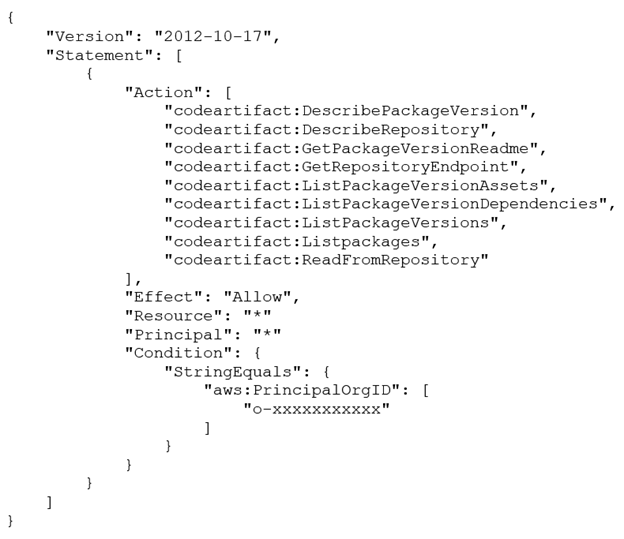
A company uses AWS CodeArtifact to centrally store Python packages. The CodeArtifact repository is configured with the following repository policy: A development team is building a new project in an account that is in an organization in AWS Organizations. The development team wants to use a Python library that has already been stored in the CodeArtifact repository in the organization. The development team uses AWS CodePipeline and AWS CodeBuild to build the new application. The CodeBuild job that the development team uses to build the application is configured to run in a VPC. Because of compliance requirements, the VPC has no internet connectivity. The development team creates the VPC endpoints for CodeArtifact and updates the CodeBuild buildspec.yaml file. However, the development team cannot download the Python library from the repository. Which combination of steps should a DevOps engineer take so that the development team can use CodeArtifact? (Choose two.)

Exhibit 1 for question 110
  • ACreate an Amazon S3 gateway endpoint. Update the route tables for the subnets that are running the CodeBuild job. (correct answer)
  • BUpdate the repository policy’s Principal statement to include the ARN of the role that the CodeBuild project uses.
  • CShare the CodeArtifact repository with the organization by using AWS Resource Access Manager (AWS RAM).
  • DUpdate the role that the CodeBuild project uses so that the role has sufficient permissions to use the CodeArtifact repository. (correct answer)
  • ESpecify the account that hosts the repository as the delegated administrator for CodeArtifact in the organization.
Reveal answer & explanation
Correct answer: A, D

The correct answer is A, D. Option A: Create an Amazon S3 gateway endpoint. Update the route tables for the subnets that are running the CodeBuild job. Option D: Update the role that the CodeBuild project uses so that the role has sufficient permissions to use the CodeArtifact repository.

Explanation

Amazon S3 provides durable, scalable object storage that is fully managed. AWS CodeBuild compiles, tests and packages code in a managed build service.

Topic 1 · Question 111

A company uses a series of individual Amazon CloudFormation templates to deploy its multi-Region applications. These templates must be deployed in a specific order. The company is making more changes to the templates than previously expected and wants to deploy new templates more efficiently. Additionally, the data engineering team must be notified of all changes to the templates. What should the company do to accomplish these goals?

  • ACreate an AWS Lambda function to deploy the CloudFormation templates in the required order. Use stack policies to alert the data engineering team.
  • BHost the CloudFormation templates in Amazon S3. Use Amazon S3 events to directly trigger CloudFormation updates and Amazon SNS notifications.
  • CImplement CloudFormation StackSets and use drift detection to trigger update alerts to the data engineering team.
  • DLeverage CloudFormation nested stacks and stack sets for deployments. Use Amazon SNS to notify the data engineering team. (correct answer)
Reveal answer & explanation
Correct answer: D

The correct answer is D. Option D: Leverage CloudFormation nested stacks and stack sets for deployments. Use Amazon SNS to notify the data engineering team.

Explanation

Amazon SNS is a managed pub/sub service for fan-out notifications to many subscribers. AWS CloudFormation provisions infrastructure as code repeatably.

Topic 1 · Question 112

A DevOps engineer has implemented a CI/CD pipeline to deploy an AWS CloudFormation template that provisions a web application. The web application consists of an Application Load Balancer (ALB), a target group, a launch template that uses an Amazon Linux 2 AMI, an Auto Scaling group of Amazon EC2 instances, a security group, and an Amazon RDS for MySQL database. The launch template includes user data that specifies a script to install and start the application. The initial deployment of the application was successful. The DevOps engineer made changes to update the version of the application with the user data. The CI/CD pipeline has deployed a new version of the template. However, the health checks on the ALB are now failing. The health checks have marked all targets as unhealthy. During investigation, the DevOps engineer notices that the CloudFormation stack has a status of UPDATE_COMPLETE. However, when the DevOps engineer connects to one of the EC2 instances and checks /var/log/messages, the DevOps engineer notices that the Apache web server failed to start successfully because of a configuration error. How can the DevOps engineer ensure that the CloudFormation deployment will fail if the user data fails to successfully finish running?

  • AUse the cfn-signal helper script to signal success or failure to CloudFormation. Use the WaitOnResourceSignals update policy within the CloudFormation template. Set an appropriate timeout for the update policy. (correct answer)
  • BCreate an Amazon CloudWatch alarm for the UnhealthyHostCount metric. Include an appropriate alarm threshold for the target group. Create an Amazon Simple Notification Service (Amazon SNS) topic as the target to signal success or failure to CloudFormation.
  • CCreate a lifecycle hook on the Auto Scaling group by using the AWS::AutoScaling::LifecycleHook resource. Create an Amazon Simple Notification Service (Amazon SNS) topic as the target to signal success or failure to CloudFormation. Set an appropriate timeout on the lifecycle hook.
  • DUse the Amazon CloudWatch agent to stream the cloud-init logs. Create a subscription filter that includes an AWS Lambda function with an appropriate invocation timeout. Configure the Lambda function to use the SignalResource API operation to signal success or failure to CloudFormation.
Reveal answer & explanation
Correct answer: A

The correct answer is A. Option A: Use the cfn-signal helper script to signal success or failure to CloudFormation. Use the WaitOnResourceSignals update policy within the CloudFormation template. Set an appropriate timeout for the update policy.

Explanation

AWS CloudFormation provisions infrastructure as code repeatably.

Topic 1 · Question 113

A company has a data ingestion application that runs across multiple AWS accounts. The accounts are in an organization in AWS Organizations. The company needs to monitor the application and consolidate access to the application. Currently, the company is running the application on Amazon EC2 instances from several Auto Scaling groups. The EC2 instances have no access to the internet because the data is sensitive. Engineers have deployed the necessary VPC endpoints. The EC2 instances run a custom AMI that is built specifically for the application. To maintain and troubleshoot the application, system administrators need the ability to log in to the EC2 instances. This access must be automated and controlled centrally. The company’s security team must receive a notification whenever the instances are accessed. Which solution will meet these requirements?

  • ACreate an Amazon EventBridge rule to send notifications to the security team whenever a user logs in to an EC2 instance. Use EC2 Instance Connect to log in to the instances. Deploy Auto Scaling groups by using AWS CloudFormation. Use the cfn-init helper script to deploy appropriate VPC routes for external access. Rebuild the custom AMI so that the custom AMI includes AWS Systems Manager Agent.
  • BDeploy a NAT gateway and a bastion host that has internet access. Create a security group that allows incoming traffic on all the EC2 instances from the bastion host. Install AWS Systems Manager Agent on all the EC2 instances. Use Auto Scaling group lifecycle hooks for monitoring and auditing access. Use Systems Manager Session Manager to log in to the instances. Send logs to a log group in Amazon CloudWatch Logs. Export data to Amazon S3 for auditing. Send notifications to the security team by using S3 event notifications.
  • CUse EC2 Image Builder to rebuild the custom AMI. Include the most recent version of AWS Systems Manager Agent in the image. Configure the Auto Scaling group to attach the AmazonSSMManagedInstanceCore role to all the EC2 instances. Use Systems Manager Session Manager to log in to the instances. Enable logging of session details to Amazon S3. Create an S3 event notification for new file uploads to send a message to the security team through an Amazon Simple Notification Service (Amazon SNS) topic. (correct answer)
  • DUse AWS Systems Manager Automation to build Systems Manager Agent into the custom AMI. Configure AWS Config to attach an SCP to the root organization account to allow the EC2 instances to connect to Systems Manager. Use Systems Manager Session Manager to log in to the instances. Enable logging of session details to Amazon S3. Create an S3 event notification for new file uploads to send a message to the security team through an Amazon Simple Notification Service (Amazon SNS) topic.
Reveal answer & explanation
Correct answer: C

The correct answer is C. Option C: Use EC2 Image Builder to rebuild the custom AMI. Include the most recent version of AWS Systems Manager Agent in the image. Configure the Auto Scaling group to attach the AmazonSSMManagedInstanceCore role to all the E...

Explanation

Auto Scaling adjusts capacity automatically to match demand, improving availability and cost efficiency. Amazon EC2 provides resizable virtual servers when you need full control of the operating system. Amazon S3 provides durable, scalable object storage that is fully managed.

Topic 1 · Question 114

A company uses Amazon S3 to store proprietary information. The development team creates buckets for new projects on a daily basis. The security team wants to ensure that all existing and future buckets have encryption, logging, and versioning enabled. Additionally, no buckets should ever be publicly read or write accessible. What should a DevOps engineer do to meet these requirements?

  • AEnable AWS CloudTrail and configure automatic remediation using AWS Lambda.
  • BEnable AWS Config rules and configure automatic remediation using AWS Systems Manager documents. (correct answer)
  • CEnable AWS Trusted Advisor and configure automatic remediation using Amazon EventBridge.
  • DEnable AWS Systems Manager and configure automatic remediation using Systems Manager documents.
Reveal answer & explanation
Correct answer: B

The correct answer is B. Option B: Enable AWS Config rules and configure automatic remediation using AWS Systems Manager documents.

Explanation

AWS Config tracks resource configuration changes and evaluates compliance. AWS Systems Manager operates and automates management of fleets of resources.

Topic 1 · Question 115

A DevOps engineer is researching the least expensive way to implement an image batch processing cluster on AWS. The application cannot run in Docker containers and must run on Amazon EC2. The batch job stores checkpoint data on an NFS volume and can tolerate interruptions. Configuring the cluster software from a generic EC2 Linux image takes 30 minutes. What is the MOST cost-effective solution?

  • AUse Amazon EFS for checkpoint data. To complete the job, use an EC2 Auto Scaling group and an On-Demand pricing model to provision EC2 instances temporarily.
  • BUse GlusterFS on EC2 instances for checkpoint data. To run the batch job, configure EC2 instances manually. When the job completes, shut down the instances manually.
  • CUse Amazon EFS for checkpoint data. Use EC2 Fleet to launch EC2 Spot Instances, and utilize user data to configure the EC2 Linux instance on startup.
  • DUse Amazon EFS for checkpoint data. Use EC2 Fleet to launch EC2 Spot Instances. Create a custom AMI for the cluster and use the latest AMI when creating instances. (correct answer)
Reveal answer & explanation
Correct answer: D

The correct answer is D. Option D: Use Amazon EFS for checkpoint data. Use EC2 Fleet to launch EC2 Spot Instances. Create a custom AMI for the cluster and use the latest AMI when creating instances.

Explanation

EC2 Spot Instances use spare capacity at a large discount, ideal for fault-tolerant or flexible workloads. Spot Instances use spare capacity at a large discount, ideal for fault-tolerant or interruptible workloads. Amazon EC2 provides resizable virtual servers when you need full control of the operating system. This option delivers the requirement at the lowest cost.

Topic 1 · Question 116

A company recently migrated its legacy application from on-premises to AWS. The application is hosted on Amazon EC2 instances behind an Application Load Balancer, which is behind Amazon API Gateway. The company wants to ensure users experience minimal disruptions during any deployment of a new version of the application. The company also wants to ensure it can quickly roll back updates if there is an issue. Which solution will meet these requirements with MINIMAL changes to the application?

  • AIntroduce changes as a separate environment parallel to the existing one. Configure API Gateway to use a canary release deployment to send a small subset of user traffic to the new environment. (correct answer)
  • BIntroduce changes as a separate environment parallel to the existing one. Update the application’s DNS alias records to point to the new environment.
  • CIntroduce changes as a separate target group behind the existing Application Load Balancer. Configure API Gateway to route user traffic to the new target group in steps.
  • DIntroduce changes as a separate target group behind the existing Application Load Balancer. Configure API Gateway to route all traffic to the Application Load Balancer, which then sends the traffic to the new target group.
Reveal answer & explanation
Correct answer: A

The correct answer is A. Option A: Introduce changes as a separate environment parallel to the existing one. Configure API Gateway to use a canary release deployment to send a small subset of user traffic to the new environment.

Explanation

Amazon API Gateway is a fully managed front door for creating and securing APIs at scale. AWS Config tracks resource configuration changes and evaluates compliance.

Topic 1 · Question 117 · Select all that apply

A company is storing 100 GB of log data in .csv format in an Amazon S3 bucket. SQL developers want to query this data and generate graphs to visualize it. The SQL developers also need an efficient, automated way to store metadata from the .csv file. Which combination of steps will meet these requirements with the LEAST amount of effort? (Choose three.)

  • AFilter the data through AWS X-Ray to visualize the data.
  • BFilter the data through Amazon QuickSight to visualize the data. (correct answer)
  • CQuery the data with Amazon Athena. (correct answer)
  • DQuery the data with Amazon Redshift.
  • EUse the AWS Glue Data Catalog as the persistent metadata store. (correct answer)
  • FUse Amazon DynamoDB as the persistent metadata store.
Reveal answer & explanation
Correct answer: B, C, E

The correct answer is B, C, E. Option B: Filter the data through Amazon QuickSight to visualize the data. Option C: Query the data with Amazon Athena. Option E: Use the AWS Glue Data Catalog as the persistent metadata store.

Explanation

Amazon Athena runs serverless SQL queries directly on data in Amazon S3 with no infrastructure to manage. AWS Glue is a serverless ETL and data-catalog service that prepares and integrates data. Amazon QuickSight is a serverless business-intelligence and dashboard service.

Topic 1 · Question 118 · Select all that apply

A company deploys its corporate infrastructure on AWS across multiple AWS Regions and Availability Zones. The infrastructure is deployed on Amazon EC2 instances and connects with AWS IoT Greengrass devices. The company deploys additional resources on on-premises servers that are located in the corporate headquarters. The company wants to reduce the overhead involved in maintaining and updating its resources. The company’s DevOps team plans to use AWS Systems Manager to implement automated management and application of patches. The DevOps team confirms that Systems Manager is available in the Regions that the resources are deployed in. Systems Manager also is available in a Region near the corporate headquarters. Which combination of steps must the DevOps team take to implement automated patch and configuration management across the company’s EC2 instances, IoT devices, and on-premises infrastructure? (Choose three.)

  • AApply tags to all the EC2 instances, AWS IoT Greengrass devices, and on-premises servers. Use Systems Manager Session Manager to push patches to all the tagged devices.
  • BUse Systems Manager Run Command to schedule patching for the EC2 instances, AWS IoT Greengrass devices, and on-premises servers.
  • CUse Systems Manager Patch Manager to schedule patching for the EC2 instances, AWS IoT Greengrass devices, and on-premises servers as a Systems Manager maintenance window task. (correct answer)
  • DConfigure Amazon EventBridge to monitor Systems Manager Patch Manager for updates to patch baselines. Associate Systems Manager Run Command with the event to initiate a patch action for all EC2 instances, AWS IoT Greengrass devices, and on-premises servers.
  • ECreate an IAM instance profile for Systems Manager. Attach the instance profile to all the EC2 instances in the AWS account. For the AWS IoT Greengrass devices and on-premises servers, create an IAM service role for Systems Manager. (correct answer)
  • FGenerate a managed-instance activation. Use the Activation Code and Activation ID to install Systems Manager Agent (SSM Agent) on each server in the on-premises environment. Update the AWS IoT Greengrass IAM token exchange role. Use the role to deploy SSM Agent on all the IoT devices. (correct answer)
Reveal answer & explanation
Correct answer: C, E, F

The correct answer is C, E, F. Option C: Use Systems Manager Patch Manager to schedule patching for the EC2 instances, AWS IoT Greengrass devices, and on-premises servers as a Systems Manager maintenance window task. Option E: Create an IAM instance profile for Systems Manager. Attach the instance profile to all the EC2 instances in the AWS account. For the AWS IoT Greengrass devices and on-premises servers, create an IAM service role for S... Option F: Generate a managed-instance activation. Use the Activation Code and Activation ID to install Systems Manager Agent (SSM Agent) on each server in the on-premises environment. Update the AWS IoT Greengrass IAM token exc...

Explanation

Amazon EC2 provides resizable virtual servers when you need full control of the operating system. AWS IAM controls authenticated and authorized access to AWS resources with fine-grained policies. AWS Systems Manager operates and automates management of fleets of resources.

Topic 1 · Question 119

A company is testing a web application that runs on Amazon EC2 instances behind an Application Load Balancer. The instances run in an Auto Scaling group across multiple Availability Zones. The company uses a blue/green deployment process with immutable instances when deploying new software. During testing, users are being automatically logged out of the application at random times. Testers also report that, when a new version of the application is deployed, all users are logged out. The development team needs a solution to ensure users remain logged in across scaling events and application deployments. What is the MOST operationally efficient way to ensure users remain logged in?

  • AEnable smart sessions on the load balancer and modify the application to check for an existing session.
  • BEnable session sharing on the load balancer and modify the application to read from the session store.
  • CStore user session information in an Amazon S3 bucket and modify the application to read session information from the bucket.
  • DModify the application to store user session information in an Amazon ElastiCache cluster. (correct answer)
Reveal answer & explanation
Correct answer: D

The correct answer is D. Option D: Modify the application to store user session information in an Amazon ElastiCache cluster.

Explanation

Amazon ElastiCache provides in-memory caching (Redis/Memcached) to reduce latency and offload the database. By spanning multiple Availability Zones / adding redundancy, this option provides the high availability and resilience required.

Topic 1 · Question 120

A DevOps engineer needs to configure a blue/green deployment for an existing three-tier application. The application runs on Amazon EC2 instances and uses an Amazon RDS database. The EC2 instances run behind an Application Load Balancer (ALB) and are in an Auto Scaling group. The DevOps engineer has created a launch template and an Auto Scaling group for the blue environment. The DevOps engineer also has created a launch template and an Auto Scaling group for the green environment. Each Auto Scaling group deploys to a matching blue or green target group. The target group also specifies which software, blue or green, gets loaded on the EC2 instances. The ALB can be configured to send traffic to the blue environment’s target group or the green environment’s target group. An Amazon Route 53 record for www.example.com points to the ALB. The deployment must move traffic all at once between the software on the blue environment’s EC2 instances to the newly deployed software on the green environment’s EC2 instances. What should the DevOps engineer do to meet these requirements?

  • AStart a rolling restart of the Auto Scaling group for the green environment to deploy the new software on the green environment’s EC2 instances. When the rolling restart is complete, use an AWS CLI command to update the ALB to send traffic to the green environment’s target group. (correct answer)
  • BUse an AWS CLI command to update the ALB to send traffic to the green environment’s target group. Then start a rolling restart of the Auto Scaling group for the green environment to deploy the new software on the green environment’s EC2 instances.
  • CUpdate the launch template to deploy the green environment’s software on the blue environment’s EC2 instances. Keep the target groups and Auto Scaling groups unchanged in both environments. Perform a rolling restart of the blue environment’s EC2 instances.
  • DStart a rolling restart of the Auto Scaling group for the green environment to deploy the new software on the green environment’s EC2 instances. When the rolling restart is complete, update the Route 53 DNS to point to the green environment’s endpoint on the ALB.
Reveal answer & explanation
Correct answer: A

The correct answer is A. Option A: Start a rolling restart of the Auto Scaling group for the green environment to deploy the new software on the green environment’s EC2 instances. When the rolling restart is complete, use an AWS CLI command to update t...

Explanation

Auto Scaling adjusts capacity automatically to match demand, improving availability and cost efficiency. Amazon EC2 provides resizable virtual servers when you need full control of the operating system.

Showing questions 101120 of 431 · Page 6 of 22